

Compare Auto Insurance Quotes and Save Big
Most Utah drivers pay more for auto insurance than they should. We at Archibald Insurance Agency see this pattern constantly-people stick with their current insurer without checking what competitors offer.
When you compare auto insurance quotes from multiple carriers, you gain real visibility into your options. The difference between quotes can easily reach hundreds of dollars annually, yet many drivers never take this simple step.
Why Your Single Quote Isn’t Telling You the Whole Story
Utah drivers pay an average of $2,188 per year for full coverage and $831 for minimum coverage, but this figure masks a critical reality: most drivers have no idea whether they’re paying a fair price. Different insurers use fundamentally different underwriting models to assess risk, which means the same driver can receive quotes ranging from $1,000 to $1,800 for identical coverage. One insurer might heavily weight your age and driving history, while another prioritizes your vehicle type or ZIP code. Without pulling multiple quotes, you’re essentially flying blind. Utah’s minimum coverage requirements-$30,000 bodily injury per person, $65,000 per accident, and $25,000 property damage-set a legal floor, but how much you pay above that baseline varies dramatically between carriers.
The Hidden Price Gap
Insurance companies don’t price uniformly because they don’t assess risk uniformly. A driver with one minor accident might face a 15% increase from one carrier but a 25% increase from another, depending on that insurer’s claims patterns and loss history. The Zebra processed over 74 million quotes, and their data consistently shows that drivers who compare options save substantially. You need to request quotes from at least three to five carriers with identical coverage limits and deductibles across all quotes to make meaningful comparisons. Switching deductibles between quotes creates noise that obscures the real price differences. When you hold coverage constant and vary only the insurer, the gaps become obvious.
Discounts Transform Your Bottom Line
Carriers offer wildly different discount structures, and discounts can reduce your premium by up to 40% for safe driving habits. Some insurers reward bundling auto with home or renters insurance aggressively, while others emphasize defensive driving discounts or good driver discounts for clean records. A few carriers offer usage-based programs like Liberty Mutual’s RightTrack, which can deliver up to 30% savings for safe driving habits. GEICO’s DriveEasy program works similarly. Without comparing quotes side-by-side, you won’t know which insurer’s discount strategy aligns with your situation. An insurer offering a 15% defensive driving discount means nothing if another carrier’s bundling discount saves you 25% because you already have homeowners insurance.
What Comparison Shopping Reveals
The only way to uncover your personal best deal is to request quotes across multiple carriers with different discount philosophies. Each insurer weights your risk profile differently, and that difference translates directly to your wallet. When you pull quotes from three to five carriers, you’ll spot patterns in how each one prices your specific situation. Some carriers might offer lower base rates but fewer discounts, while others charge more upfront but provide substantial savings through their discount programs. The real winner for your budget emerges only after you compare all the options side-by-side with identical coverage levels.
How to Gather and Compare Auto Insurance Quotes
Start by requesting quotes from at least three to five different carriers, and this step matters more than most drivers realize. When The Zebra analyzed millions of quotes, they found that drivers who compare options across multiple insurers consistently save hundreds annually compared to those who stick with a single quote. The variation isn’t random-it reflects how differently each company prices your specific risk profile. Contact carriers directly through their websites, call their local agents, or use comparison platforms like The Zebra to pull quotes simultaneously. Each method works, but pulling quotes yourself from multiple carriers ensures you control the process and understand exactly what coverage each quote includes. Utah drivers often assume all quotes are equivalent, but that assumption costs them money.
Set Identical Coverage Across All Quotes
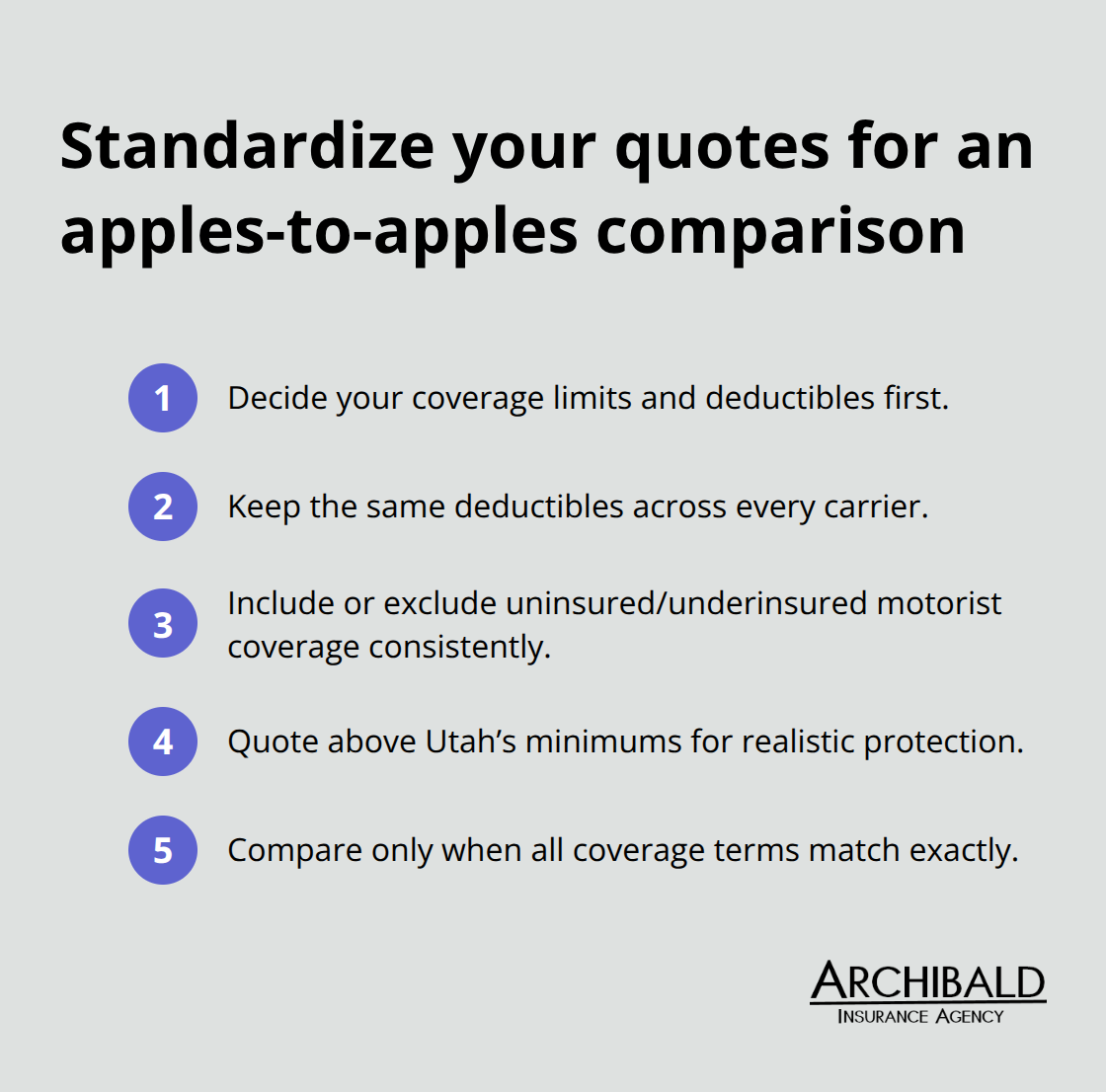
The biggest mistake drivers make when comparing quotes is mixing coverage levels between carriers. One quote might include a $1,000 deductible while another uses $500, or one might include uninsured motorist coverage while another doesn’t. These differences hide the actual price variation between insurers and make comparison impossible. Set your coverage limits and deductibles before requesting quotes, then hold them constant across every carrier. Use Utah’s minimum requirements as your baseline, but request identical quotes above those minimums. Most Utah drivers benefit from higher limits than the legal minimum, so try requesting quotes at $100,000 bodily injury per person and $100,000 per accident, which provides real protection without excessive cost. When every quote uses the same coverage structure, the price differences you see reflect only how each insurer assesses your risk, not how they structure their policies differently.
Understand How Discounts Reduce Your Premium
Each carrier offers different discounts, and these discounts can reduce your premium by 20% to 40% depending on your situation. Some insurers aggressively discount bundling-combining auto with home or renters insurance-while others emphasize safe driver discounts or defensive driving course completion. Liberty Mutual’s RightTrack program can deliver up to 30% savings for safe driving habits, and GEICO’s DriveEasy works similarly. Ask each carrier specifically which discounts apply to your situation before finalizing your comparison. A carrier quoting $1,200 annually might drop to $900 after you apply bundling and defensive driving discounts, while another quoting $1,100 might only reach $1,000 after discounts. The final price after discounts determines your real cost, not the base quote.
Request Quotes With and Without Discounts
Most carriers don’t volunteer information about how their discounts stack or which ones actually apply to your specific coverage combination. Request quotes with and without anticipated discounts so you understand the real savings each carrier offers. This approach reveals which insurers truly reward your situation versus which ones simply advertise discounts that don’t apply to you. Some carriers stack discounts aggressively, while others limit how many you can combine. When you see the actual numbers, you’ll spot which insurer’s discount strategy aligns with your profile. The comparison process becomes much clearer once you account for the full discount picture rather than just the base rate. Understanding these discount mechanics prepares you to evaluate which carrier truly offers the best value-and that knowledge leads directly to identifying which factors actually drive your personal insurance costs.
What Drives Your Auto Insurance Premium
Driving History Sets Your Rate Foundation
Your driving history is the single most influential factor insurers examine when calculating your premium, and this reality should shape how you approach quote comparison. A clean driving record costs significantly less than one marked by accidents or violations. A single at-fault accident increases your premium by 25% to 40%, while a speeding ticket typically adds 10% to 15%. Multiple violations compound these increases dramatically. When you request quotes, insurers pull your Motor Vehicle Report from the Utah DMV, which shows every accident, ticket, and claim filed in the past three to five years. This report determines whether you qualify for good driver discounts, which can reduce premiums by 10% to 15%. If your record includes recent violations, your rate will reflect that risk immediately across all carriers.
If your driving record has blemishes, complete a defensive driving course before requesting quotes. This action qualifies you for discounts that offset some of the violation penalty. Defensive driving discounts typically range from 5% to 10%, and some insurers stack this discount on top of other savings.
Vehicle Characteristics Impact Your Quote Substantially
Your vehicle’s characteristics matter nearly as much as your driving behavior because insurers assess the cost to repair or replace your car and the safety risk it presents. Newer vehicles with advanced safety features like automatic emergency braking and lane-keeping assistance often qualify for discounts ranging from 5% to 25% depending on the carrier. Conversely, older vehicles or those with poor safety ratings cost more to insure because repair costs are higher and crash protection is lower.
A 2024 vehicle equipped with top safety ratings will generate lower quotes than a 2015 model with minimal safety technology, even if both drivers have identical clean records. Your vehicle’s age, make, model, and body style all factor into the quote. Sports cars and high-performance vehicles carry substantially higher premiums than sedans or SUVs because they’re associated with higher accident rates.
Location and Mileage Affect Your Premium
Location within Utah influences your rate significantly. Salt Lake City drivers typically pay more than rural drivers because urban areas have higher accident frequency, theft rates, and medical costs. Your annual mileage matters too because more time on the road increases accident exposure. Drivers commuting 50 miles daily will receive higher quotes than those driving 10 miles daily, all else equal.
When you compare quotes across carriers, these vehicle and location factors remain constant, so the price differences you observe reflect how each insurer weights these objective risk factors differently. This variation is precisely why pulling multiple quotes reveals your best deal.
Final Thoughts
Comparing auto insurance quotes from multiple carriers cuts your premiums without sacrificing coverage. Utah drivers who pull quotes from three to five insurers save 20 to 40 percent annually compared to those who stick with their current rate, yet most drivers never attempt this simple step. The process takes less than an hour and directly addresses the fact that each carrier prices your risk profile differently.
An independent insurance agency like Archibald Insurance Agency handles this comparison work for you. We represent numerous carriers, which means we pull quotes from multiple companies simultaneously rather than requiring you to contact each insurer individually. Our team identifies which discounts apply to your profile and presents you with side-by-side options so you see exactly where you save the most.
Stop overpaying for auto insurance. Contact Archibald Insurance Agency today and let us show you how much you can save when you compare auto insurance quotes across the right carriers.


