

No Medical Exam Life: Quick Coverage Without the Wait
Life insurance doesn’t have to mean weeks of medical tests and waiting. No medical exam life insurance gets you covered fast, often within days instead of months.
At Archibald Insurance Agency, we know that speed matters when you’re protecting your family. This guide walks you through how no exam policies work, who they’re right for, and what trade-offs come with them.
What No Medical Exam Life Insurance Actually Is
No medical exam life insurance strips away the traditional underwriting process and replaces it with faster risk assessment methods. Instead of scheduling a physical exam, you complete an online application and answer health questions. The insurer then pulls data from prescription records, driving history, and medical databases like the Medical Information Bureau to verify your health profile. This approach works because modern data systems let insurers assess risk without requiring you to sit in a doctor’s office. The entire process typically takes days rather than weeks, which is why people choose this route when they need coverage quickly. You should know that no medical exam doesn’t mean no underwriting-insurers still review your information carefully, but they do it faster using technology and existing records instead of scheduling appointments.
How Accelerated Underwriting Works
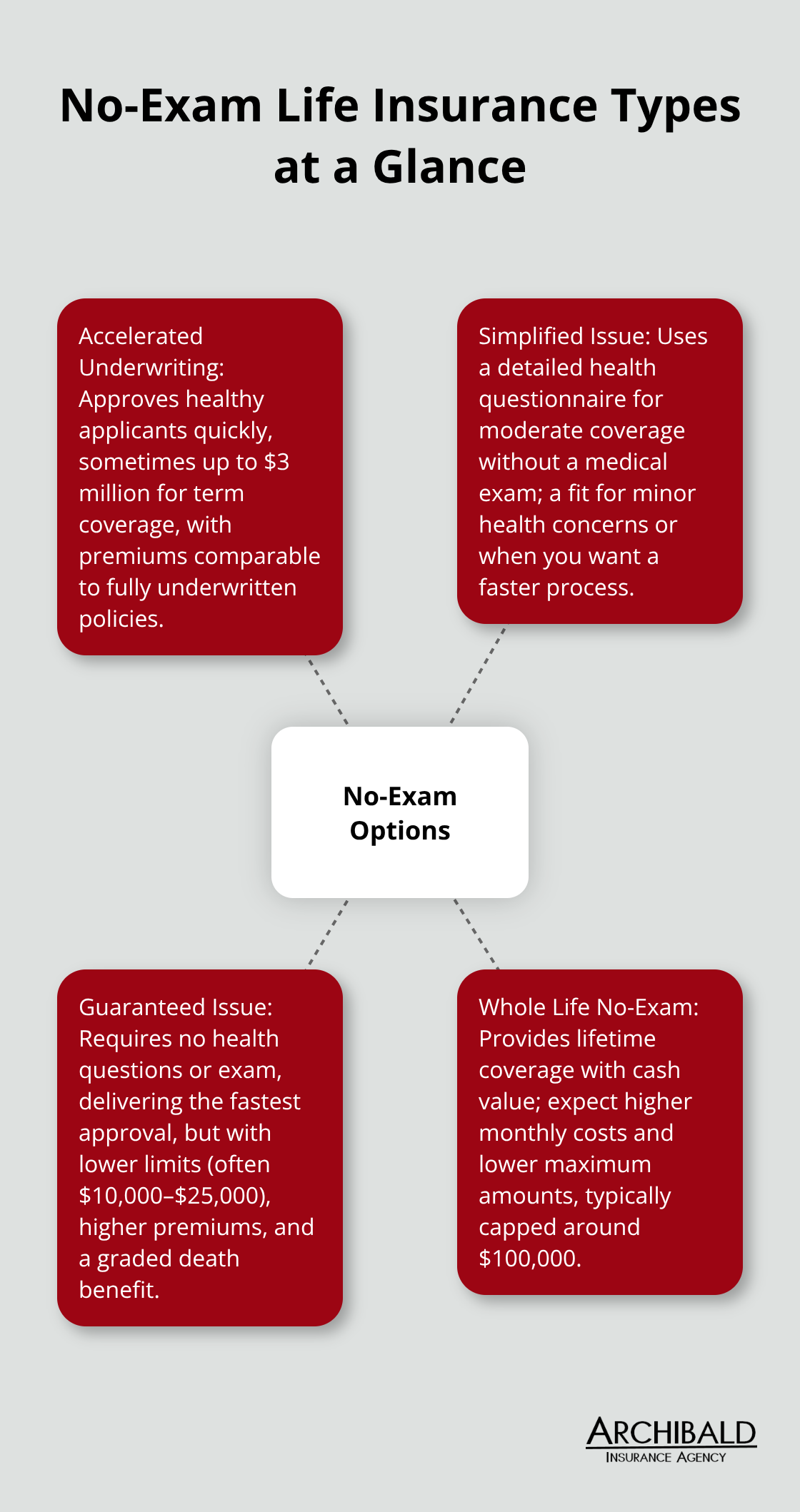
Accelerated underwriting uses data and technology to approve life insurance faster, without a medical exam. If you’re in good health with no major medical history, this route gives you substantial coverage amounts, sometimes up to $3 million for term policies, with premiums comparable to fully underwritten policies. The insurer verifies your information through existing databases and makes a decision within days. This option works well if you want both speed and competitive pricing without sacrificing coverage limits.
Simplified Issue for Moderate Coverage
Simplified issue sits in the middle ground, using a health questionnaire to qualify moderate coverage without requiring a medical exam. You answer more questions than accelerated underwriting requires, but fewer than a full medical exam demands. This path suits people who have minor health concerns or want a faster process than traditional underwriting but don’t qualify for accelerated rates.
Guaranteed Issue: Speed Over Coverage
Guaranteed issue requires no medical questions at all, making it the fastest option, but comes with trade-offs: lower coverage limits around $10,000 to $25,000, higher premiums, and a graded death benefit that means full payouts don’t happen for two to three years. You get approval quickly regardless of health status, which appeals to people with serious medical conditions or those who need immediate protection.
Whole Life No-Exam Policies
Whole life no-exam policies provide lifetime coverage with cash value, but expect significantly higher monthly costs and lower maximum amounts, typically capped around $100,000. These policies build savings over time, though the trade-off is substantial upfront expense compared to term options.
Choosing the Right Type for Your Situation
You should pick based on your actual situation. If you’re healthy and need substantial coverage, accelerated underwriting makes sense. If you have health issues or need quick approval regardless of cost, simplified or guaranteed issue works better. Your choice depends on how much coverage you need, your health profile, and how quickly you want protection in place. Understanding these differences helps you move forward with the option that actually fits your circumstances rather than settling for what seems fastest.
Why No Exam Life Insurance Delivers Speed When You Need It
Getting approved for life insurance in days instead of weeks changes everything when you’re protecting your family fast. No exam policies cut through the traditional underwriting bottleneck because insurers skip the medical appointment scheduling and lab work. Accelerated underwriting moves applications faster with more efficient processes and reduced human error, while traditional policies often take 4 to 8 weeks from start to finish. This speed matters most when life circumstances shift suddenly-a new mortgage, a child born, or a job change that eliminates employer coverage. Your family’s financial protection becomes the priority, and waiting months for approval isn’t an option. The online application itself takes 15 to 20 minutes, and you answer straightforward health questions rather than scheduling multiple medical appointments. No exam policies work because insurers now access real-time data from prescription databases, driving records, and financial systems instead of relying solely on information you provide. They verify your health profile quickly without requiring you to sit in a doctor’s office.
Fast Access Removes Barriers for People with Health Issues
If you have a pre-existing condition, diabetes, high blood pressure, or a history of cancer, traditional underwriting can stretch to 12 weeks or longer while underwriters request medical records and specialist reports. No exam policies, particularly simplified issue and guaranteed issue options, sidestep this delay entirely. Simplified issue uses your health questionnaire to make a decision without digging into your full medical history, which cuts weeks off the timeline. Guaranteed issue life insurance allows you to skip health questions and medical exams, meaning people with serious conditions get approval regardless of medical background. A person managing multiple medications or recovering from a recent health event qualifies for guaranteed issue coverage in days when traditional policies would require extensive medical documentation. The trade-off is lower coverage amounts and higher premiums, but you actually get protection in place rather than waiting indefinitely. Lincoln Financial stands out for favorable underwriting of people with pre-existing conditions, and they accept daily cannabis users without automatically grouping them with tobacco smokers (which can lower premiums compared to other carriers).
The Application Reality Is Genuinely Simpler
You complete everything online without coordinating schedules with medical professionals or taking time off work for appointments. Most applications require basic information: age, coverage amount desired, term length, occupation, and answers to health questions about current medications and past diagnoses. The insurer then pulls your prescription history and driving records electronically to verify consistency. If everything aligns, you get approval within days. Traditional underwriting requires you to schedule a medical exam, wait for lab results, and then wait for underwriters to review everything-three separate waiting periods that no exam policies eliminate. For people working irregular hours, managing caregiving responsibilities, or living in rural areas where scheduling medical exams is difficult, this streamlined process removes real friction from getting protected. You don’t need a doctor’s appointment to prove you’re healthy enough for coverage (the data already available to insurers demonstrates your health profile).
What Happens Next in Your Coverage Timeline
Once you submit your application and the insurer verifies your information through existing databases, the decision comes quickly.
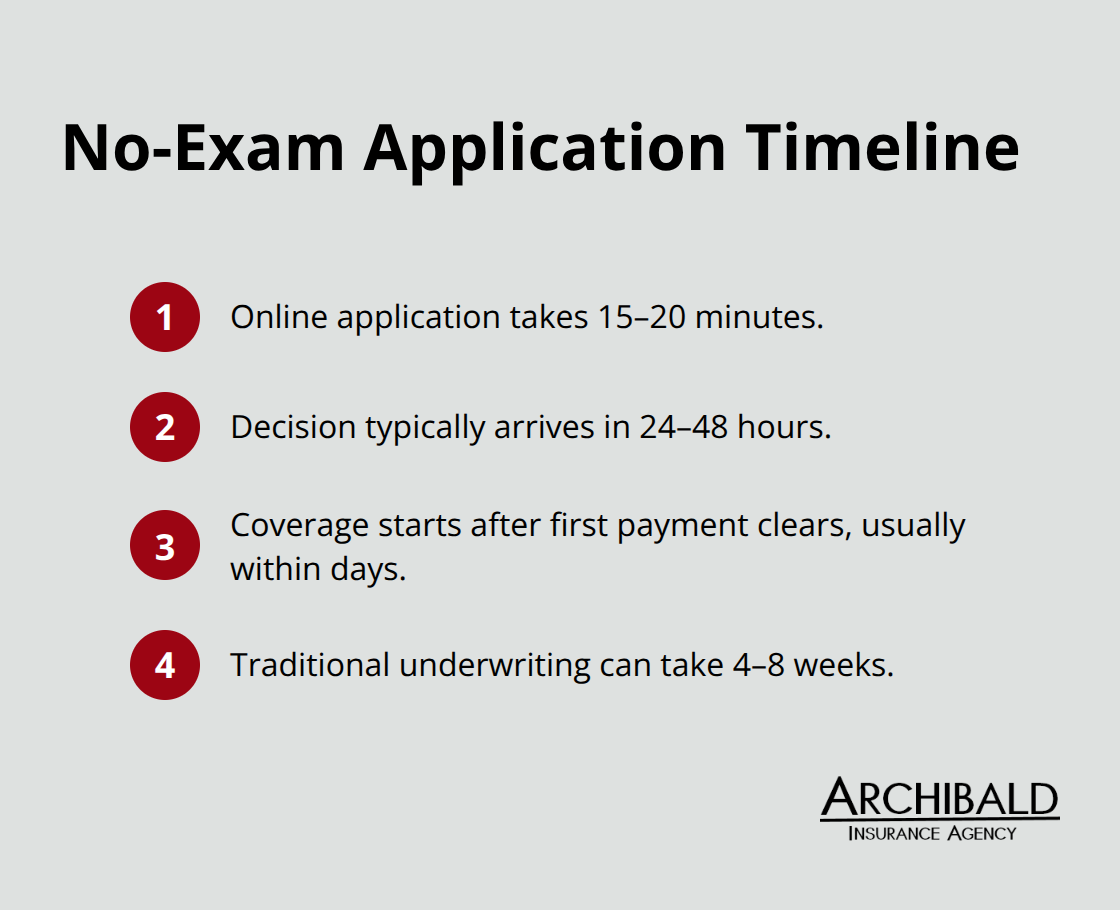
Most carriers provide approval or request additional information within 24 to 48 hours. After approval, your coverage begins once your first premium payment clears, which typically happens within days. This compressed timeline means your family moves from unprotected to covered in less time than traditional underwriting takes just to schedule a medical exam. Understanding this speed advantage helps you recognize when no exam policies solve your actual problem-getting protection in place when your circumstances demand it.
What You’ll Actually Pay for No Exam Coverage
Premium Costs Rise Without Medical Verification
No exam life insurance costs more than traditional policies when you compare the same coverage amount and term length. A healthy 35-year-old male seeking $500,000 in 20-year term coverage pays roughly $25–$30 monthly through traditional underwriting, but that same person pays $35–$45 monthly for accelerated underwriting without a medical exam, according to pricing data from mid-2026. The premium jump reflects the insurer’s higher risk when they skip the medical exam and rely on data verification instead. Guaranteed issue policies cost significantly more-sometimes double or triple the accelerated underwriting rate-because the insurer accepts applicants regardless of health status. A $25,000 guaranteed issue policy for a 60-year-old might run $80–$120 monthly when a fully underwritten term policy for the same person could cost $40–$60. The trade-off is clear: you pay more to avoid the exam and waiting period.
Whole life no-exam policies compound this cost problem substantially. A $100,000 whole life policy without medical exam for a 45-year-old costs $200–$300 monthly compared to $80–$120 for the same coverage with a medical exam. These higher premiums stick with you for the life of the policy, so the total cost over 20 or 30 years becomes substantial. You should calculate the lifetime premium difference before choosing no exam coverage-sometimes waiting a few extra weeks for traditional underwriting saves thousands of dollars over the policy term.
Coverage Limits Drop Significantly
Coverage limits drop noticeably when you skip the medical exam. No-exam term policies up to $1.5 million are available, though higher death benefits may require a medical exam. Simplified issue tops out around $500,000–$750,000. Guaranteed issue rarely exceeds $25,000–$50,000, which covers final expenses and small debts but leaves your family financially exposed if you need substantial income replacement. Whole life no-exam policies max around $100,000, forcing you to choose between low coverage and high cost.
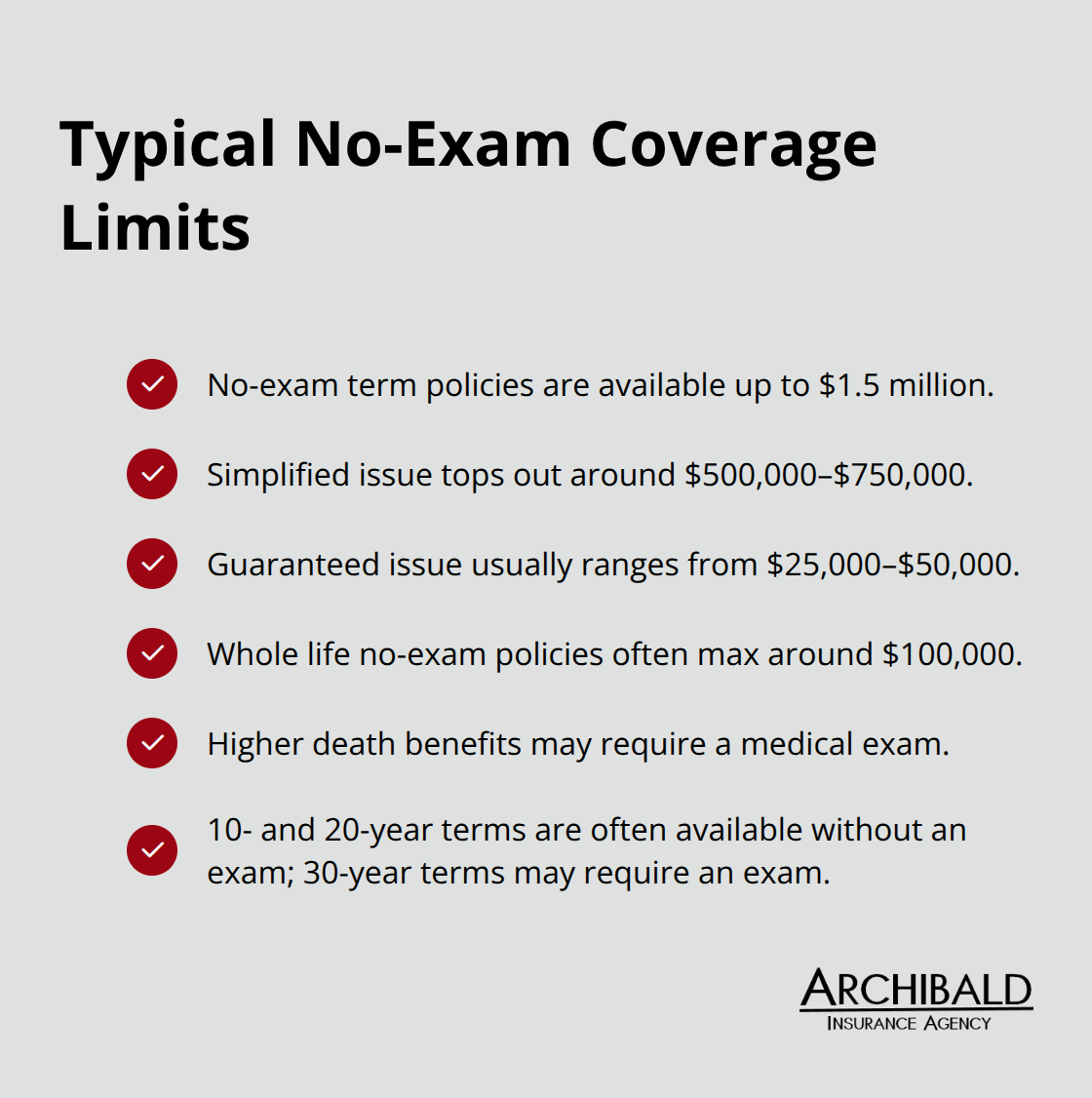
If you need $1 million in coverage and only qualify for $500,000 through no exam underwriting, you face a real problem: either accept partial protection or pursue traditional underwriting to get the full amount. Some insurers also restrict which term lengths they offer without a medical exam-you might find 10-year and 20-year terms available, but 30-year terms require a full exam. This matters because younger applicants often benefit from longer terms that lock in low rates for decades.
Underwriting Restrictions Still Apply
Underwriting restrictions mean your application could still face delays or denials based on what insurers discover in their data verification. Prescription records showing undisclosed medications, driving history revealing traffic violations, or financial records flagging fraud concerns trigger requests for additional information or outright denials. The no exam process isn’t truly automatic-it’s faster, but insurers maintain underwriting standards.
If you have a declined claim history with another carrier, that information shows up in insurer databases and can disqualify you from no exam coverage. Some carriers won’t issue no exam policies to applicants with certain occupations (commercial pilots, hazardous material handlers) or high-risk hobbies (skydiving, professional racing). State restrictions also apply-New York limits some no-exam term products, and guaranteed issue availability varies by state. You need to verify with your carrier whether your specific situation qualifies before assuming no exam coverage is available.
Final Thoughts
No medical exam life insurance solves a real problem when you need protection fast and can’t wait months for traditional underwriting. The speed advantage matters most when life circumstances shift suddenly-a new mortgage, a child born, or job loss of employer coverage. Accelerated underwriting delivers substantial coverage at competitive rates if you’re healthy, while simplified and guaranteed issue options work for people with pre-existing conditions who face extended delays through traditional channels.
The trade-offs demand careful consideration before you apply. No medical exam life policies typically cost more than traditional coverage for identical amounts, your maximum coverage drops significantly, and underwriting restrictions still apply despite the faster process. These limitations don’t disqualify no-exam coverage for your situation, but they do mean you should calculate whether the speed benefit justifies higher premiums and lower limits for your family’s actual needs.
We at Archibald Insurance Agency help Utah families match their coverage to real circumstances rather than settling for what seems fastest. Whether no-exam policies fit your needs or traditional underwriting makes more financial sense, our team explains the actual costs and benefits so you protect your family without unnecessary delays or overpaying. Contact us today to discuss which approach works best for you.
Disclaimer: The information provided in this blog is for general informational purposes only and does not constitute legal, financial, or insurance advice. Coverage options, terms, and availability may vary. Please consult with a licensed professional for advice specific to your situation


