

E&O Protection Utah: How Coverage Shields Your Business
One mistake in your professional work can cost thousands in legal fees and settlements. E&O protection in Utah isn’t optional for service providers, consultants, and tech firms-it’s a business necessity.
At Archibald Insurance Agency, we help Utah business owners understand exactly what errors and omissions coverage protects and why standard policies leave dangerous gaps. This guide walks you through the coverage you actually need.
What E&O Insurance Actually Covers
E&O insurance protects your business when a client claims you made a mistake that cost them money. This includes legal defense costs, settlements, and judgments-expenses that standard business liability policies simply don’t cover. If you’re a consultant who gave faulty advice, a real estate agent who missed a disclosure requirement, or a software developer whose code created financial losses for a client, E&O coverage steps in where general liability stops.
Professional liability claims have increased in the market, making this protection more relevant than ever for Utah service providers. Your standard business policy covers physical injuries or property damage, but it leaves you exposed when someone sues over the quality or outcome of your work.
The Claims That Actually Happen
A bookkeeper miscalculates tax deductions, costing a client thousands in penalties. A consultant recommends a strategy that backfires, leading to significant business losses. A property manager fails to enforce lease terms, resulting in financial damage to the landlord. These scenarios happen regularly in Utah’s professional services sector.
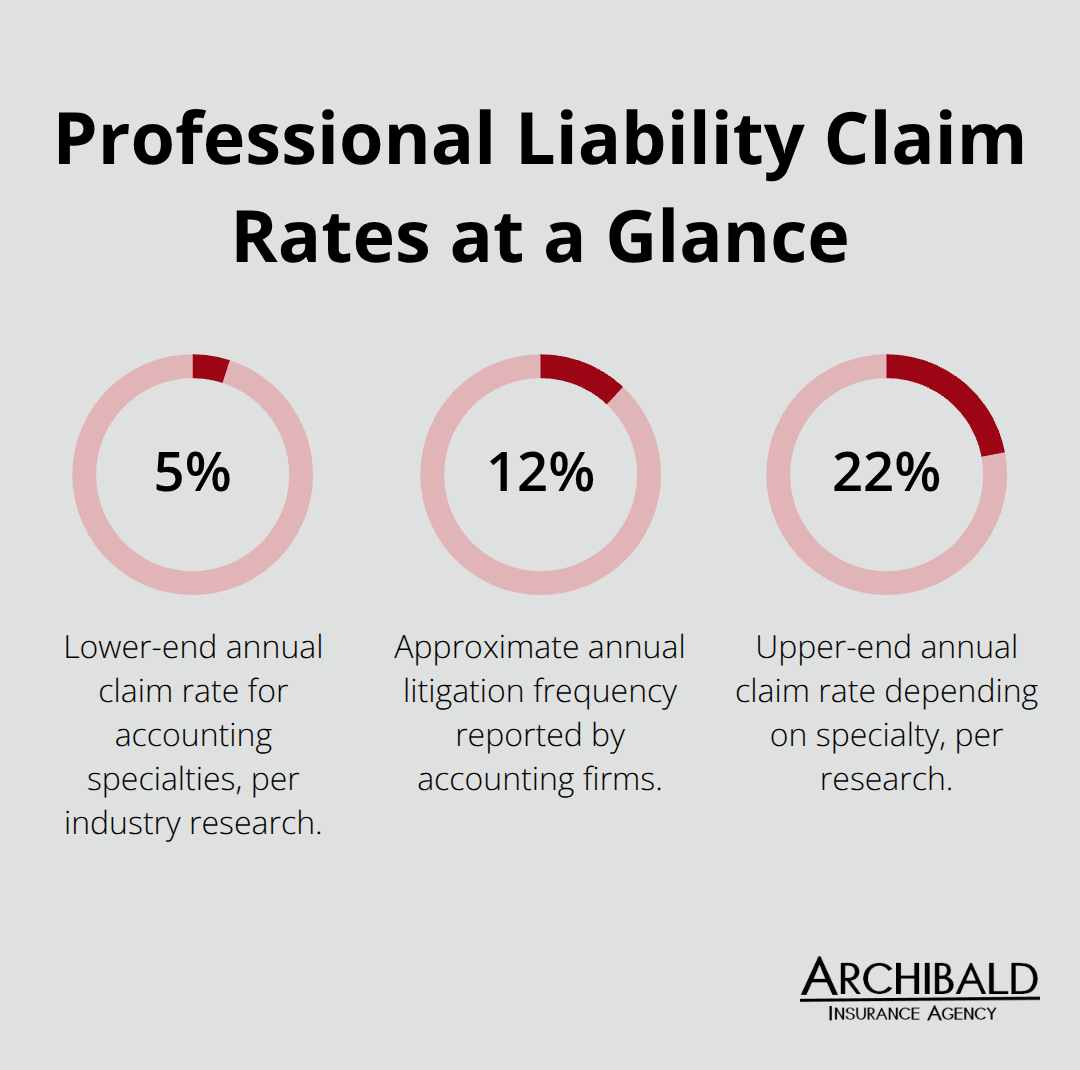
Accounting firms face claims across the industry, with research showing annual claim rates ranging from 5% to 22% depending on specialty. Real estate professionals in Utah handled over 43,000 transactions in 2023, and even a small percentage of disputes can create substantial liability exposure. Tech firms face particularly aggressive litigation, with software errors triggering claims that can easily exceed six figures when multiple clients are affected.
Why Your Current Coverage Has Critical Gaps
General liability insurance covers accidents and injuries on your property or caused by your products, but it doesn’t touch professional mistakes or negligence in your services. A client suing over poor advice, missed deadlines, or inadequate work quality falls outside that protection entirely.
Many Utah business owners discover this gap only after a claim arrives, at which point it’s too late. Your existing policy’s exclusions likely state that coverage doesn’t apply to claims arising from professional services you provided. This means you’re personally liable for defense costs and damages, which can drain your business reserves quickly. E&O coverage fills this exact gap by specifically protecting against claims related to the work you do.
Moving Forward With the Right Protection
The gap between what you think you’re covered for and what you actually are covered for can prove catastrophic. Different industries face different risk profiles, which means your E&O needs vary significantly based on the services you provide.
Industries That Need E&O Coverage in Utah
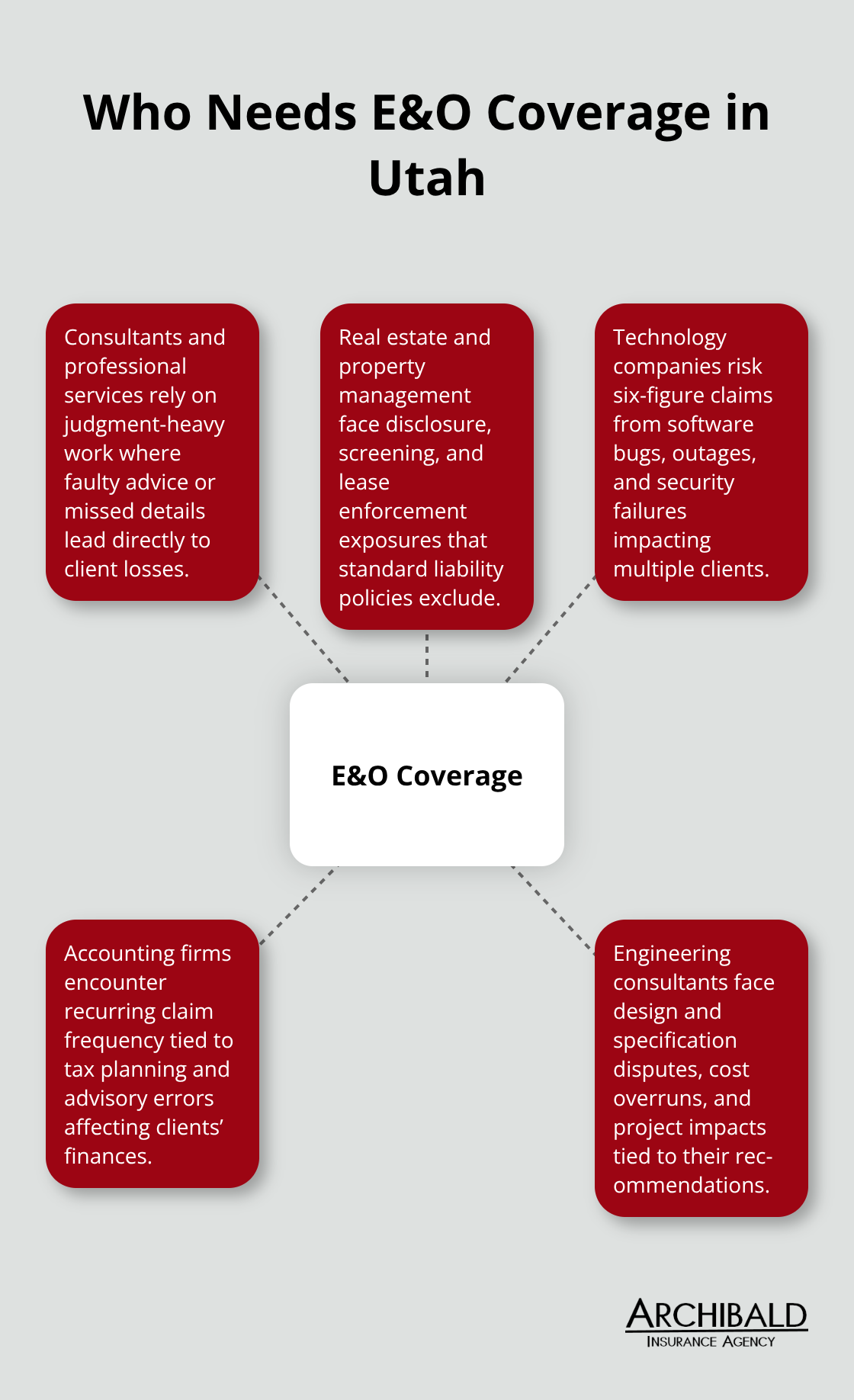
Certain industries face professional liability exposures that standard business insurance simply doesn’t address. Consulting firms, real estate professionals, and technology companies operate in Utah’s economy where a single mistake triggers immediate financial consequences for clients. The risk profiles differ dramatically across these sectors, but the protection gap remains consistent: clients sue over the quality and outcome of your work, not accidents or property damage.
Consultants and Professional Service Providers Face the Highest Exposure
Utah’s consulting and professional services sector generates significant revenue, but it also generates significant claims. Accounting firms report approximately 12% annual litigation frequency among professionals in the industry. A single miscalculation in tax planning, financial forecasting, or business strategy costs clients tens of thousands of dollars. Management consultants who recommend operational changes that fail expose themselves to substantial liability when clients demand compensation for lost revenue or wasted implementation costs. Engineering consultants in Utah’s growing construction sector face claims when designs don’t meet specifications or cost overruns result from their recommendations. These professionals cannot rely on general liability coverage because their work product, not physical accidents, creates the damage claims arise from.
Real Estate and Property Management Require Specialized Protection
Utah’s real estate market processed significant residential transaction volume, and property management companies operate hundreds of rental portfolios across the state. Real estate agents face claims from clients alleging missed disclosure requirements, misrepresentation of property conditions, or failure to disclose material facts affecting value. Property managers face claims from landlords over lease enforcement failures, tenant screening negligence, or maintenance decisions that result in property damage or liability. A property manager who fails to enforce a lease clause allowing a tenant to make unpermitted alterations exposes the landlord to substantial repair costs. A real estate agent who doesn’t disclose a property’s history of water damage or foundation issues faces litigation when buyers discover problems after closing. These claims don’t involve injuries or property damage in the traditional sense; they involve the professional judgment and services the agent or manager provided. Standard business liability policies explicitly exclude professional services coverage, leaving these professionals personally responsible for legal defense and damages.
Technology Companies Face Rapidly Escalating Claims
Utah’s tech sector continues expanding, with software development firms, IT service providers, and digital agencies operating across the state. A single software bug affecting multiple clients can trigger claims exceeding six figures when the error causes business interruption or data loss. Cloud service providers face claims when security breaches or service outages damage client operations. IT consultants who recommend systems that fail to meet client needs or implement solutions with inadequate security face claims for resulting losses. These claims move quickly from initial notification to litigation because the financial impact on clients is immediate and quantifiable. Tech firms cannot control the outcomes of their work the way manufacturers control product defects; software and digital solutions operate in complex client environments where failures impact multiple business functions simultaneously.
Each of these industries operates with different risk profiles, which means your E&O needs vary significantly based on the services you provide. The next step involves assessing your specific exposure and selecting coverage limits that actually match your business operations.
Selecting the Right E&O Policy for Your Utah Business
Calculate Your Maximum Potential Liability
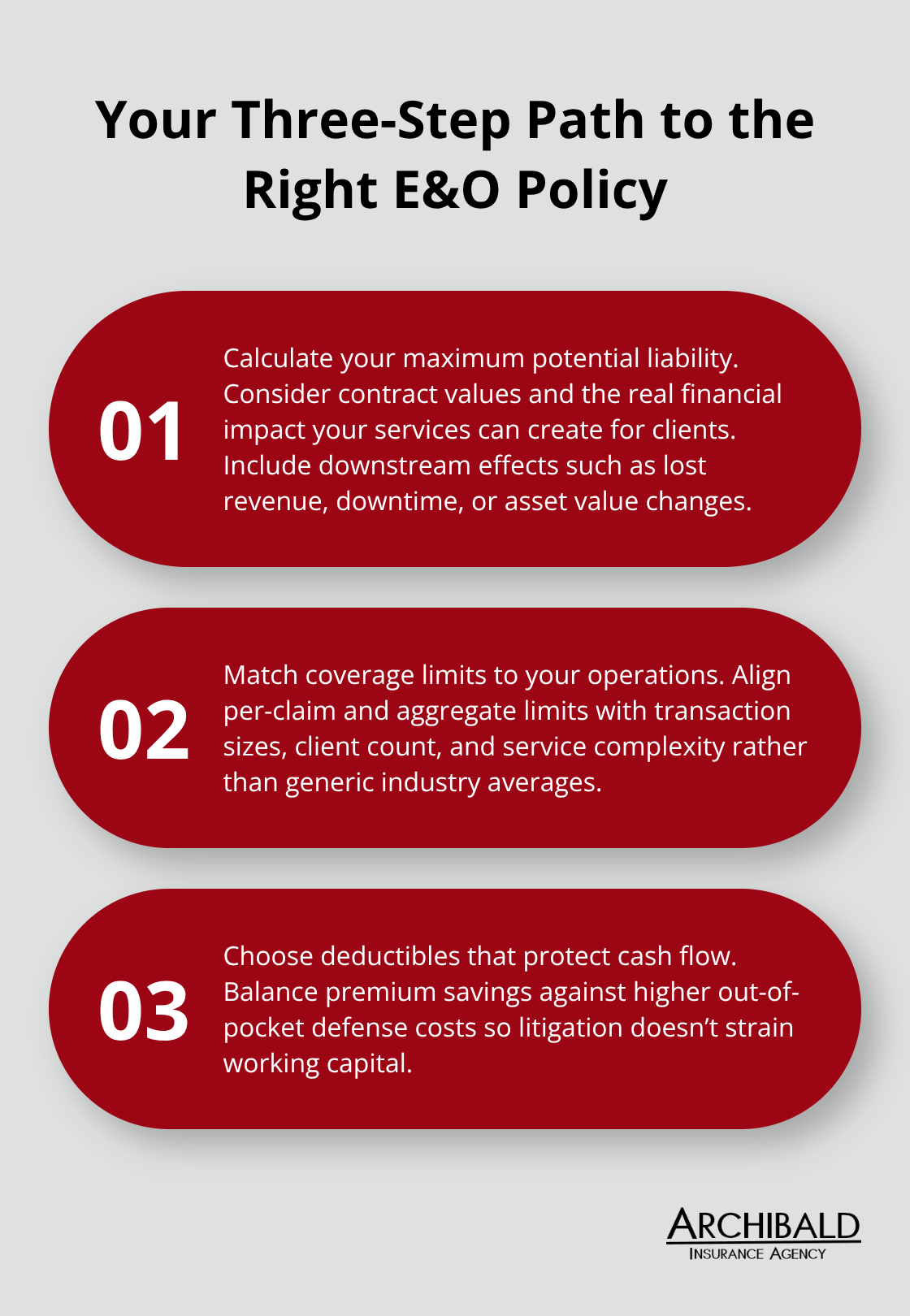
Your business risk profile determines the coverage limits you need, and most Utah professionals underestimate their exposure significantly. A consultant earning $150,000 annually might face a claim for $500,000 when a client alleges that faulty advice destroyed a major business opportunity. A real estate agent in a $400,000 property transaction faces potential liability exceeding the transaction value if a client sues over misrepresentation. A software developer whose code fails might defend against claims from multiple affected clients simultaneously, with total exposure reaching seven figures.
The average cost of professional liability insurance is $88 per month, with Utah averaging $76 per month. This gap between what you think you could lose and what you actually could lose determines whether your coverage protects your business or leaves you personally liable for the difference.
Start by calculating your maximum potential liability based on client contract values and the financial impact your work creates for clients. If you manage $10 million in client assets as a financial advisor, your exposure isn’t limited to your annual fees; it extends to the value of assets you influence. If you design systems affecting client operations, your exposure includes client losses from downtime, data loss, or security breaches. If you handle real estate transactions, your exposure includes the full property value if a client alleges misrepresentation affected their decision.
Match Coverage Limits to Your Industry and Operations
Most Utah professionals should carry minimum coverage limits of $1 million per claim and $2 million aggregate. Errors and omissions insurance policies include both legal costs and damage awards in a single limit of liability. Accounting firms frequently carry $2 million per claim limits because a single tax planning error can trigger claims exceeding $1 million. Real estate teams managing high-volume transactions often select $1 million per claim but aggregate limits of $3 million or higher. Technology companies with multiple clients typically need $2 million or higher per claim because a single software failure can affect numerous clients simultaneously.
Your specific contracts, client base size, transaction values, and service complexity all factor into proper limit selection. These variables differ dramatically across businesses within the same industry, which means industry averages often miss the mark for your actual operations.
Select Deductibles That Protect Your Cash Flow
Your deductible selection directly impacts your premium costs, but it also impacts your financial exposure when a claim arrives. A $2,500 deductible reduces your premium by roughly 15 to 25 percent compared to a $1,000 deductible, but it increases your out-of-pocket costs when defending against claims. Utah businesses with strong risk management practices and clean claims histories can support higher deductibles, while businesses in high-claims industries should minimize deductible amounts to protect cash flow during litigation.
The claims process consumes significant time and resources even when your coverage applies. A high deductible forces you to fund legal defense costs from operating capital while awaiting claim resolution, which strains business finances during the investigation and litigation phases.
Final Thoughts
E&O protection in Utah shields your business from the financial devastation that follows a professional mistake. Unlike general liability coverage, errors and omissions insurance specifically addresses claims arising from the quality and outcome of your work. Whether you’re a consultant, real estate professional, or technology company, a single claim can exceed your annual revenue if you lack proper coverage.
Calculate your maximum potential liability based on client contract values and the financial impact your services create. Match your coverage limits to your industry and operations, not to generic industry averages. Select deductibles that protect your cash flow during the claims process, recognizing that litigation consumes significant time and resources even when coverage applies.
Contact Archibald Insurance Agency to discuss your E&O protection needs and get a quote that reflects your actual business operations. Our team understands the professional liability risks facing Utah’s consulting firms, real estate professionals, and technology companies. We represent numerous insurance carriers, which means we customize coverage that fits your specific needs and budget.
Disclaimer: The information provided in this blog is for general informational purposes only and does not constitute legal, financial, or insurance advice. Coverage options, terms, and availability may vary. Please consult with a licensed professional for advice specific to your situation


