

Understanding Term Life: From Basics to Big Decisions
Term life insurance is one of the most straightforward ways to protect your family’s financial future without breaking the bank. Understanding term life means recognizing that you’re getting affordable, temporary coverage when you need it most.
At Archibald Insurance Agency, we help Utah families navigate these decisions every day. The right term policy can cover your mortgage, replace lost income, and give your loved ones real security during your peak earning years.
How Term Life Insurance Actually Works
Term life insurance operates on a simple principle: you pay a monthly or annual premium, and if you pass away during the term, your beneficiaries receive the death benefit. There’s no cash value component, no investment accounts, no complexity. The policy covers a specific timeframe-typically 10, 20, or 30 years-and ends when that term expires. This simplicity explains why term life has become the dominant choice for Utah families. People want protection without paying for features they don’t need. Your premium goes directly toward death benefit coverage rather than subsidizing a savings account or surrender charges. When you’re in your 30s or 40s with a mortgage, young kids, and student loans, that affordability matters enormously. A 30-year-old non-smoker can typically secure $500,000 in coverage for around $30 to $40 monthly on a 20-year term. That same person would pay significantly more for permanent policies that include cash value components.
Coverage Types and What They Mean for Your Situation
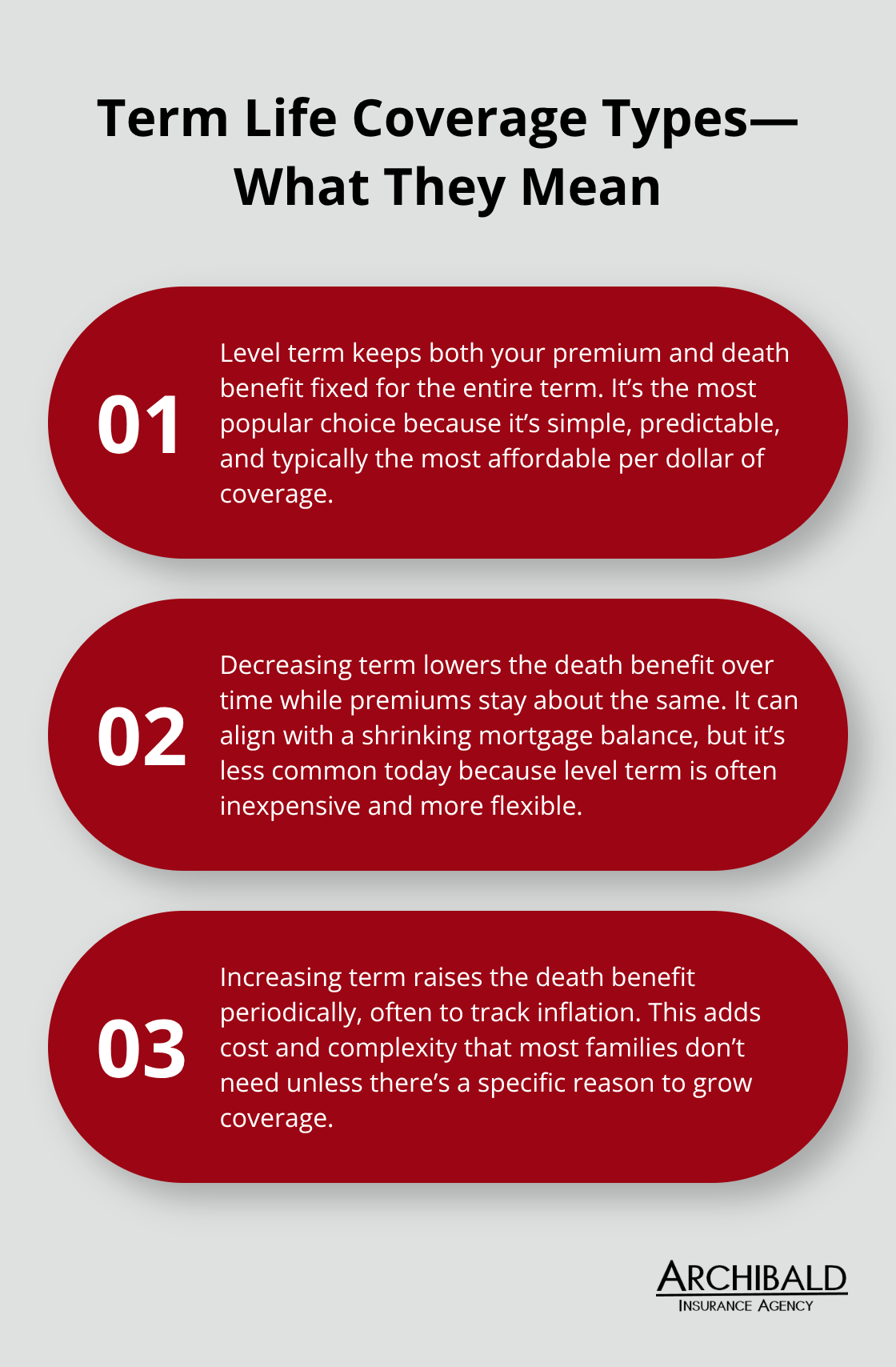
Level term policies keep your premium and death benefit constant throughout the entire term, which is what most people choose. Decreasing term coverage drops the death benefit over time while keeping premiums steady-this option makes sense if you’re primarily protecting a mortgage that shrinks each year, though it’s less common now because level term is so affordable. Increasing term raises the death benefit periodically, typically tied to inflation, but this approach adds cost and complexity that most Utah families don’t need. The real decision isn’t about fancy variations; it’s about picking level term with a benefit amount that matches your actual obligations. Most families underestimate what they need.
The general rule is to calculate 8 to 10 times your annual income, then add specific debts. If you earn $60,000 yearly with a $250,000 mortgage and $30,000 in student loans, you need roughly $550,000 to $650,000 in coverage. That’s not theoretical-that’s what your family would actually need to maintain their lifestyle and eliminate debt.
Why Term Length Directly Controls Your Costs
A 20-year term costs significantly less than a 30-year term for the same person at the same age, but your age when you buy matters more than anything else. A 35-year-old buying a 20-year policy pays less monthly than a 45-year-old buying the same 20-year term because risk increases with age. Lock in coverage while you’re young. If you buy at 30, a 30-year term gets you to age 60 at rates that reflect your current health. If you wait until 40 to buy that same 30-year policy, you’re paying substantially more per month. This is why people often regret waiting. A non-smoking 30-year-old might pay $25 monthly for $500,000 over 30 years, while a 40-year-old pays closer to $45 for identical coverage. That $240 annual difference compounds over decades.
Matching Your Term to Your Life Stage
Choose your term based on what you’re protecting. Young children and a mortgage? Try a 25 or 30-year term. Kids nearly grown and mortgage halfway paid? A 15 or 20-year term works fine. The goal is having coverage expire when you no longer need it, not paying premiums indefinitely. Your specific situation determines the right choice. Once you understand how term length and coverage amount work together, the next step involves calculating exactly what your family needs and avoiding the mistakes that cost people thousands of dollars.
Why Term Life Makes Sense for Utah Families
Term life insurance addresses the specific financial pressures Utah families face during their working years. The median home price in Utah increased 2.8 percent from $506,000 to $519,990 between August 2024 and July 2025, according to the Utah Association of Realtors. That’s not theoretical-it’s the mortgage sitting on your family’s shoulders right now. When you’re 35 years old with a $450,000 mortgage, two kids in school, and a spouse who depends on your income, term life provides genuine protection at prices that fit your actual budget. A 35-year-old non-smoker in Utah can secure $500,000 in coverage for approximately $35 to $45 monthly on a 20-year term. That’s less than most people spend on streaming subscriptions, yet it replaces your entire income if something happens to you. Your family loses your paycheck the moment you pass away, but your mortgage payment, property taxes, utilities, and grocery bills continue. Term life bridges that gap.
What Your Family Actually Owes
Most Utah families dramatically underestimate their actual financial obligations when calculating coverage needs. The average Utah household carries $6,500 in credit card debt, according to WalletHub, plus student loans averaging $37,000 per borrower based on Federal Reserve data. Your mortgage represents your largest obligation, but it’s not your only one. If you pass away with $280,000 remaining on your mortgage, $40,000 in student loans, and $15,000 in car payments, your family inherits $335,000 in debt obligations immediately. Your life insurance death benefit needs to cover these specific debts plus replace your income for the years your family still depends on it. Many people buy $250,000 in coverage when they need $600,000 because they only thought about their mortgage. That gap creates real hardship. Your spouse might need to sell the house because they can’t cover the payments on a single income. Your kids might need to take out loans for college instead of attending the school you wanted for them.
The Cost of Waiting
Your age and health status determine your premium more than anything else. The longer you wait to buy term life, the more you’ll pay monthly, and the harder it becomes to qualify for good rates. A 30-year-old buying a 30-year term pays roughly $25 monthly for $500,000 of coverage. A 40-year-old buying the same policy pays approximately $50 monthly for identical coverage. Over 30 years, that $25 monthly difference adds up to $9,000 more in premiums. If you develop health conditions like high blood pressure, diabetes, or sleep apnea before you buy coverage, your rates increase substantially or you might face coverage exclusions. Utah has seen a significant rise in type 2 diabetes diagnoses, with nearly 10% of Utah adults affected according to the Utah Department of Health and Human Services. Waiting until your health situation becomes complicated makes term life more expensive or potentially unavailable at reasonable rates.
Why Your Peak Years Matter Most
The time to buy term life is right now, while you’re young and healthy enough to qualify for the best possible rates. This isn’t a sales pitch-it’s recognizing that your circumstances change. Your kids grow up, your mortgage shrinks, your career progresses. The financial dependency that requires term life is temporary, but the cost of waiting is permanent. Utah families with children under 18 absolutely need this protection because the financial dependency is real and measurable. The cost of raising a child to age 18 has climbed to more than $300,000. That figure doesn’t include college expenses, which now average $28,000 annually at Utah universities. Term life protects your family’s standard of living and covers education expenses you’ve already committed to.
Once you understand why term life makes financial sense for your situation, the next step involves calculating exactly how much coverage your family needs and selecting the term length that matches your actual timeline.
Choosing the Right Term Length and Coverage Amount
Start with a number, not a guess. Most people use the arbitrary rule of ten times annual income and call it done, but that misses what your family actually needs to survive. Take your current annual income and multiply it by the number of years until your youngest child turns 18 or finishes college. If you earn $65,000 yearly and have a ten-year-old child, that’s roughly $650,000 just to replace lost income during those eight years. Now add your specific debts. Write down your mortgage balance, student loans, car payments, credit card balances, and any other obligations. According to the Federal Reserve, the average American household carries $9,326 in credit card debt. Utah families typically carry student loan debt averaging $37,000 per borrower. Add your mortgage balance, which in Utah averages around $450,000 to $500,000 based on recent home prices. If your total obligations come to $550,000 and your income replacement need is $650,000, you need $1.2 million in coverage, not $500,000. This is why so many people are underinsured-they never actually calculated what they owe.
The Real Difference Between Term Lengths
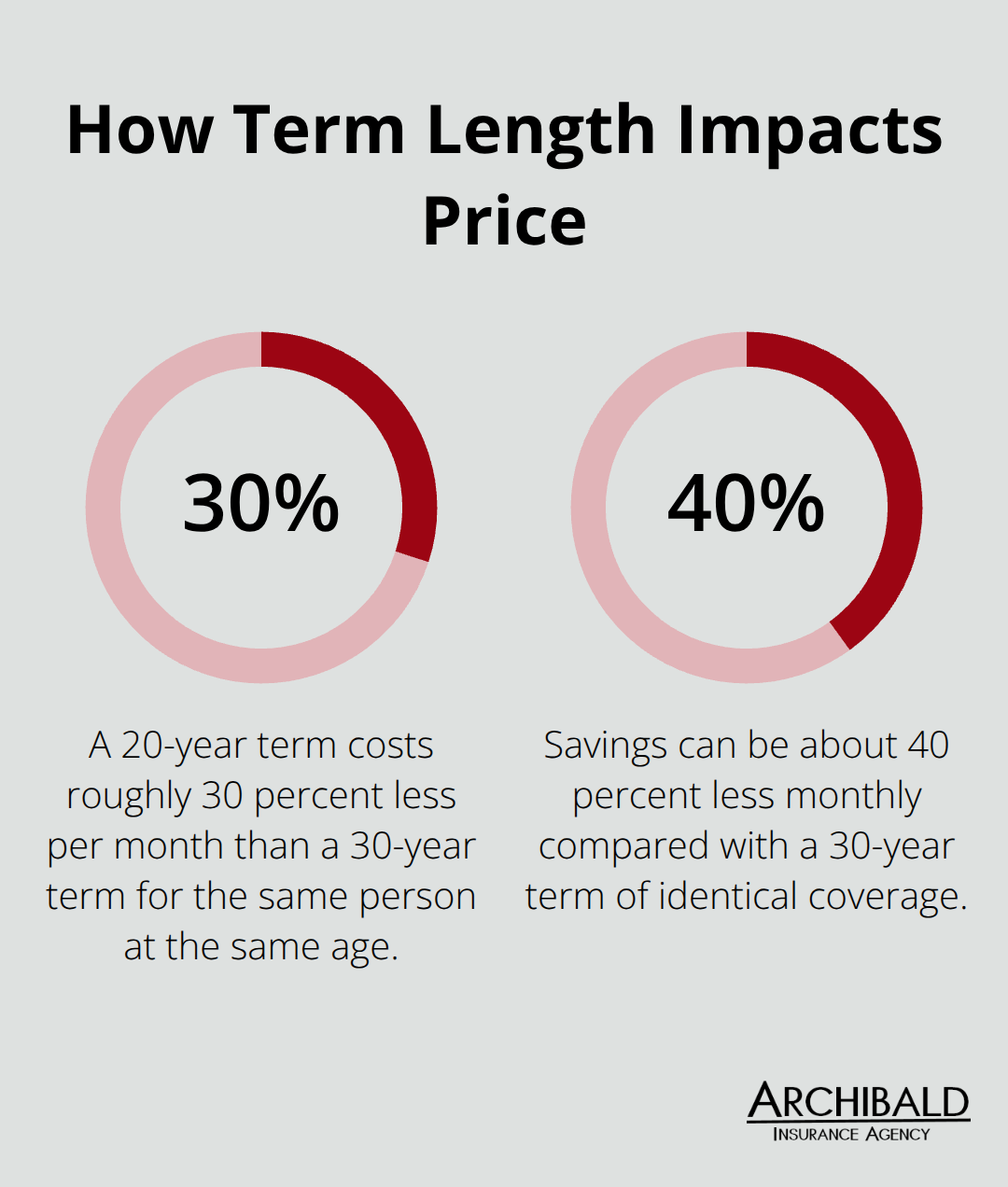
A 20-year term costs roughly 30 to 40 percent less monthly than a 30-year term for the same person at the same age, but that comparison ignores what you actually need. If your youngest child is eight years old, a 20-year term gets you to age 58 with coverage extending until your child turns 28, which is unnecessarily long. A 15-year term might be perfect because your child graduates high school, starts working, and your mortgage shrinks significantly. The twenty-year option makes sense when you have a newborn or toddler. The thirty-year option is almost always a mistake for Utah families because most people don’t need coverage into their sixties when their kids are grown and their mortgage is manageable on a single income. A non-smoking 35-year-old pays approximately $35 monthly for $500,000 over twenty years but pays roughly $50 monthly for the same coverage over thirty years. Over the full term, that’s $900 more in total premiums for coverage you probably won’t need. Try the term that covers your actual financial obligations, then stop paying for years you don’t need.
Where People Waste Money on Coverage
The biggest mistake is purchasing too little coverage to save money on premiums. Someone might buy $250,000 in coverage to keep monthly payments under $30, then their family loses the house anyway because that benefit barely covers the mortgage. The second mistake is purchasing too much coverage for too long. A 45-year-old with teenage children doesn’t need a 30-year term that extends to age 75. The third mistake, which costs people thousands of dollars, is waiting too long to buy. A thirty-year-old pays $25 monthly for a thirty-year term, but a forty-year-old pays $50 monthly for identical coverage. That ten-year delay costs $3,000 in additional premiums over the policy life. Health changes matter enormously. Once you develop high blood pressure, diabetes, or other conditions, your rates increase substantially or insurers might exclude certain causes of death from coverage.
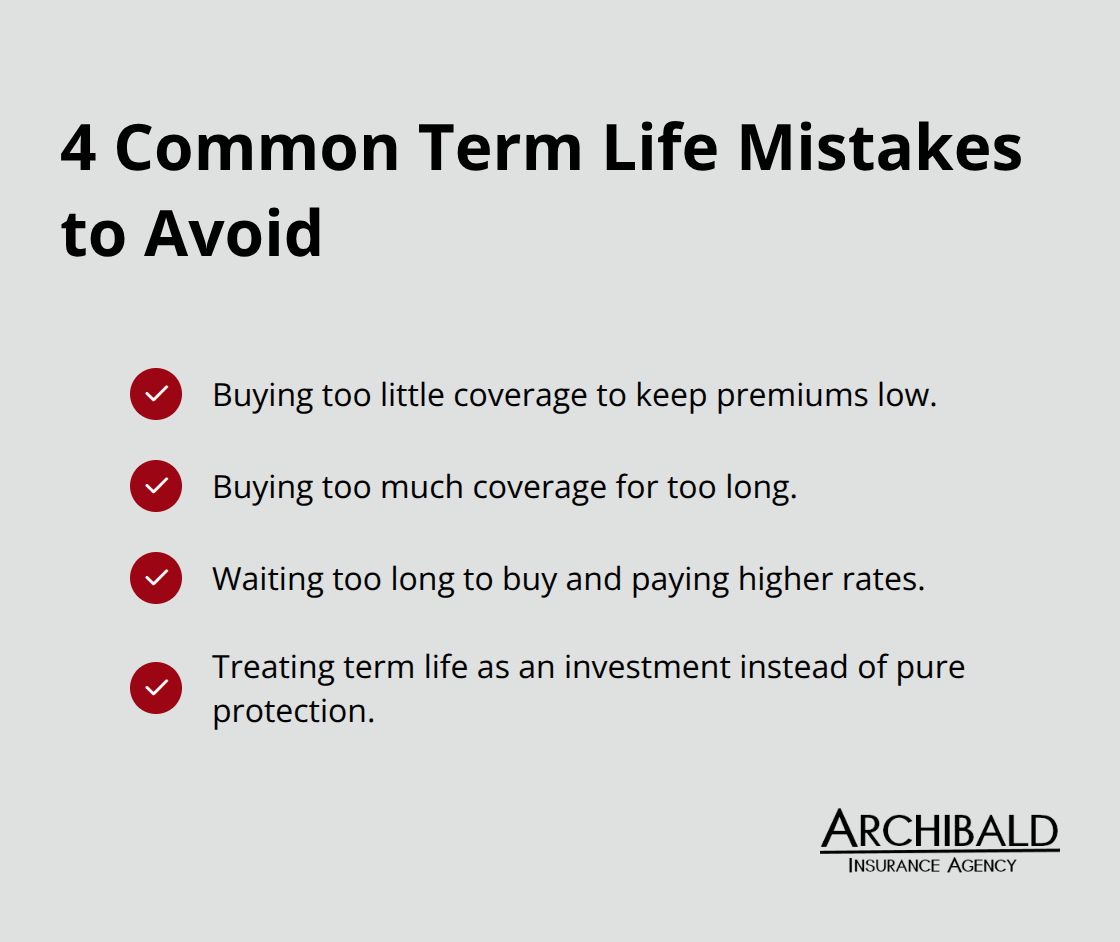
The fourth mistake is treating term life as an investment. Some people reject term because it has no cash value, then purchase permanent insurance they can’t afford and let it lapse. Term life isn’t supposed to build wealth-it’s supposed to protect your family’s financial stability during the years when they depend on your income.
Final Thoughts
Understanding term life means you make a straightforward financial decision based on real numbers, not guesswork. You calculate what your family owes, add your income replacement needs, pick a term that covers those years, and buy coverage while you’re young and healthy. The math stays simple throughout the entire process.
Every year you delay costs you thousands of dollars in additional premiums, and health changes can make coverage more expensive or harder to qualify for. A thirty-year-old buying today pays substantially less than a forty-year-old buying the same policy tomorrow. The time to protect your family is right now, while you’re in your peak earning years and your dependents need that protection most.
Contact Archibald Insurance Agency to discuss your family’s specific needs and determine the right coverage amount for your situation. We’ll help you compare term options and get you protected without unnecessary complexity or cost. Your family’s financial future deserves attention today, not tomorrow.
Disclaimer: The information provided in this blog is for general informational purposes only and does not constitute legal, financial, or insurance advice. Coverage options, terms, and availability may vary. Please consult with a licensed professional for advice specific to your situation


