

Coverage Options for Auto: Finding the Right Fit for Your Vehicle
Picking the right coverage options for auto insurance isn’t one-size-fits-all. Your vehicle, driving habits, and financial situation all play a role in determining what protection makes sense for you.
At Archibald Insurance Agency, we help Utah drivers navigate these decisions with clarity. This guide walks you through the coverage types available, what affects your rates, and how to match your policy to your actual needs.
Understanding Auto Insurance Coverage Types
Utah’s Liability Requirements and Why Minimums Fall Short
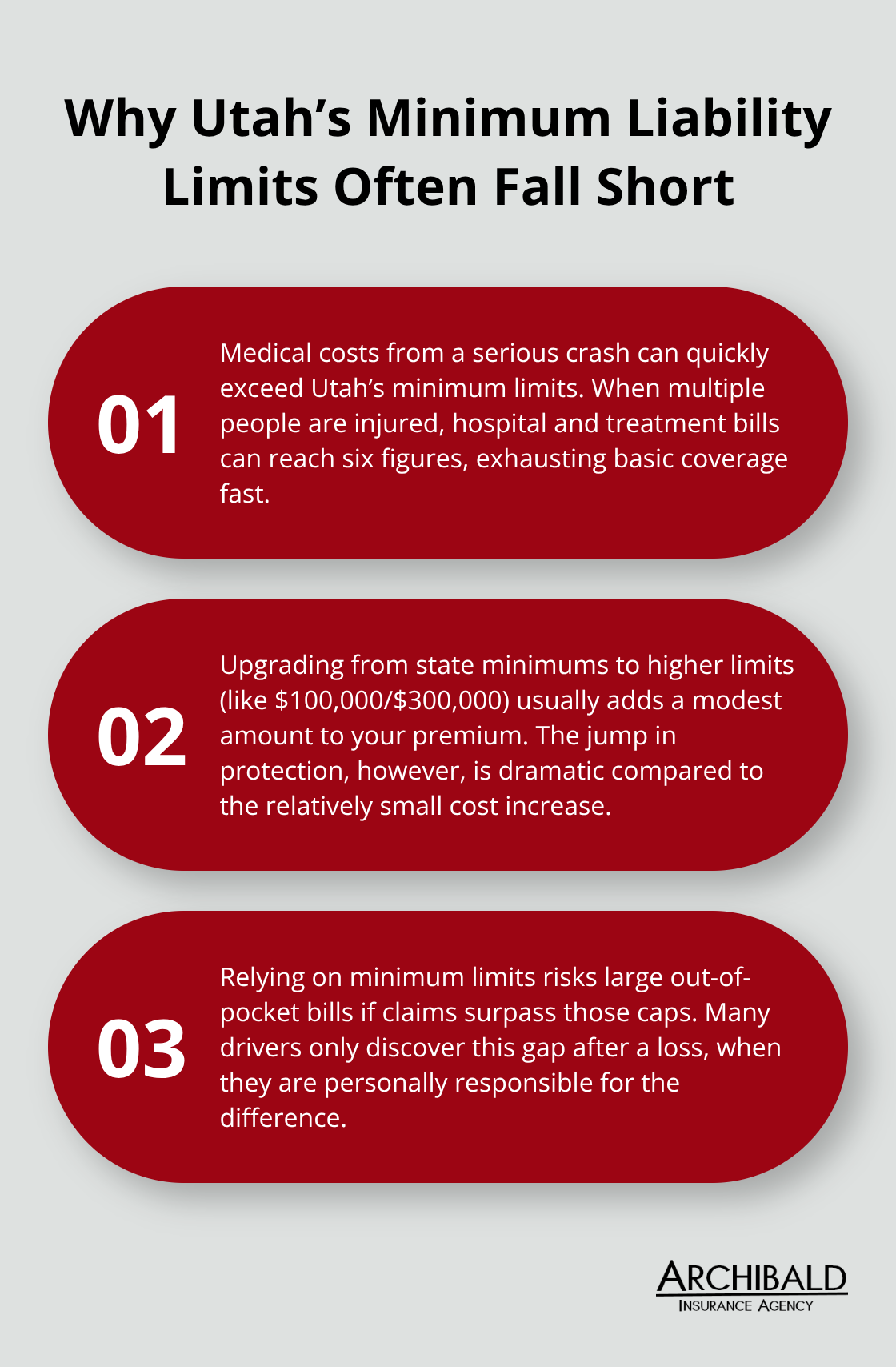
Utah law mandates that every vehicle on public roads carries liability insurance, with minimum limits of $25,000 per person and $65,000 per accident for bodily injury, plus $15,000 for property damage. These minimums exist because they reflect the bare legal floor, not the protection you should actually carry. A single serious accident can easily exceed these limits-medical bills alone can reach $100,000 or more when multiple people are injured. The difference in premium cost between state minimums and $100,000/$300,000 coverage is typically modest, yet the protection gap is enormous. Many Utah drivers mistakenly believe minimum coverage is sufficient, then face devastating out-of-pocket costs when claims exceed those limits.
Collision and Comprehensive Coverage for Physical Damage
Collision coverage pays to repair your vehicle after an accident with another car or object, while comprehensive coverage handles theft, vandalism, weather, and animal collisions. If you finance or lease your vehicle, your lender requires both of these coverages. Even if you own your car outright, collision and comprehensive make financial sense if your vehicle’s value exceeds your ability to replace it immediately. For a vehicle worth $15,000, a $500 deductible on collision costs roughly $40–60 more annually than a $1,000 deductible, yet provides substantially better protection. The math changes for older vehicles-a car worth $3,000 may not justify collision coverage because a total loss payout minus your deductible leaves little recovery.
Uninsured and Underinsured Motorist Protection
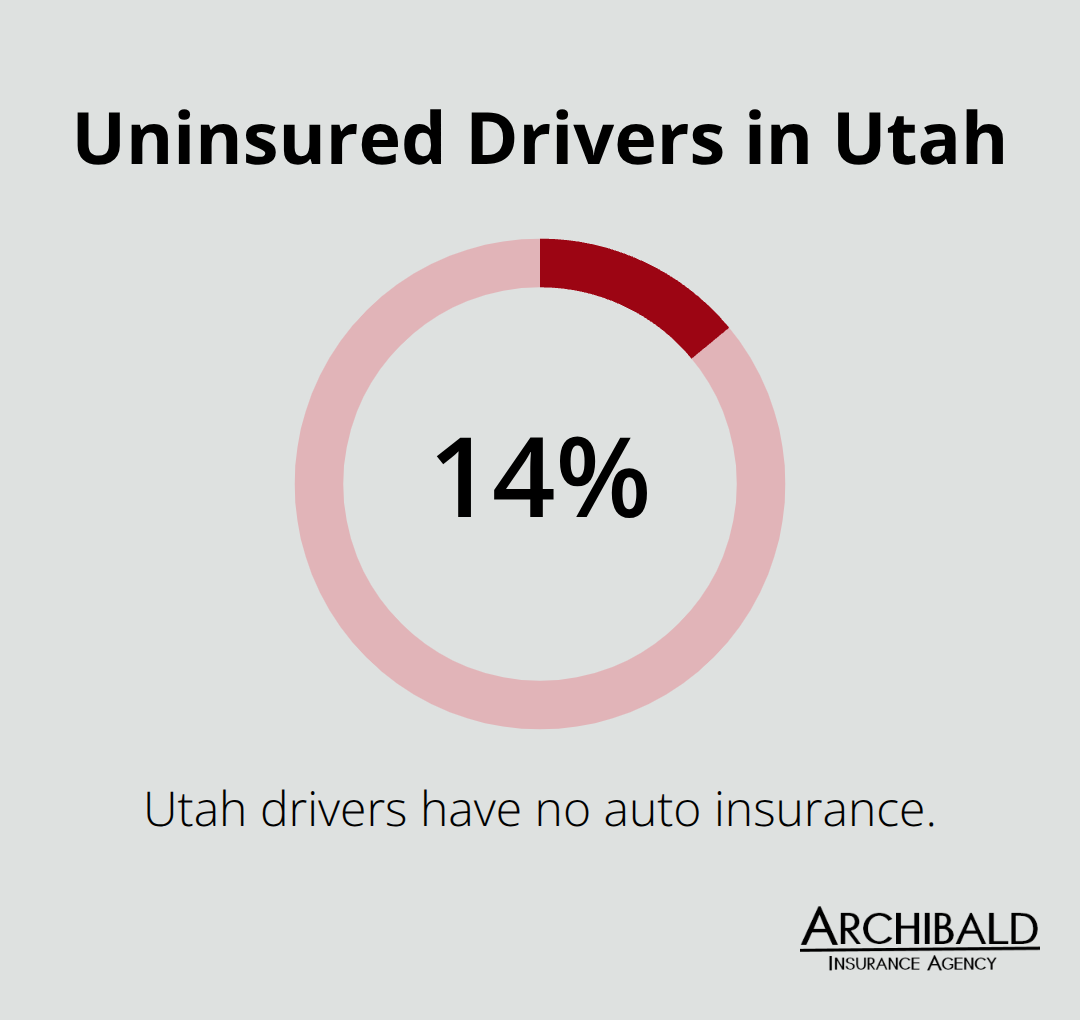
Uninsured and underinsured motorist coverage protects you when the other driver lacks insurance or carries insufficient limits to cover your damages. Utah allows this coverage, and in 2022, 14.0 percent of motorists were uninsured, according to a 2023 study by the Insurance Research Council. If an uninsured driver causes $40,000 in damage to your vehicle and injuries, your own UM/UIM coverage steps in to bridge that gap. This coverage is inexpensive-typically $100–150 annually for solid limits-yet prevents catastrophic financial exposure. Utah drivers often skip this protection, then regret that decision after an accident with an uninsured motorist.
Matching Coverage to Your Situation
Your coverage choices ultimately depend on three factors: your vehicle’s actual value, whether you can absorb a loss without financial hardship, and your exposure to other drivers’ mistakes. A financed vehicle with high value demands full coverage. An older paid-off car with modest value might justify liability-only with uninsured motorist protection. Once you understand what coverage types exist and why they matter, the next step is recognizing what actually drives your rates up or down-because the same coverage can cost vastly different amounts depending on your vehicle, driving history, and personal circumstances.
What Drives Your Auto Insurance Rates Up or Down
Your premium reflects a combination of your vehicle, your driving record, and your personal circumstances that insurers evaluate. Understanding what moves your rate helps you identify where you have control and where you don’t.
Vehicle Type and Safety Features Shape Your Cost
A 2024 sedan with advanced safety features and moderate repair costs will cost significantly less to insure than a 2024 sports car with expensive parts and higher theft risk. Safety features like automatic emergency braking and collision avoidance systems reduce claim frequency and lower your premium. Repair costs also drive rates-a vehicle that costs $8,000 to repair after a collision generates larger claims than one costing $3,000, so insurers charge accordingly.
Your Driving History Controls the Largest Rate Factor
Your driving record is the single largest factor you control. A clean record with no accidents or violations keeps your rate stable, while a single at-fault accident typically increases your premium by 25–40 percent for three years. Multiple violations or claims compound this effect dramatically. A DUI conviction can raise rates by 50–100 percent or more, and some insurers will drop you entirely.
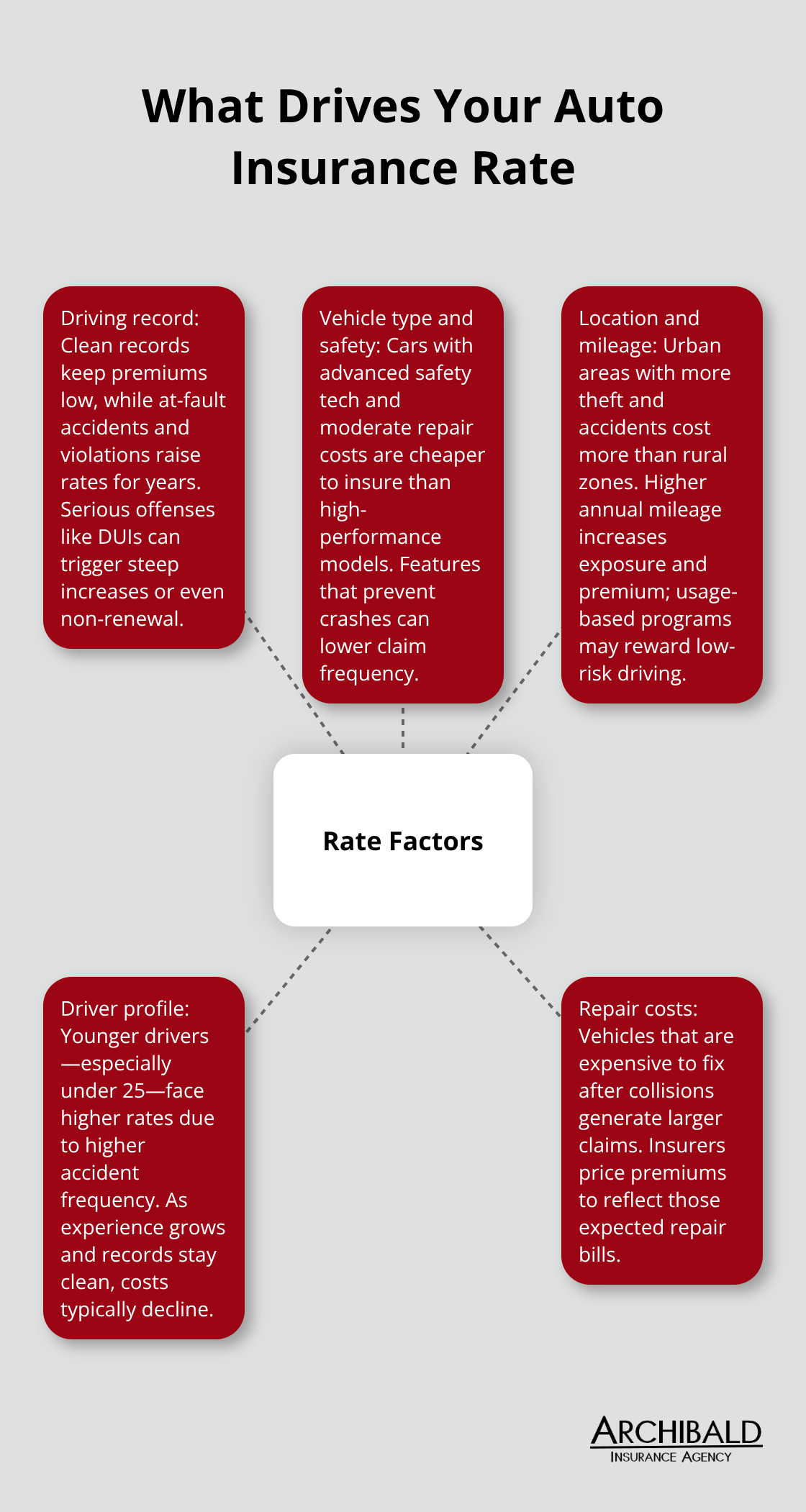
Traffic violations like speeding or careless driving add 10–30 percent to your annual cost. Completing a defensive driving course can earn you a 5–10 percent discount and demonstrates to insurers that you take safety seriously.
Age, Location, and Mileage Create Rate Variation
Drivers under 25 face the highest rates because insurance data shows this group has the highest accident frequency. A 19-year-old typically pays 2–3 times more than a 40-year-old for identical coverage. Location affects your rate because urban areas have higher theft and accident rates than rural zones. Salt Lake City drivers pay more than those in smaller Utah towns. Annual mileage also influences cost-driving 5,000 miles yearly costs less than driving 20,000 miles because more time on roads means more exposure to accidents. Some insurers now offer usage-based programs that track your actual driving behavior and mileage, which can save safe, low-mileage drivers 10–30 percent.
How These Factors Combine to Set Your Premium
Utah’s average full coverage cost was $1,285 annually in 2023, below the national average of $1,438, but your individual rate depends on how these factors combine. If you have a newer vehicle, clean driving record, and live in a lower-risk area, you’ll pay well below state averages. If you have an older vehicle, a recent accident, and frequent commute miles, you’ll pay above average. Once you understand what drives your rates, the next logical step is learning how to select coverage that actually matches your needs and budget rather than simply accepting whatever quote arrives first.
How to Choose the Right Coverage for Your Needs
Calculate Your Vehicle’s Actual Value Today
Start by determining what your vehicle is worth today, not what you paid for it. Use Kelley Blue Book to find your car’s current market value based on condition, mileage, and local demand. Consider the vehicle’s options, condition, mileage, and comparable sales prices in your area. A vehicle worth $8,000 justifies full collision and comprehensive coverage with a $500 deductible because a total loss would cause genuine financial hardship. A vehicle worth $2,500 does not. The math is straightforward: if repair costs after a collision would exceed your ability to pay without debt, you need collision coverage. If theft or weather damage would force you to replace the vehicle immediately, you need comprehensive.
Match Coverage to Vehicle Age and Value
For vehicles worth less than $4,000, liability-only coverage with strong uninsured motorist protection often makes more financial sense than collision and comprehensive premiums that exceed what you would recover in a claim. Age matters significantly here. A 2008 vehicle with 140,000 miles has unpredictable repair costs and declining value, making high deductibles ($1,000 or $1,500) reasonable. A 2022 vehicle with 25,000 miles and factory warranty justifies lower deductibles ($250 or $500) because repairs will be expensive and you have years ahead to recoup the coverage benefit.
Choose a Deductible You Can Actually Afford
Your financial situation determines the deductible you can pay out of pocket after an accident. Make sure you have enough in your emergency fund to cover your deductible in case of an accident. If an unexpected $1,000 expense would require credit card debt, your deductible should be $500 or less, even if it costs $30–50 more annually. If you have a six-month emergency fund, a $1,000 deductible makes sense and saves meaningful money on premiums. Utah drivers often select deductibles based on premium savings alone, then panic when a claim arrives and they cannot pay what they owe.
Request Quotes from Multiple Carriers
Comparing quotes from at least three carriers is non-negotiable because the same coverage can vary by $400–600 annually depending on the insurer’s underwriting model and available discounts. Request quotes online or speak with an independent agent who represents multiple carriers. When quotes arrive, ignore the premium alone and compare what each quote actually includes: are the liability limits identical, the deductibles the same, and optional coverages like uninsured motorist protection included across all quotes? A quote $300 cheaper annually is worthless if it excludes uninsured motorist coverage that another quote includes.
Understand How Your Risk Profile Affects Rates
Utah drivers typically receive quotes from national carriers, but regional carriers often deliver better rates for specific situations. A driver with one speeding ticket from three years ago might pay 8% less with one carrier than another, so multiple quotes reveal where your specific risk profile earns the best rate. Once you have three comparable quotes with identical coverage, the decision becomes clear.
Final Thoughts
Selecting the right coverage options for auto insurance requires matching your protection to three concrete realities: what your vehicle is worth, what you can afford to pay out of pocket, and what financial exposure you’re willing to accept. Utah’s minimum liability limits exist as a legal floor, not a safety net-a $25,000 bodily injury limit evaporates in seconds when a serious accident occurs, leaving you personally liable for the difference. Collision and comprehensive coverage protect your vehicle’s value, but only make financial sense when that value justifies the premium cost.
Uninsured motorist protection costs little and matters greatly given that 14 percent of Utah drivers carry no insurance at all. Your driving history, vehicle type, location, and mileage determine your premium, but your coverage choices determine whether an accident becomes a manageable claim or a financial catastrophe.
The practical next step is gathering quotes from multiple carriers with identical coverage limits and deductibles, then comparing what each actually includes.
We at Archibald Insurance Agency understand that coverage decisions feel overwhelming because the stakes are real. As an independent agency in Salt Lake City, we represent multiple insurance carriers, which means we can match you with the coverage options and rates that fit your actual needs and budget. Contact us today to discuss your coverage options for auto with someone who knows Utah’s roads and insurance market.
Disclaimer: The information provided in this blog is for general informational purposes only and does not constitute legal, financial, or insurance advice. Coverage options, terms, and availability may vary. Please consult with a licensed professional for advice specific to your situation


