

Affordable Auto Insurance Utah: How to Save on Your Premiums
Auto insurance costs in Utah don’t have to drain your budget. We at Archibald Insurance Agency know that finding affordable auto insurance in Utah means understanding what drives your premiums up and knowing exactly where to cut costs without sacrificing protection.
This guide walks you through the specific factors that impact your rates, proven strategies to lower them, and how working with an independent agent gives you access to better options than you’d find on your own.
What Drives Your Utah Auto Insurance Rates
Your driving record is the single most important factor determining what you’ll pay for auto insurance in Utah. Insurance companies treat this as a direct indicator of risk, and the data backs this up. Drivers with a clean record pay roughly 30-40% less than those with accidents or violations. A single at-fault accident increases your premiums by 25-41% depending on your insurer, while a DUI conviction spikes rates by 200% or more. Utah insurers specifically scrutinize violations like speeding tickets, at-fault collisions, and reckless driving charges. If you’ve had incidents, most companies offer accident forgiveness programs after 3-5 years of clean driving. Check with your insurer about this option because it can save you thousands over time.
How Your Vehicle Impacts Premiums
The vehicle you drive matters far more than most Utah drivers realize. Insurance companies charge higher premiums for cars that are expensive to repair, frequently stolen, or involved in more severe accidents. A Honda Civic costs significantly less to insure than a BMW or Mercedes, not because of snobbery but because repair costs are lower. Age also plays a role, though counterintuitively. A 2022 model costs more to insure than a 2015 model due to repair complexity and replacement parts availability. Conversely, very old vehicles sometimes qualify for lower premiums because insurers assume they’re driven less frequently. Safety ratings directly affect your rates too. Vehicles with top crash test scores from the National Highway Traffic Safety Administration typically earn lower premiums. If you’re shopping for a new car, insurance costs should factor into your decision alongside fuel economy and reliability.
Coverage and Deductibles Shape Your Bottom Line
Utah requires minimum liability coverage of 25/50/20, meaning $25,000 bodily injury per person, $50,000 per accident, and $20,000 property damage. This bare-minimum coverage leaves you dangerously exposed. If you cause an accident that injures multiple people or damages expensive property, you could be personally liable for amounts far exceeding these limits. Raising your liability limits to 100/300/100 costs only slightly more but protects your assets substantially.
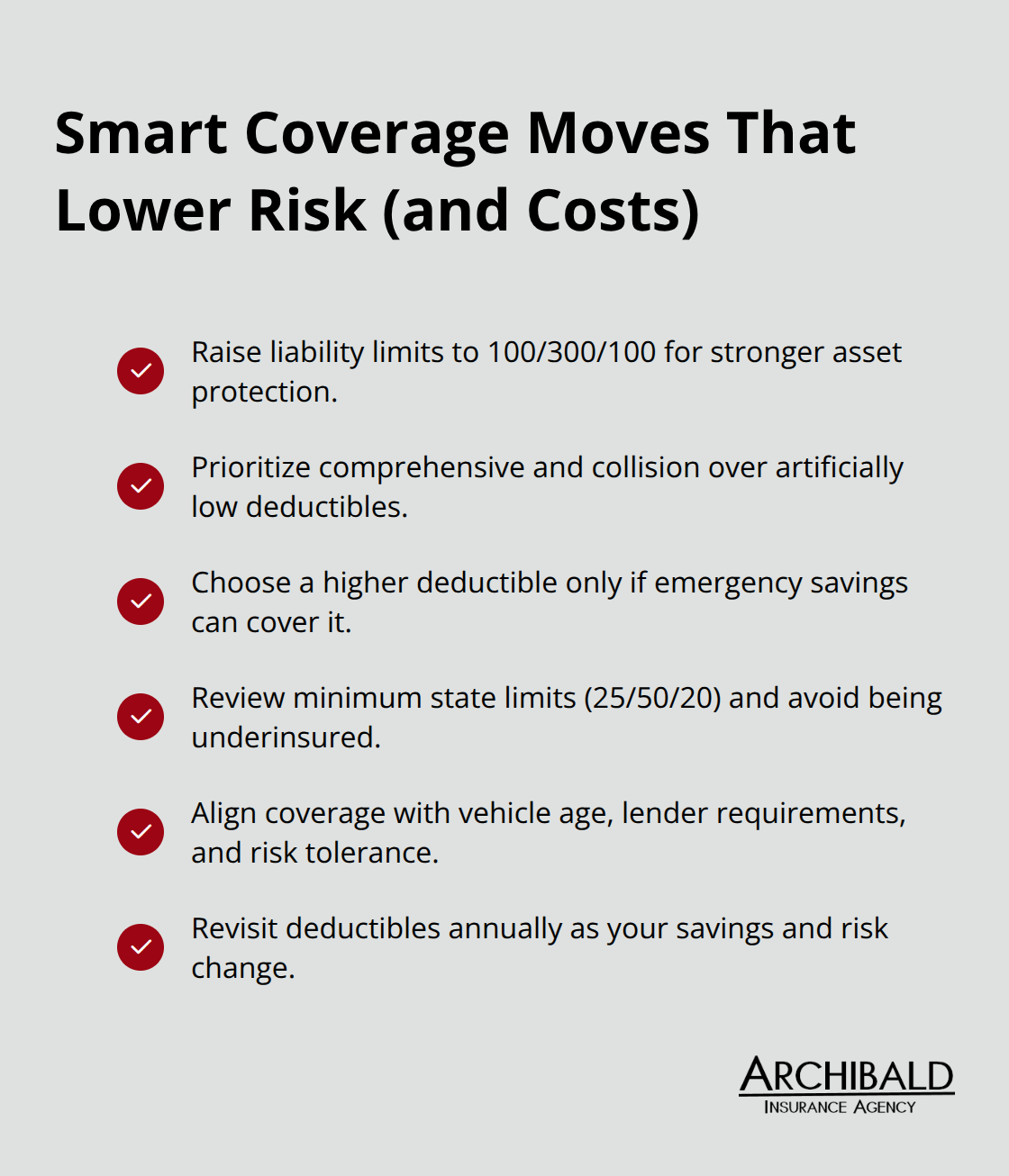
Your deductible (what you pay out-of-pocket before insurance kicks in) directly controls your monthly cost. A $500 deductible typically costs 15-30% more per month than a $1,000 deductible. The math works in your favor if you increase your deductible only when you have emergency savings to cover it. Too many Utah drivers choose low deductibles while skipping comprehensive or collision coverage entirely, which is backwards. Comprehensive and collision coverage protect you from theft, weather damage, and accidents regardless of fault, and you should prioritize these over artificially low deductibles you might never use.
Finding the Right Balance for Your Situation
The rates you pay reflect your specific risk profile, not some universal standard. Two drivers in Salt Lake City with identical vehicles can pay vastly different premiums based on their driving history, age, and coverage choices. This is where independent agents make a real difference. An independent agent represents multiple insurance carriers (not just one company), which means they can match your situation to the insurer that offers the best rate for your particular circumstances. Rather than accepting whatever quote you find online, talking with an agent who understands Utah’s insurance market helps you identify which factors you can control and which ones you cannot.
How to Cut Your Auto Insurance Costs Without Cutting Coverage
Bundling your auto insurance with home or renters coverage stands as one of the most straightforward ways to reduce what you pay each month. Insurance companies reward bundling because it increases customer loyalty and reduces their administrative costs. According to the National Association of Insurance Commissioners, bundling typically saves drivers between 15-25% on their premiums. A driver in Utah paying $1,200 annually for auto insurance alone could save $180-300 simply by adding a home policy to the same insurer. The savings compound when you add multiple policies. If you currently have auto insurance through one company and home insurance through another, consolidating with a single carrier that offers both policies makes financial sense. Most insurers offer additional discounts for bundling life insurance or business coverage, so ask about every option available to you.
The Discount Landscape Most Drivers Miss
Utah insurers offer discounts that go far beyond the standard safe driver category, yet most policyholders never claim them. Safe driver discounts typically reduce your premium by 10-15%, but defensive driving course completion adds another 5-10% on top of that. The Insurance Institute for Highway Safety offers recognized defensive driving courses that take just a few hours and qualify for discounts with most Utah carriers. Low mileage discounts apply if you drive fewer than 10,000-12,000 miles annually, which saves 10-30% depending on your insurer.
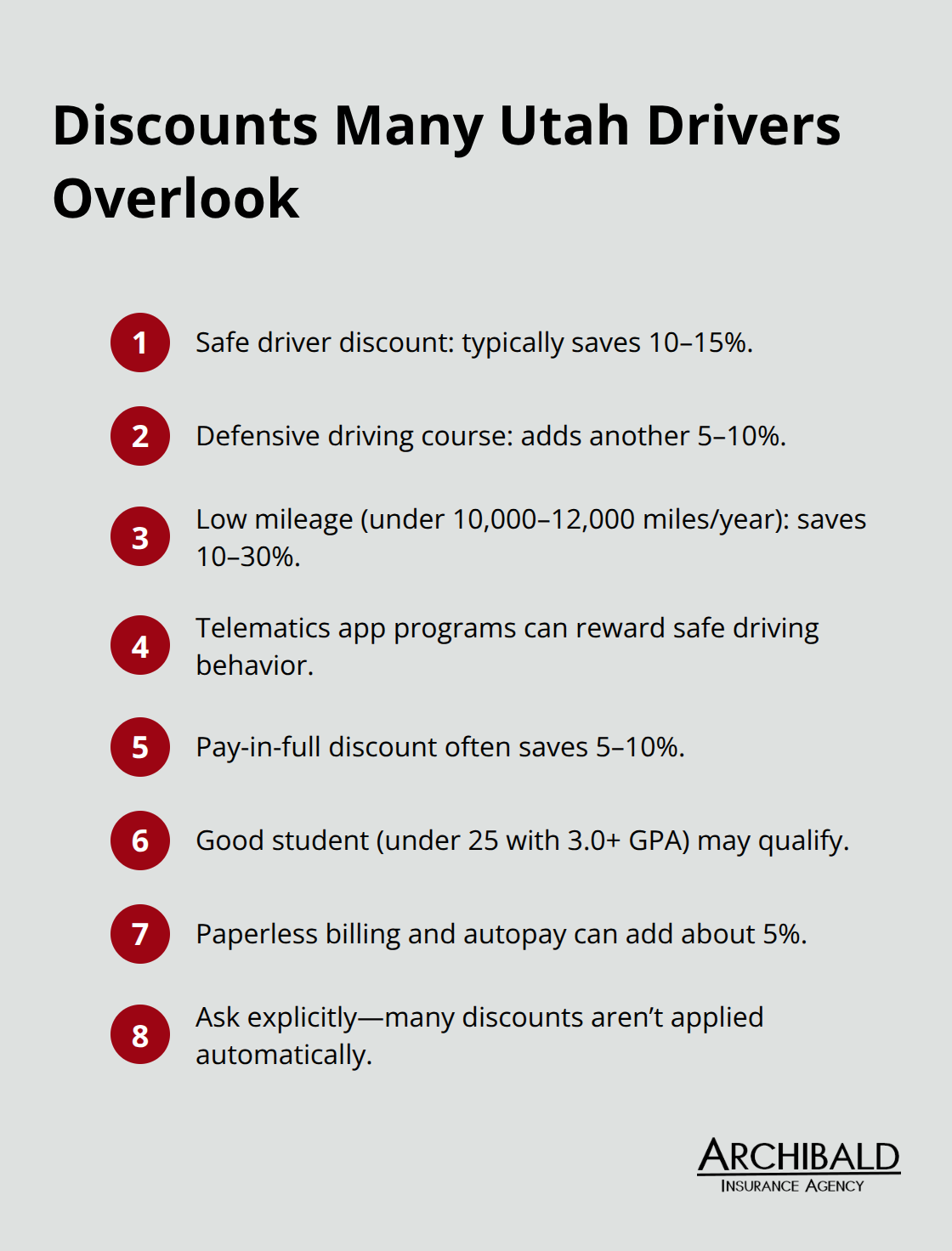
Telematics programs, where you install an app that monitors your actual driving behavior, can save safe drivers money according to Consumer Reports. Paying your premium in full upfront rather than monthly installments often saves 5-10%. Student good grades discounts apply to drivers under 25 with a 3.0 GPA or higher. Paperless billing and automatic payment discounts add another 5% savings. Insurance companies don’t automatically apply all of these discounts, and you won’t find them through online quote comparisons. You must specifically ask about each one and verify that your current policy includes them.
When Raising Your Deductible Makes Mathematical Sense
Increasing your deductible from $500 to $1,000 typically reduces your monthly premium by 15-30%, which translates to $180-360 in annual savings depending on your insurer and vehicle. Increasing it further to $1,500 saves even more. The question becomes whether you have the cash reserves to cover that deductible if an accident happens. If you have three to six months of emergency savings set aside, raising your deductible is mathematically sound. You essentially self-insure the first $1,000 and let the insurance company cover anything beyond that. This only works if you genuinely won’t touch that emergency fund for the deductible. Many Utah drivers make the opposite mistake (keeping a $250 deductible while skipping comprehensive coverage entirely), which means they pay extra monthly to protect against scenarios they’ve already decided not to cover. That’s backwards logic. If you can absorb a $1,000 deductible from savings, you should raise it and maintain comprehensive and collision coverage instead.
Why Independent Agents Uncover Better Options
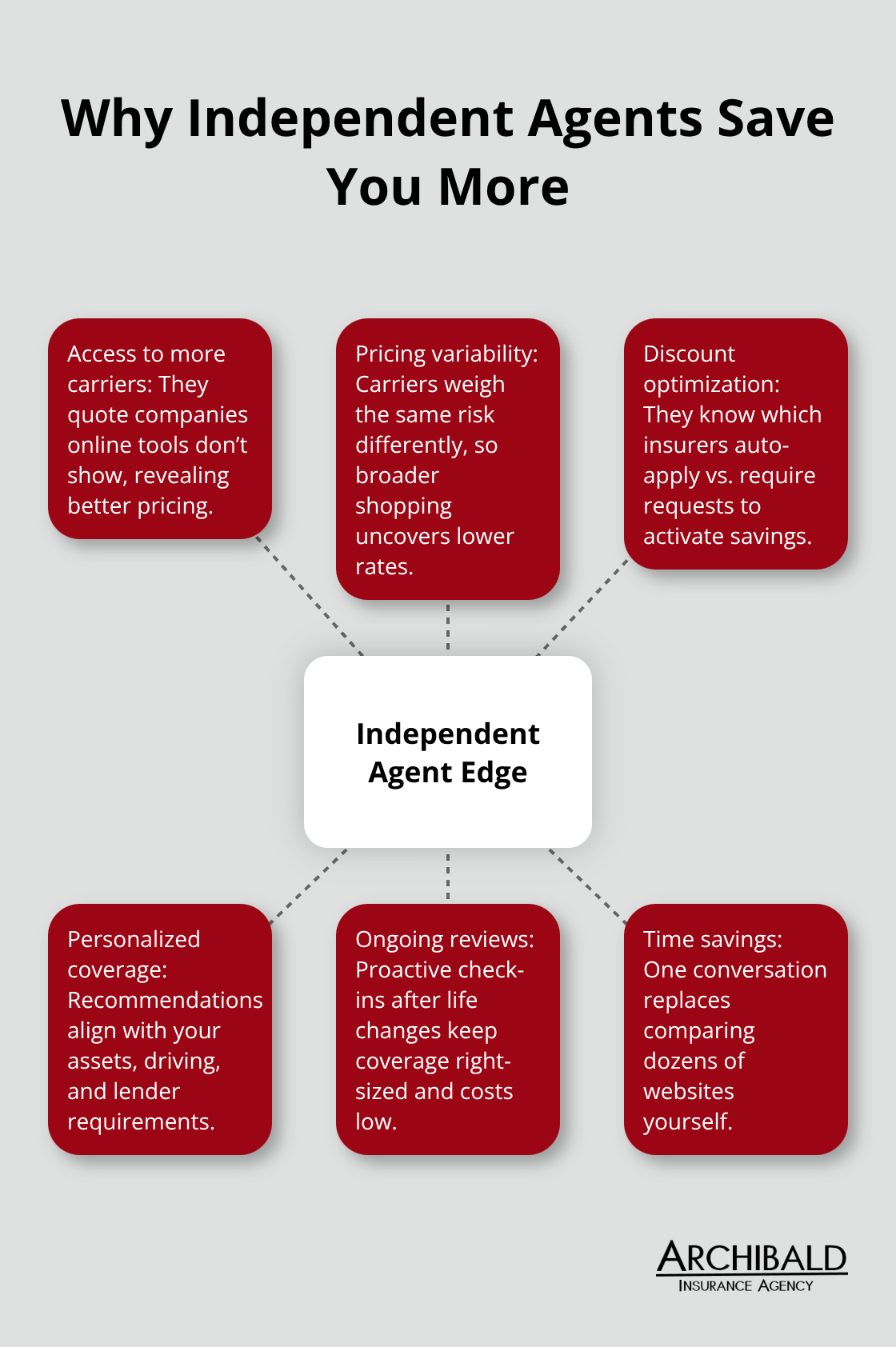
An independent agent represents multiple insurance carriers, not just one company, which means they match your situation to the insurer that offers the best rate for your particular circumstances. Rather than accepting whatever quote you find online, talking with an agent who understands Utah’s insurance market helps you identify which factors you can control and which ones you cannot. Independent agents know which carriers offer the most generous discounts for your specific profile and which ones apply them automatically versus those that require you to ask. They also understand how different insurers calculate rates for bundled policies, low mileage drivers, and other scenarios that affect your final cost. This expertise saves you time and money that you’d otherwise spend comparing quotes across dozens of websites.
Why Independent Agents Find Better Rates Than Online Quotes
Access to Carriers That Online Tools Don’t Show
Online quote tools show you rates from only the carriers they partner with, which typically represents a fraction of the market available in Utah. An independent agent represents numerous insurance carriers, meaning they access pricing from companies that don’t advertise directly to consumers online. This expanded access matters significantly because different insurers price risk differently based on their underwriting models. One carrier might charge $1,200 annually for a 35-year-old driver with one minor violation, while another charges $950 for the identical profile because their algorithm weights that violation less heavily.
You’d never find that $250 difference through online comparison sites.
Independent agents know which carriers offer the most aggressive pricing for your specific situation, whether that’s a young driver with limited history, someone rebuilding after an accident, or a senior with multiple vehicles. They also understand each carrier’s discount application process. Some insurers automatically apply safe driver discounts, while others require you to request them explicitly. Without an agent, discounts worth hundreds of dollars annually slip through the cracks.
Personalized Coverage Recommendations Based on Your Assets
An independent agent evaluates your entire situation and recommends coverage that actually protects you rather than just selling you the cheapest policy available. They analyze your assets, driving patterns, and financial situation to determine whether you need higher liability limits, whether comprehensive coverage makes sense for your vehicle age, and whether bundling truly saves money given your specific circumstances. They catch mistakes that cost money later, like drivers who skip collision coverage on financed vehicles (your lender requires it anyway) or those who carry insufficient liability limits despite owning a home.
An agent can also identify which discounts apply to your profile and verify they’re active on your policy, something that requires actual human attention rather than algorithm processing. When your situation changes (you get married, buy a house, change jobs), an independent agent proactively reviews your coverage rather than waiting for you to remember to contact your insurer. This ongoing relationship approach means you stay properly covered and maintain the lowest possible rate for your current circumstances throughout the year.
Final Thoughts
Saving on affordable auto insurance in Utah requires three concrete actions: understanding what drives your rates, actively managing the factors you control, and working with someone who represents your interests rather than a single company’s bottom line. Your driving record, vehicle choice, and coverage decisions directly impact what you pay each month. Bundling policies saves 15-25% for most drivers, defensive driving courses add another 5-10%, and raising your deductible to match your emergency savings cuts costs by 15-30%.
Online quote tools show you only a fraction of available carriers and miss discounts that require human attention to apply. An independent agent represents multiple insurance companies, which means they match your specific situation to the carrier offering the best rate for your profile. They catch mistakes like insufficient liability limits or missing discounts worth hundreds annually, and they review your coverage when your life changes rather than waiting for you to remember to call.
We at Archibald Insurance Agency work with numerous carriers to find rates that fit your budget without sacrificing protection. Our team evaluates your entire situation and recommends coverage that actually protects your assets. Contact us today to review your current policy and identify savings you’re likely missing.
Disclaimer: The information provided in this blog is for general informational purposes only and does not constitute legal, financial, or insurance advice. Coverage options, terms, and availability may vary. Please consult with a licensed professional for advice specific to your situation


