

E&O for Architects: Protecting Design Professionals
A single design oversight can trigger lawsuits, project shutdowns, and financial losses that threaten your firm’s survival. Architects face unique liability risks that general business insurance simply doesn’t cover.
E&O for architects is the professional liability protection your firm needs to operate with confidence. We at Archibald Insurance Agency help Utah design professionals secure the right coverage to safeguard their reputation and bottom line.
Why Architects Face Real Financial Threats
Design professionals operate in an industry where a single mistake spirals into catastrophic liability. According to the American Institute of Architects, professional liability claims against architectural firms have increased steadily over the past decade, with average claim costs exceeding $250,000. These aren’t theoretical risks-they’re everyday threats that can bankrupt firms without proper protection. A missed specification in construction documents, a failure to catch a structural conflict between trades, or inadequate site investigation triggers lawsuits that drain resources for years. General liability policies explicitly exclude professional services, leaving architects exposed to claims that standard business insurance won’t cover. This gap between what architects think they’re covered for and what they actually are covered for represents the single biggest mistake design firms make when managing risk.
Financial Exposure Extends Far Beyond Direct Damages
When a design error surfaces during construction, financial consequences extend far beyond the cost of fixing the mistake itself. Project delays alone cost $5,000 to $15,000 per day on mid-sized commercial projects, and architects often bear responsibility for these delays when design coordination failures occur. Construction defect claims routinely exceed $500,000 for residential projects and can reach millions for commercial work. Your firm pays for legal defense, expert witnesses, investigation costs, and the time your team spends away from billable work (costs that mount quickly in complex litigation).
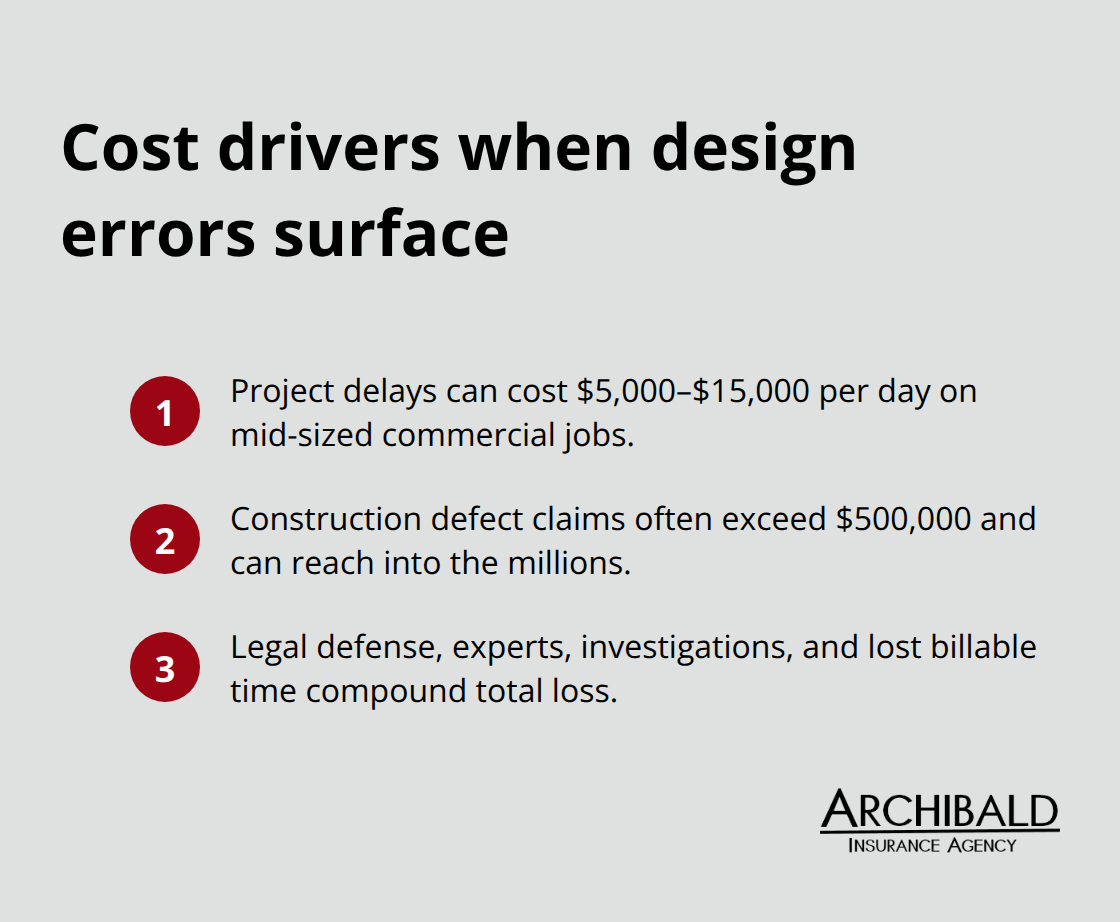
A claim can drag through litigation for three to five years, consuming management attention and straining cash flow. E&O insurance covers these legal expenses, settlement costs, and damages-protecting your firm’s operating capital and preventing a single project mistake from destroying years of profitable work.
Claims Patterns Reveal Where Architects Are Most Vulnerable
The most frequent claims against design professionals stem from specific, preventable failures. Inadequate site investigations and incomplete specifications account for roughly 35 percent of claims, according to industry data from design professional insurers. Coordination failures between disciplines-structural, mechanical, electrical, and architectural teams not communicating effectively-generate another significant portion of claims. Construction defects that originate in design decisions create the largest individual claim values, sometimes reaching seven figures.
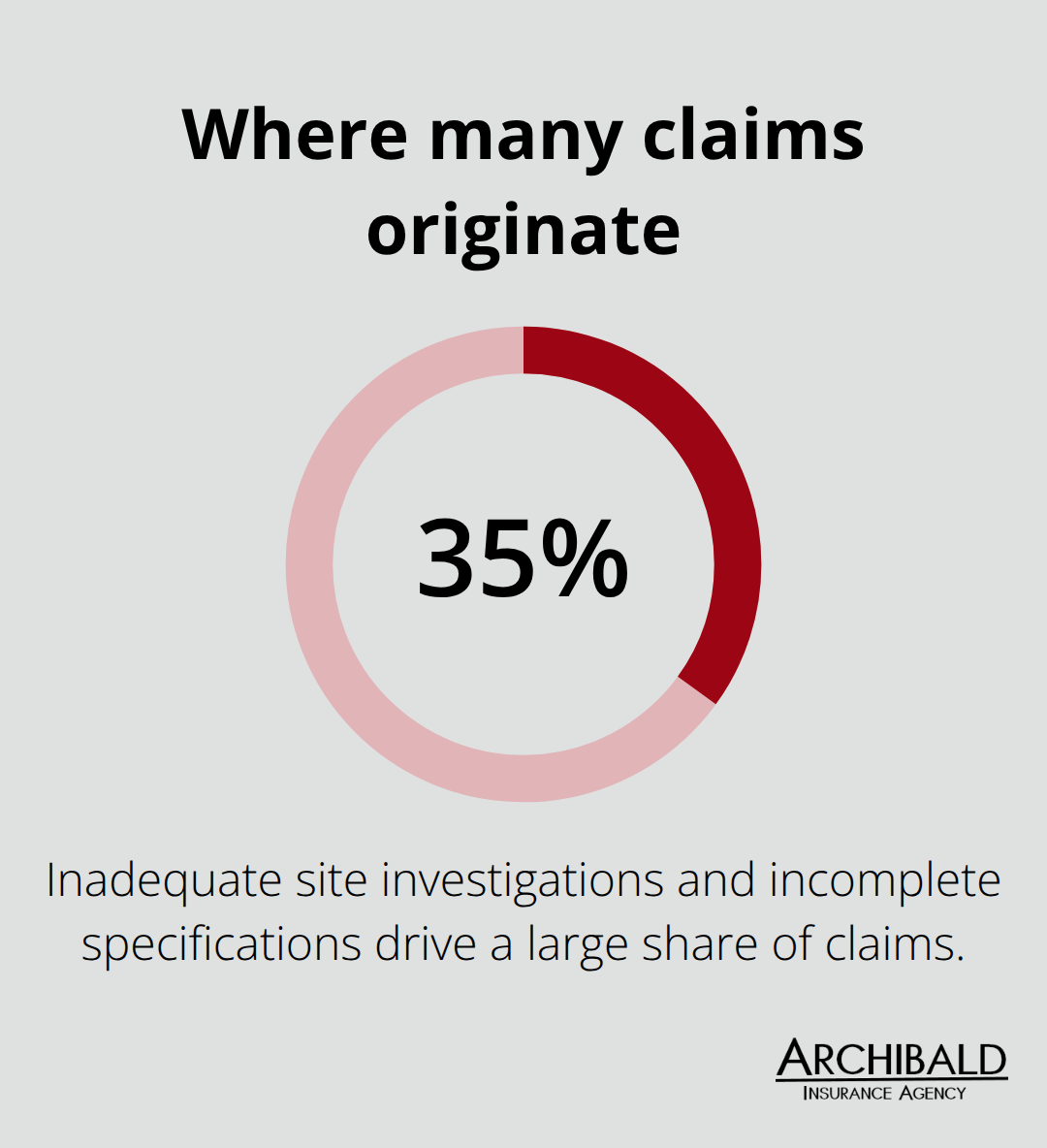
These patterns matter because they show that E&O insurance protects against the specific, predictable mistakes that happen in architectural practice (not random bad luck). Your coverage should reflect these actual risk patterns, not generic professional liability language that leaves gaps when real claims arise.
Where Design Mistakes Actually Happen
Incomplete Site Data and Specifications Trigger the Largest Claims
The claims data tells a clear story about architectural practice: most E&O losses stem from three distinct failure points that repeat across firms of all sizes. Inadequate site investigations and incomplete specifications represent a major category of claims. These aren’t vague oversights-they’re concrete problems like missing soil bore data before foundation design, incomplete window specifications that lead to water infiltration during construction, or failure to identify existing structural conditions that conflict with new design intent. When a contractor encounters missing information in construction documents, work stops, change orders multiply, and the architect absorbs liability for delays and cost overruns.
Architects prevent these losses through systematic discipline. Establish mandatory site investigation protocols before design begins, require specification sign-offs at 50 percent and 90 percent design phases, and document every assumption made during design. Many firms invest in thorough documentation to avoid claims when problems surface. The investment in comprehensive site investigation and clear specifications costs far less than defending a single claim.
Coordination Failures Between Disciplines Create Expensive Conflicts
Coordination failures between design disciplines create a major claim category, particularly on projects with separate structural, mechanical, electrical, and plumbing consultants. Structural steel conflicts with mechanical ductwork, electrical panels occupy space reserved for HVAC equipment, and these conflicts get discovered during construction rather than in the design phase. These coordination gaps generate significant architectural claims, with average costs exceeding $300,000 per incident.
The solution requires execution rather than theory. Architects should implement mandatory three-dimensional coordination reviews at 60 percent design completion, require all consultants to review and comment on each other’s drawings before issuing for construction, and assign one team member responsibility for overall coordination rather than assuming consultants will self-coordinate. This structured approach catches conflicts before construction begins.
Design Defects Produce the Highest Individual Claim Values
Design defects produce the highest individual claim values on commercial and residential projects. Poor waterproofing details, inadequate thermal breaks, undersized structural members, and flawed connection details all originate in design but manifest as construction failures months or years after project completion. These claims stretch over three to five years of litigation, consuming management time and straining cash flow long after the project closes.
Protecting your firm requires E&O coverage with adequate limits for your project types and sizes, because these specific, predictable failures happen in architectural practice far more often than one-time anomalies. The right policy covers legal defense, expert witnesses, investigation costs, and settlement amounts-protecting your operating capital when these design-origin claims surface. Understanding which coverage limits match your firm’s actual exposure becomes the next critical step in securing proper protection.
Matching Coverage Limits to Your Firm’s Actual Exposure
Calculate Limits Based on Your Project Portfolio
Choosing E&O coverage requires moving past generic policy language and matching limits directly to your firm’s project portfolio and revenue. Most architects drastically underestimate their exposure because they anchor on industry minimums rather than their specific risk profile. If your firm completes $5 million in annual billings across mixed residential and commercial work, a $1 million per-claim limit leaves you exposed when a single design defect claim reaches $500,000 or higher.
The American Institute of Architects reports that firms with $2 million to $10 million in annual revenue typically need $2 million to $5 million per-claim limits to match their actual exposure. Start by calculating your largest project value, multiply it by 1.5 to account for cost escalation during litigation, and use that as your minimum per-claim limit. This straightforward calculation ties your coverage directly to the work you actually perform.
Review Claims History to Adjust Your Limits
Add another layer by reviewing your firm’s claims history over the past five years. If you’ve filed zero claims, that’s not a reason to reduce limits-it’s confirmation that your risk management practices work, but it doesn’t eliminate the possibility of a future claim that exceeds smaller limits. Firms with one prior claim should increase limits by 25 to 50 percent because historical claims often signal vulnerability in specific project types or disciplines.
Structure Aggregate Limits Strategically
Aggregate limits matter equally to per-claim limits, yet most architects treat them as secondary. Your aggregate limit caps total coverage across all claims in a policy year. A firm with $2 million per-claim and $3 million aggregate coverage faces a dangerous gap: one $2 million claim exhausts 67 percent of annual protection, leaving minimal coverage for additional claims.
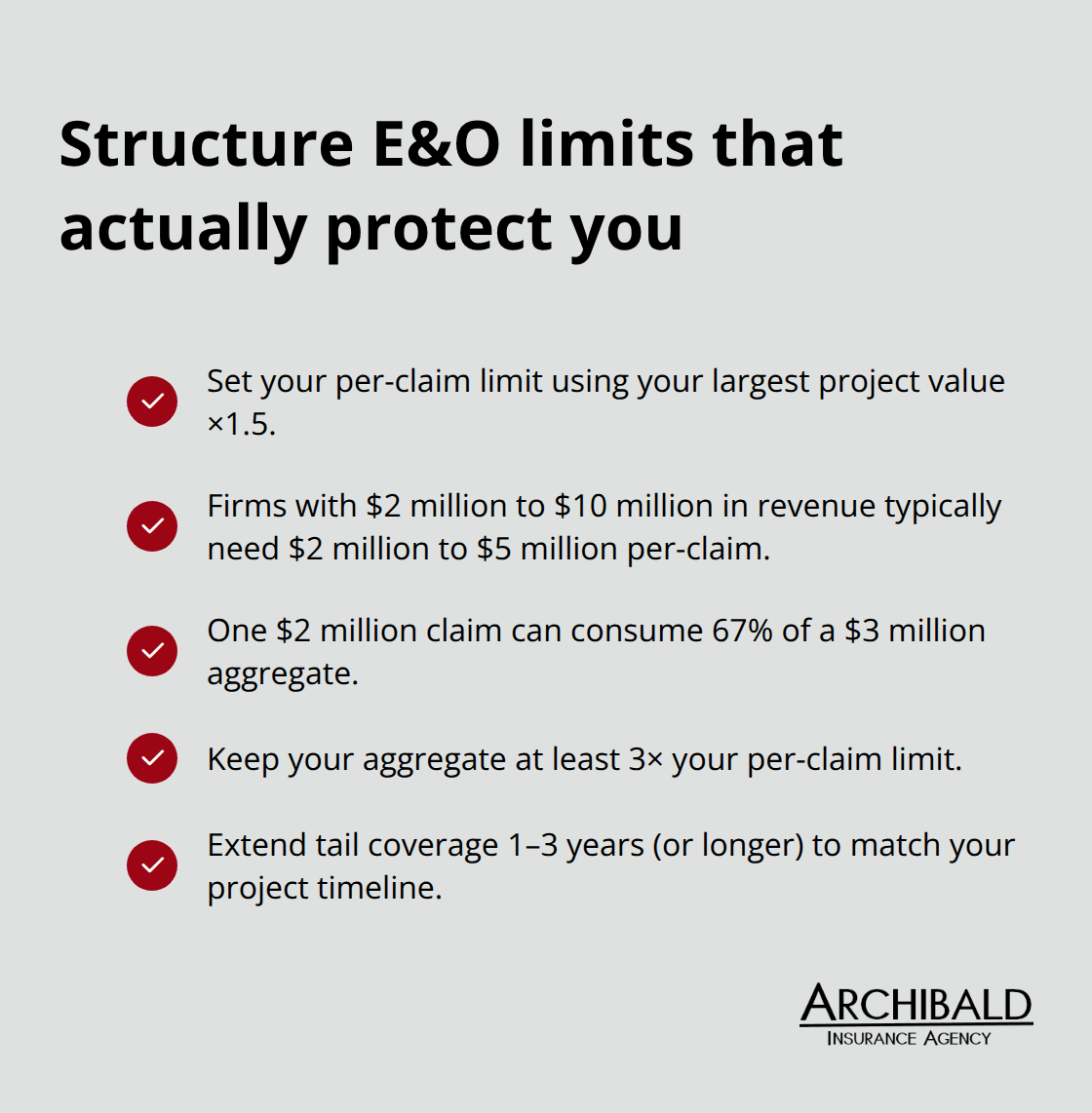
Most architectural practices should maintain aggregate limits at least three times your per-claim limit to protect against multiple claims in a single year.
Extend Tail Coverage to Match Your Project Timeline
Examine your policy’s tail coverage, which extends protection for claims filed after the policy expires-essential because design defect claims often surface years after project completion. Standard tail coverage runs for one to three years post-expiration, but many carriers offer extended tails for an additional premium. Coordinate with your insurance professional to confirm that your tail coverage matches your firm’s project delivery timeline. A firm completing five-year design-build projects needs longer tail protection than one focused on short-term residential design.
Identify Coverage Gaps in Your Service Lines
Finally, review exclusions with particular attention to claims arising from BIM coordination, sustainability certifications, or specialized services your firm markets. Many standard E&O policies exclude emerging service lines, creating coverage gaps precisely where your firm differentiates itself. Your insurance professional should map your service offerings against policy exclusions before binding coverage, ensuring protection aligns with how you actually practice architecture.
Final Thoughts
E&O for architects isn’t optional protection-it’s the foundation that allows your firm to operate without constant fear of financial collapse. Design professionals face predictable, recurring liability exposures that standard business insurance explicitly excludes, and a single coordination failure or specification gap can trigger claims exceeding $500,000. Without proper coverage, your firm absorbs these costs directly from operating capital, draining resources that should fund growth and innovation.
Selecting adequate coverage requires honest assessment of your project portfolio, historical claims patterns, and the specific services your firm delivers. Matching per-claim limits to your largest projects, maintaining aggregate limits that cover multiple claims, and extending tail coverage to match your project timeline transforms E&O insurance from a checkbox compliance item into genuine financial protection. Many architects discover too late that their coverage limits fall short when actual claims surface-a mistake that costs far more than the premium difference between inadequate and appropriate limits.
We at Archibald Insurance Agency work with Utah architectural firms to build E&O coverage that reflects your actual practice, not generic industry minimums. As an independent agency representing multiple carriers, we compare policy terms, exclusions, and limits across options to find protection matching your firm’s specific exposure. Contact us to review your current coverage or discuss protection for your growing firm.
Disclaimer: The information provided in this blog is for general informational purposes only and does not constitute legal, financial, or insurance advice. Coverage options, terms, and availability may vary. Please consult with a licensed professional for advice specific to your situation


