
Utah Vehicle Insurance Quotes: Finding Coverage That Fits Your Ride
Finding the right Utah vehicle insurance quotes takes more than a quick online search. Your coverage needs depend on where you drive, how often you’re on the road, and what protection matters most to your situation.
At Archibald Insurance Agency, we help Utah drivers cut through the confusion and find policies that actually fit their needs. This guide walks you through comparing quotes, understanding your options, and locking in savings without sacrificing the coverage you need.
Why Utah Drivers Face Different Coverage Needs
Utah’s driving landscape demands coverage that goes beyond state minimums, and this reality separates smart drivers from those who face gaps in their protection too late. The state’s 27 scenic byways-including Logan Canyon and Highway 12-attract year-round traffic, but winter conditions on these routes create serious collision and weather-related risks. Snow, ice, and flash flooding in certain regions make comprehensive coverage a practical necessity rather than an optional add-on. Utah also operates under a no-fault system, which fundamentally changes how claims work compared to other states. Your Personal Injury Protection (PIP) covers your medical costs regardless of who caused an accident, but the $3,000 PIP minimum can vanish quickly with serious injuries. If medical expenses exceed $3,000 or involve permanent disability, you can pursue a lawsuit, which explains why many drivers increase their PIP limits well above the legal floor.
Minimum Coverage Falls Short for Most Drivers
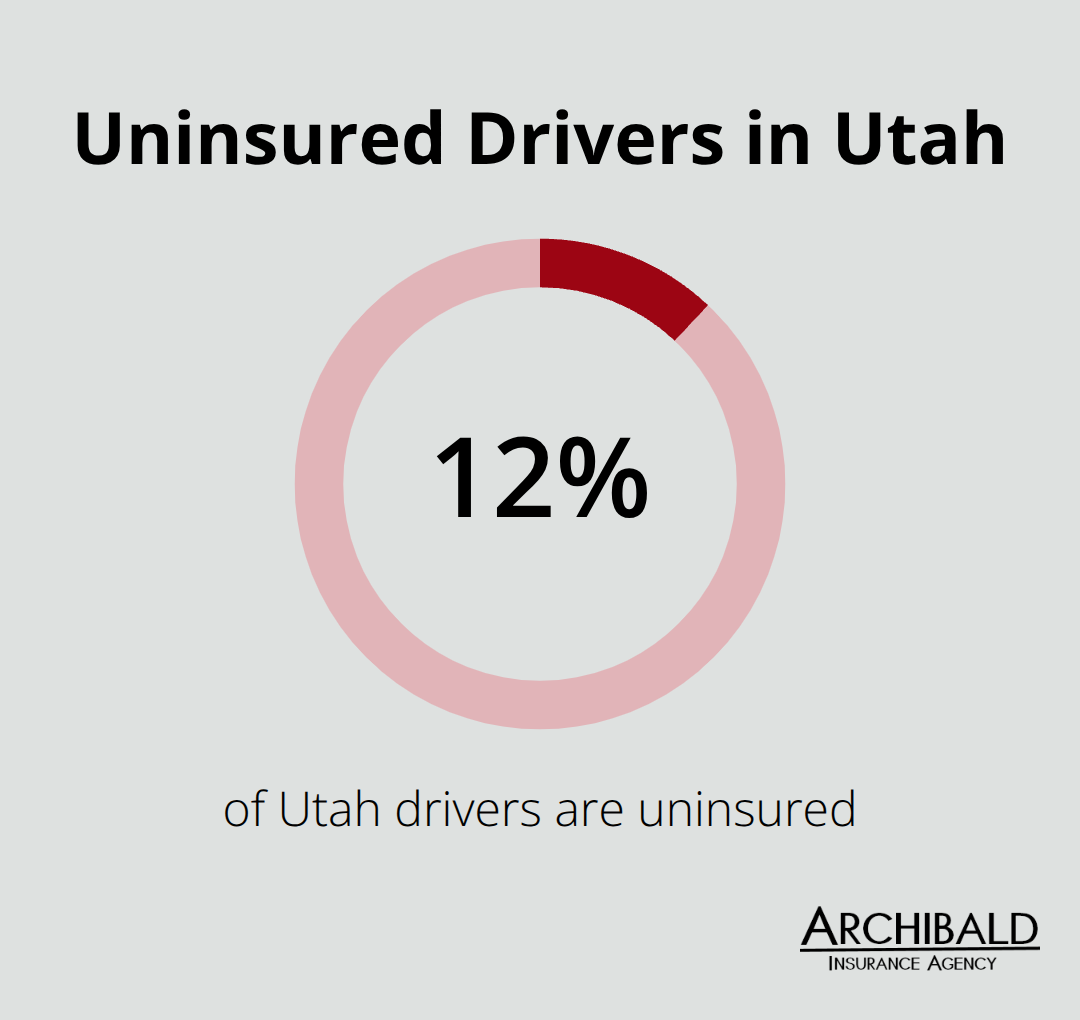
Utah requires $30,000 bodily injury liability per person and $65,000 per accident, property damage liability of $25,000, and uninsured motorist coverage at the same $30,000/$65,000 split. These minimums exist to meet legal requirements, not to protect your financial security. A serious accident on I-15 with multiple vehicles can easily generate $50,000 or more in damages, leaving you personally liable for anything above your $25,000 property damage limit. Uninsured and underinsured motorist coverage deserves special attention because approximately 12% of Utah drivers carry no insurance at all. This coverage protects you when the at-fault driver has insufficient limits or no policy whatsoever.
Most drivers try limits of at least $100,000/$300,000 for bodily injury and $50,000 for property damage to match their actual asset exposure.
Weather and Seasonal Risks Change Your Coverage Math
Winter driving in Utah creates specific hazards that standard policies don’t automatically address. Comprehensive coverage handles weather damage, theft, and vandalism, becoming essential for anyone parking outdoors during snow season. A hailstorm can cost $5,000 to $15,000 in vehicle repairs depending on your car’s value. Collision coverage protects you when you slide on ice or hydroplane during rain, and your deductible choice matters significantly. A $500 deductible costs more upfront but saves money if you file a claim, while a $1,000 deductible lowers your premium but means higher out-of-pocket costs when you need coverage. Most Utah drivers benefit from comprehensive and collision coverage with $500 deductibles given the region’s weather patterns, though your specific situation depends on your vehicle’s age and your emergency savings capacity.
Why Your Driving Habits and Vehicle Type Matter
Your actual coverage needs shift based on how you use your vehicle and what you drive. A newer vehicle with a car payment warrants full comprehensive and collision coverage, while an older paid-off car might justify higher deductibles to lower premiums. Drivers who commute on mountain passes face different risks than those who stay in Salt Lake City, and your annual mileage affects accident probability. A commercial driver or rideshare participant needs coverage that standard personal auto policies don’t provide. These variables mean that comparing quotes requires honest answers about your driving patterns and vehicle situation. The next step involves understanding what information you need to gather before you request quotes from multiple carriers.
Comparing Quotes Without Wasting Your Time
Gathering quotes from multiple carriers takes about 30 minutes of actual work, and the payoff justifies the effort. Utah drivers who shop around every two years consistently find better rates than those who stay loyal to one insurer. State Farm quoted about $103 per month in Salt Lake City for similar coverages, Progressive quotes show roughly $100 per month for two vehicles, and Geico averages around $108 per month for drivers with clean records. These numbers prove that identical coverage costs wildly different amounts depending on the carrier you choose. The gap between the cheapest and most expensive quote for the same person often exceeds $50 per month, which adds up to $600 annually.
Prepare Your Information Before You Request Quotes
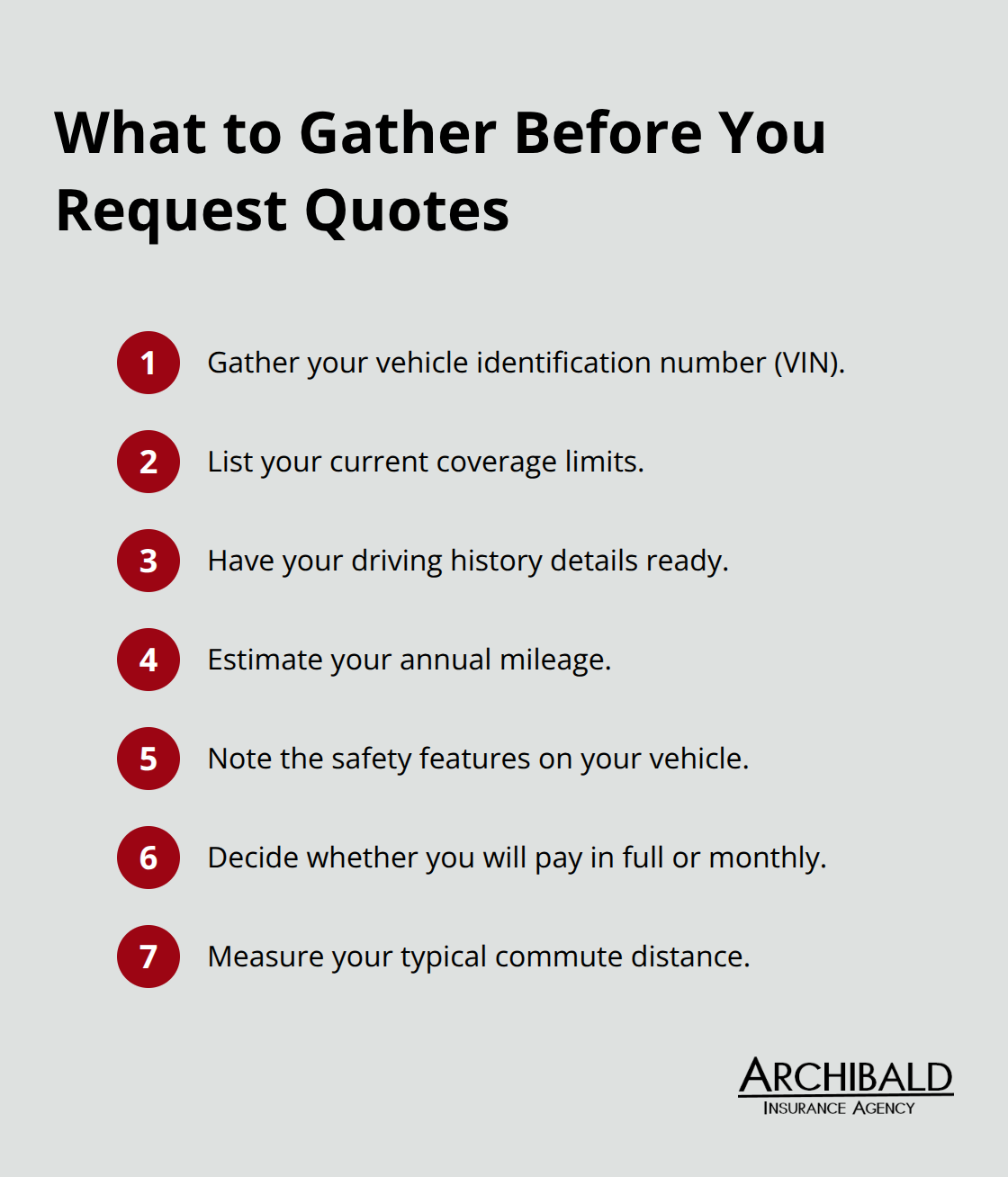
Start with the specific information carriers actually need before you request a single quote. Your vehicle identification number, current coverage limits, driving history, and annual mileage all affect pricing. Carriers also ask about safety features, whether you pay in full or monthly, and your commute distance. Having these details ready before you start requesting quotes eliminates the frustration of stopping mid-application to hunt down information.
Most major carriers offer free online quote tools where you enter your information once and receive an estimate within minutes. Progressive, Geico, State Farm, and USAA all operate in Utah, and each uses different rating models that reward different driver profiles.
What Coverage Limits Actually Mean for Your Wallet
Coverage types fall into two categories: liability protection that covers damage you cause to others, and first-party coverage that protects your own vehicle and medical costs. Bodily injury liability covers medical expenses and lost wages for people you injure, while property damage liability covers their vehicle repairs or replacement. Utah’s minimums of $30,000 bodily injury per person and $25,000 property damage are genuinely insufficient because a single serious accident can generate $50,000 to $100,000 in damages. Most Utah drivers carry $100,000 bodily injury and $50,000 property damage limits, which costs roughly $10 to $20 more per month than state minimums.
Comprehensive and collision coverage protects your vehicle, with comprehensive handling weather, theft, and vandalism while collision covers accidents regardless of fault. Your deductible choice directly impacts your monthly premium. A $500 deductible typically costs $30 to $50 more per month than a $1,000 deductible, so you need to calculate whether you could actually afford a $1,000 out-of-pocket expense if you filed a claim. Uninsured motorist coverage protects you when the at-fault driver lacks sufficient insurance, and underinsured motorist coverage covers situations where their limits don’t match your damages. Utah doesn’t require these, but 14.0 percent of motorists are uninsured, making this protection genuinely valuable for most drivers.
Request Identical Coverage From Multiple Carriers
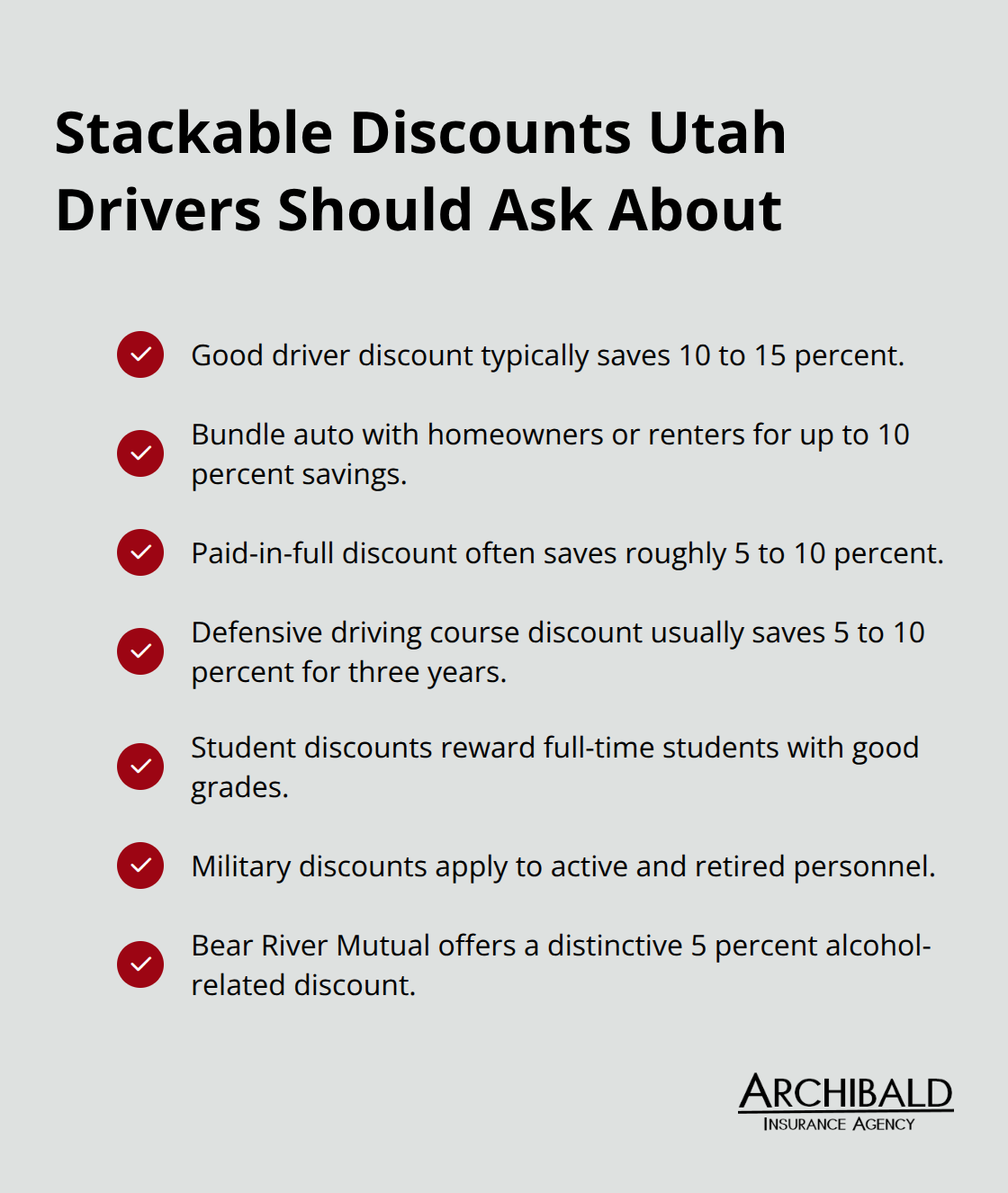
Request the same bodily injury limits, property damage limits, deductibles, and coverage types from each insurer to make fair comparisons. Many drivers accidentally compare different coverage levels and think they’re seeing genuine price differences when they’re actually comparing apples to oranges. Ask about all available discounts before finalizing any quote. Good driver discounts reward clean driving records, multi-policy discounts apply when you bundle auto with home or renters insurance, and paid-in-full discounts reduce premiums when you pay annually instead of monthly.
Defensive driving course discounts typically save 5 to 10 percent and remain active for three years after completing an approved course. Student discounts apply to full-time students with good grades, and military discounts cover active or retired personnel. Bear River Mutual, Utah’s local mutual insurer, offers a distinctive alcohol-related discount of about 5 percent for drivers who confirm they don’t consume alcohol. After you gather quotes with identical coverage, compare the actual coverage quality and claims handling reputation alongside price. Cheaper quotes sometimes reflect lower customer service standards or partnerships with repair shops that cut corners. Reading recent customer reviews on independent sites reveals whether an insurer pays claims quickly or creates unnecessary delays.
Move Forward With Your Top Choices
Once you’ve gathered three to five quotes with identical coverage and discounts applied, the decision becomes straightforward because you’ll see exactly what each carrier charges for the protection you actually need. The next step involves understanding how deductibles, additional discounts, and bundling strategies can lower your premiums even further while maintaining the coverage that protects your assets and your family.
Lowering Your Premiums Without Sacrificing Protection
Choose Your Deductible Based on What You Can Actually Afford
Your deductible choice directly controls your monthly cost, and Utah drivers often get this calculation wrong by selecting deductibles they cannot actually afford. A $500 deductible typically costs $30 to $50 more per month than a $1,000 deductible, which means you recover that extra premium in roughly one year if you file a claim. The real question isn’t which deductible sounds cheaper-it’s which out-of-pocket amount you could actually pay if your car needed repairs tomorrow. Most Utah drivers carry $500 deductibles because the region’s weather patterns create genuine collision and comprehensive risks, but if you have $3,000 in emergency savings and rarely drive during winter months, increasing your deductible to $1,000 may reduce premiums by 10 to 20 percent. Progressive and Geico both allow you to adjust deductibles within seconds on their online quote tools, so test different amounts before you commit. The math becomes clearer when you see the actual premium difference for your specific vehicle and driving record.
Stack Discounts to Maximize Your Savings
Discounts represent the fastest way to lower your premiums without changing your coverage, and most Utah drivers leave money on the table by not asking about them. A good driver discount for maintaining a clean record typically saves 10 to 15 percent, while bundling auto with homeowners or renters insurance yields multi-policy discounts that commonly reach 10 to 25 percent depending on the carrier. Paid-in-full discounts apply when you pay your annual premium upfront instead of monthly installments, and this alone saves roughly 5 to 10 percent on many policies. Defensive driving course completion qualifies you for savings that typically run 5 to 10 percent and remain active for three years, making it valuable even if you’re an experienced driver. Student discounts apply to full-time students with good grades, military discounts cover active and retired personnel, and Bear River Mutual offers a distinctive 5 percent discount for drivers who confirm they don’t consume alcohol.
When you request quotes, explicitly ask about every discount available because carriers don’t automatically apply them unless you mention your eligibility.
Bundle Auto and Home Insurance for Maximum Savings
Bundling deserves special attention because bundling auto and home insurance often costs less than purchasing them separately, even when you compare the total premium against single-policy rates from competitors. State Farm and USAA advertise bundling savings up to 10 percent, and this discount stacks with good driver discounts and paid-in-full discounts to create meaningful savings. If you own a home or rent an apartment, bundling your auto policy should be your first move before comparing individual auto quotes across carriers. This strategy (combining multiple policies with one insurer) frequently produces the lowest total premium for Utah drivers who need both auto and home coverage. At Archibald Insurance Agency, our team represents numerous carriers, which means we can help you identify which insurer offers the best bundling rates for your specific situation rather than limiting you to a single company’s bundle pricing.
Final Thoughts
Choosing the right vehicle insurance in Utah requires three core decisions: matching your coverage to actual risks, comparing Utah vehicle insurance quotes across multiple carriers with identical limits, and stacking every available discount. Winter weather, no-fault system rules, and the reality that 14 percent of Utah drivers carry no insurance all push you toward coverage that exceeds state minimums. Your deductible choice, bundling strategy, and discount eligibility directly control your final premium far more than loyalty to any single insurer.
Shopping for quotes every two years keeps your rates competitive because carriers constantly adjust their pricing models. A quote that seemed expensive last year may become your cheapest option today, while your current insurer might have raised rates significantly. The gap between the lowest and highest quote for identical coverage regularly exceeds $600 annually, which means skipping the comparison process costs you real money.
An independent agent eliminates the guesswork because they represent multiple carriers and understand which insurers reward your specific driving profile. Contact Archibald Insurance Agency to discuss your situation with someone who understands Utah’s unique driving environment and can match you with coverage that actually fits your ride.
Disclaimer: The information provided in this blog is for general informational purposes only and does not constitute legal, financial, or insurance advice. Coverage options, terms, and availability may vary. Please consult with a licensed professional for advice specific to your situation


