

Compare Life Insurance Utah: Find Your Best Fit
Life insurance protects your family’s financial future, but choosing the right policy can feel overwhelming. We at Archibald Insurance Agency help Utah residents compare life insurance options and find coverage that matches their actual needs.
Whether you need temporary protection or lifelong coverage, understanding your choices matters. This guide walks you through the main policy types, key factors to consider, and how to select the right fit for your situation.
Life Insurance Types in Utah
Term life insurance costs significantly less than permanent coverage, making it the practical choice for most Utah families. Term policies provide a death benefit for a set period-typically 10, 20, or 30 years-and offer no cash value component. Once your term expires, you can renew at a higher rate, convert to a permanent policy, or let coverage end. This structure works well if you need protection while your children are young, your mortgage remains active, or your income-earning years stretch ahead.
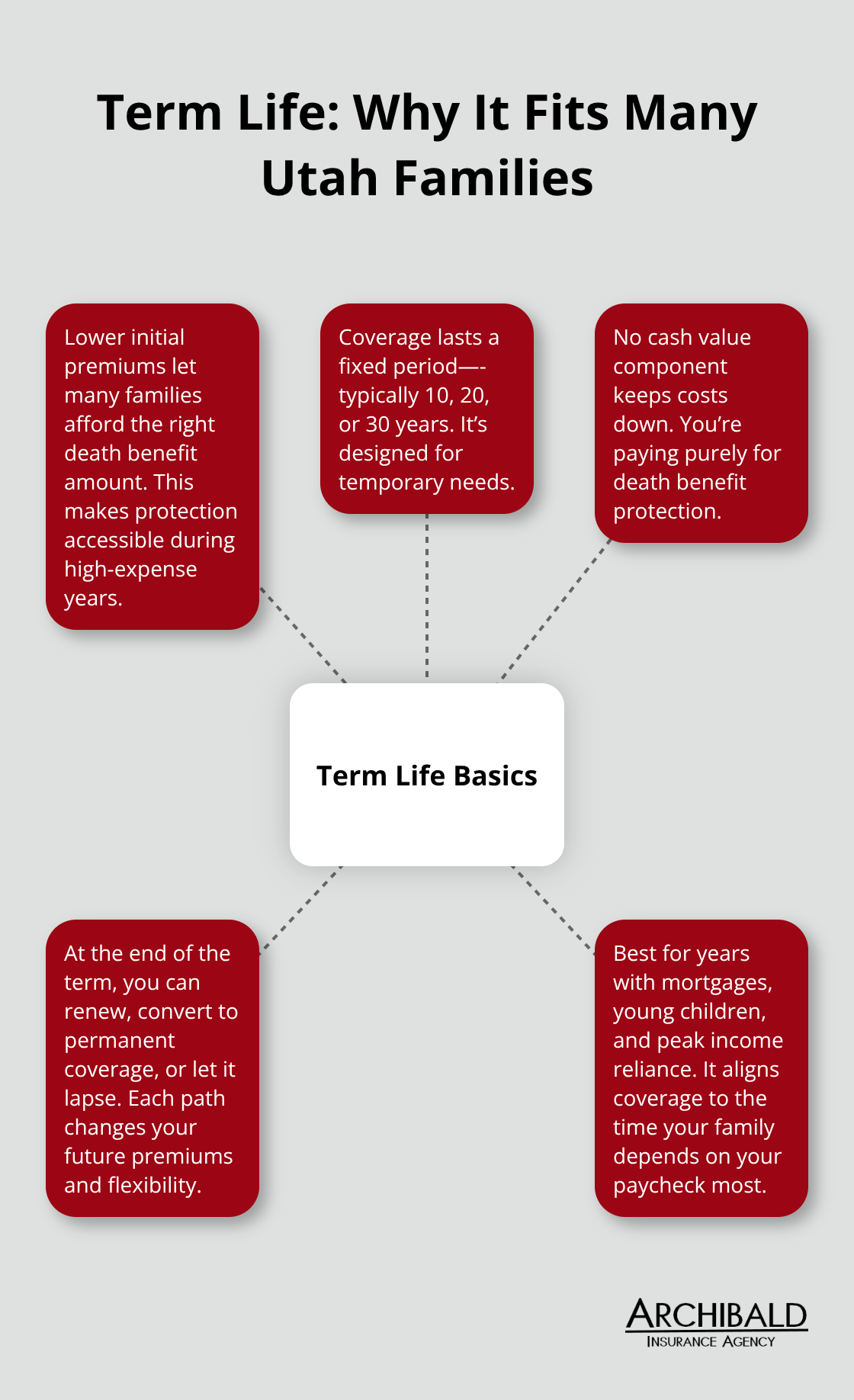
The low initial cost means you can actually afford the coverage amount your family truly needs rather than settling for inadequate protection because premiums were too high.
When Permanent Coverage Makes Sense
Whole life and universal life policies build cash value alongside your death benefit, which means premiums stay level or flexible while your policy accumulates money over time. Whole life premiums run 5 to 15 times higher than term initially, but the trade-off is permanent protection as long as you pay premiums and lifetime access to your accumulated cash value through loans or withdrawals. Universal life offers more flexibility-you adjust your death benefit and premium payments based on your changing needs, and your account earns interest, though charges reduce it. However, if insufficient funds remain in your account, coverage lapses unless you increase premiums or lower your benefit. This requires active monitoring and isn’t a set-it-and-forget-it product. No-medical-exam whole life options in Utah can provide coverage without health screening, which matters if you have pre-existing conditions or prefer to skip medical exams.
Health Status and Underwriting Advantages
Your health history doesn’t automatically disqualify you from affordable coverage. If you have pre-existing conditions like depression or heart issues, some carriers offer notably favorable underwriting and don’t penalize daily marijuana users the way most carriers do. Smokers often assume life insurance is unaffordable, but competitive rates exist for smokers, and rates can drop after one year of quitting. The key action is to request quotes from multiple carriers, not just one, and ask each company how your specific health status, smoking status, or lifestyle affects your premium.
Selecting Your Policy Type
Your choice between term and permanent life depends on how long you need protection and what you can afford today. Most Utah families benefit from term life during their working years when expenses are highest and income is their family’s primary asset. Never cancel an existing policy before your new one is active and approved, as replacement can trigger surrender charges, tax consequences, and potential loss of coverage if underwriting fails. Once you understand which policy type fits your situation, the next step involves determining exactly how much coverage your family actually needs.
How Much Life Insurance Do You Actually Need
Calculate Your Real Coverage Amount
Your coverage amount must match your actual financial obligations, not a generic formula. Add up your mortgage balance, outstanding debts, final expenses (typically $10,000 to $15,000), and the years of household income your family would need if you died today. For a Utah household with a $300,000 mortgage, $50,000 in car loans, and two children who need support for 15 more years, the math becomes concrete quickly. If your household income is $80,000 annually, your family would need roughly $1.2 million to cover the mortgage, debts, and 15 years of income replacement, minus any Social Security survivor benefits and existing savings.
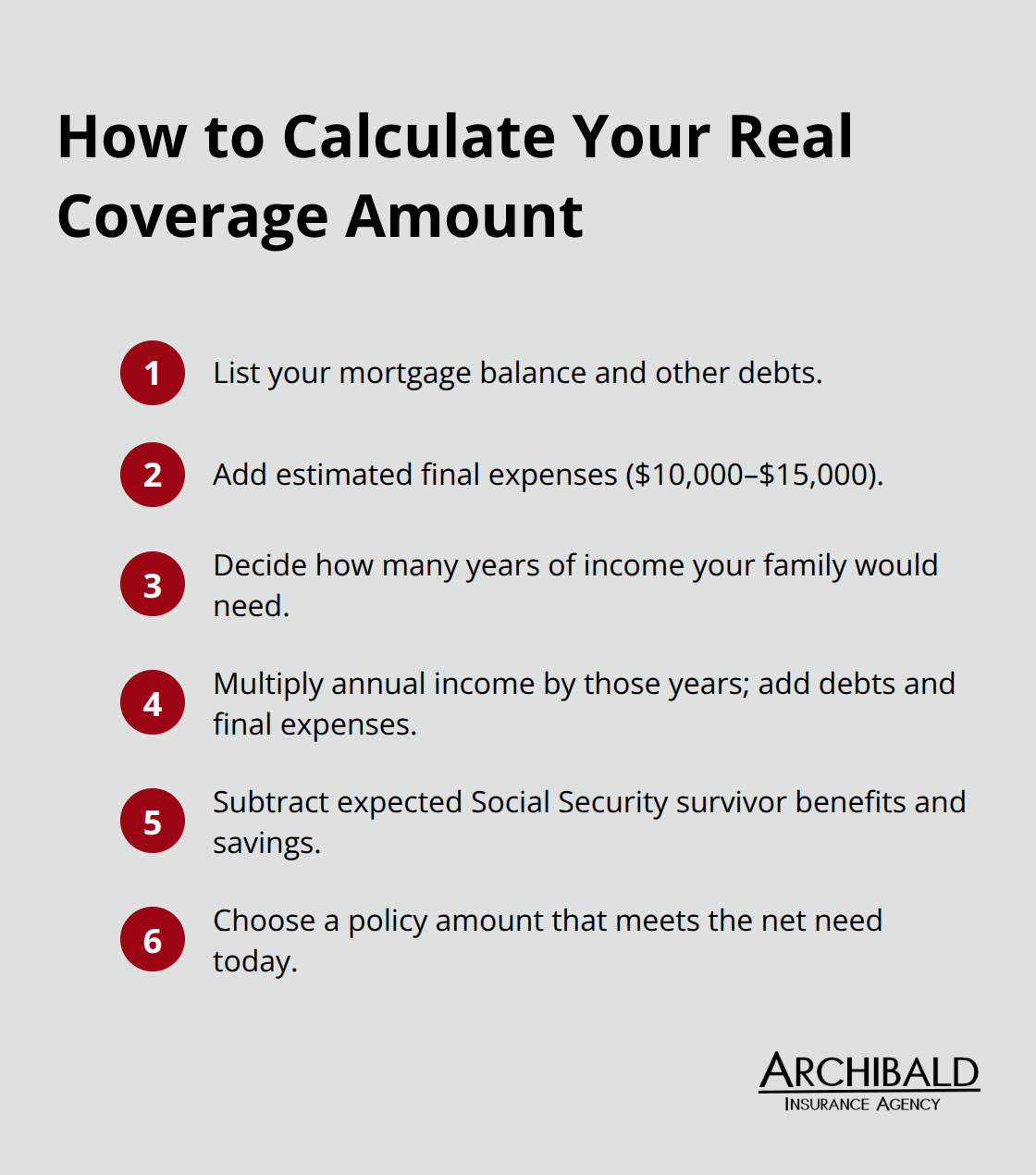
Rather than relying on a standard multiplier, calculate your coverage needs based on your specific situation, because your obligations are unique. Once you know your target amount, term life becomes far more affordable than you might expect.
What Utah Residents Actually Pay
A 35-year-old healthy male in Utah pays around $30 to $50 per month for a $500,000 20-year term policy, according to recent data. That translates to roughly $360 to $600 annually for protection that covers most families’ core needs during their earning years. A 35-year-old healthy female pays slightly less for the same coverage. These rates demonstrate that adequate protection fits within most household budgets without requiring permanent policies or cash value components.
Compare Multiple Carriers to Find Your Best Rate
Compare quotes from different carriers reveals how much your specific health status, smoking history, and other factors actually affect your price. Don’t request one quote and assume that’s your rate. Legal & General America consistently offers some of the cheapest rates for healthy non-smokers in Utah, with rates around $23 per month for women and $27 per month on the same $500,000 20-year term. However, if you have pre-existing conditions, Lincoln Financial often provides more favorable underwriting than competitors, particularly for applicants with depression or heart issues and those who use marijuana.
Smokers should know that rates exist at competitive levels, and some carriers will reduce your premium after one year of quitting if you stop smoking. Request illustrations from at least three carriers before deciding, because the difference between the cheapest and most expensive option for your profile can easily exceed $100 annually. When you collect quotes, ask each carrier specifically how your health history, medications, lifestyle, and driving record affect their premium.
Verify Your Carrier Before You Commit
The Utah Insurance Department maintains a licensee lookup tool where you can verify that any agent or company you’re considering is actually authorized to sell life insurance in Utah. A June 2026 case exposed a ghost broker who defrauded more than 1,000 consumers, so verification protects you from fraud before you hand over money. This verification step takes minutes and prevents costly mistakes.
Once you’ve narrowed your options based on price and carrier reliability, the next step involves understanding which policy features and riders actually matter for your family’s protection.
Picking the Right Policy for Your Situation
Your timeline and financial goals determine which policy features actually matter for your coverage. If you’re 35 with young children and a 25-year mortgage, your priority is affordable death benefit protection during your highest-obligation years, which term life delivers without the premium burden of cash value. If you’re 50 with children in college and substantial savings already accumulated, permanent coverage with cash value might align better with estate planning and tax efficiency goals, though you’ll pay significantly more in premiums. Most Utah residents choose based on what sounds sophisticated rather than what solves their actual problem. Term and whole life insurance can financially protect loved ones if you pass away. Your timeline shapes everything-a 20-year term expires when your youngest child finishes college and your mortgage principal has declined substantially, which is precisely when your coverage needs drop.
Riders and Features Worth Paying For
Policy riders modify your base coverage to address specific concerns, but most riders add cost without solving real problems. A Waiver of Premium Rider is an optional add-on to a life insurance policy that will waive or pay your life insurance premiums for you if you become disabled. Accelerated death benefit riders let you access part of your death benefit if you receive a terminal diagnosis, which provides real financial relief during catastrophic illness. Conversion riders on term policies let you switch to permanent coverage later without re-qualifying medically, which protects you if your health declines-this matters more than most people realize because it preserves your insurability. Riders like accidental death benefit, which pays extra if you die in an accident, sound appealing but statistically add unnecessary cost; your family needs the base death benefit regardless of how you die.
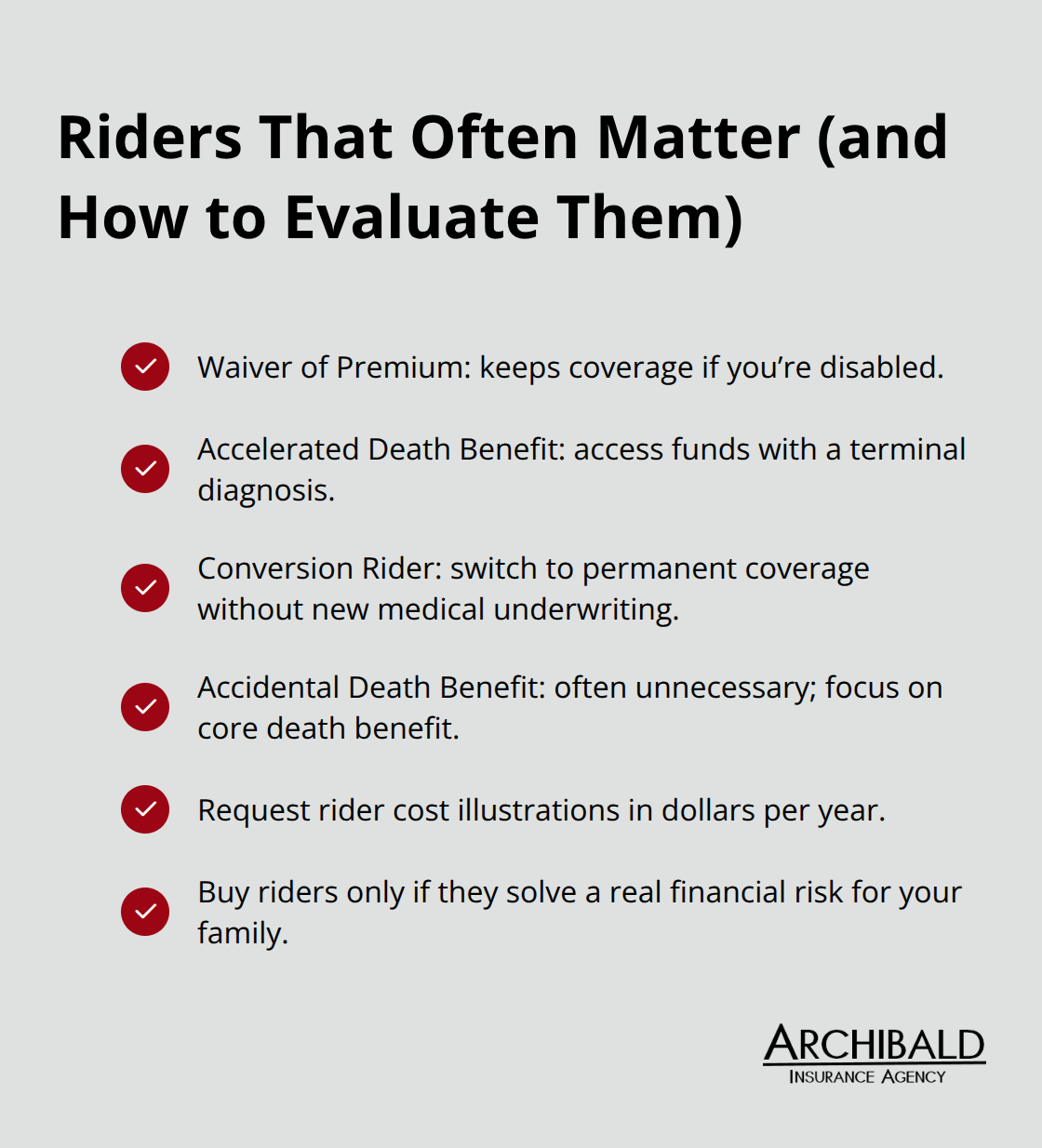
Request illustrations showing the exact annual cost of each rider you’re considering, then ask yourself whether that specific rider prevents a real financial problem in your situation.
What Independent Agents Offer That Captive Agents Cannot
An independent agent representing multiple carriers shows you how your specific circumstances affect pricing and coverage options across different companies, whereas captive agents represent only one insurer and have limited flexibility. An independent agent asks about your debts, your family’s timeline, your health status, and your comfort level with premium payments-then shows you specific numbers from actual carriers rather than theoretical scenarios. The right agent never pressures you toward permanent coverage or complex riders; instead, they show you options and explain the trade-offs clearly. If an agent dismisses your questions or pushes you toward a more expensive policy without addressing your stated concerns, that’s a sign to get a second opinion elsewhere.
Prepare Your Information Before Meeting with an Agent
Before meeting with any agent, gather your mortgage statement, recent pay stubs, list of outstanding debts, and any health conditions or medications you take. This information lets your agent request accurate quotes and explain precisely how each factor affects your price. You’ll receive better guidance when your agent understands your complete financial picture, because they can match you with carriers that offer favorable underwriting for your specific health profile. An agent who takes time to understand your situation provides far more value than one who quotes a single carrier or pushes a standard product. Start with adequate base coverage at a premium you can comfortably afford, then adjust as your life changes.
Final Thoughts
Life insurance in Utah doesn’t force you to choose between affordability and adequate protection. Term life delivers the coverage most families actually need at premiums that fit realistic budgets, while permanent options like whole life and universal life serve specific situations where lifetime protection and cash value growth align with your financial goals. Your health status, age, and timeline determine which policy type makes sense, but the core principle remains constant: match your coverage amount to your actual obligations rather than settling for whatever feels standard.
When you compare life insurance in Utah, you’re not just comparing premiums-you’re evaluating which carrier offers favorable underwriting for your specific situation and which policy features actually prevent real financial problems for your family. The difference between the cheapest and most expensive option for your profile can exceed $100 annually, which means requesting quotes from multiple carriers isn’t optional if you want genuine value. Verify any carrier through the Utah Insurance Department’s licensee lookup before committing, and ask each company specifically how your health history, smoking status, and other factors affect pricing.
An independent agent representing multiple carriers shows you how your circumstances affect options across different companies, rather than limiting you to one insurer’s products. We at Archibald Insurance Agency help Utah residents navigate these decisions by gathering your complete financial picture, explaining trade-offs clearly, and matching you with carriers that offer competitive rates for your health profile. Contact us today to discuss your coverage needs and receive personalized quotes that reflect your actual circumstances.
Disclaimer: The information provided in this blog is for general informational purposes only and does not constitute legal, financial, or insurance advice. Coverage options, terms, and availability may vary. Please consult with a licensed professional for advice specific to your situation


