

Life Insurance Options Utah: Choosing a Plan That Fits
Life insurance is one of the most important financial decisions you’ll make, yet many Utah residents put it off because the options feel overwhelming.
At Archibald Insurance Agency, we’ve helped thousands of families navigate life insurance options in Utah and find plans that actually match their needs and budgets. This guide breaks down the three main types of coverage, walks you through what to consider, and shows you how to move forward with confidence.
Three Life Insurance Types and How They Work
Term Life Insurance: Maximum Protection at Minimal Cost
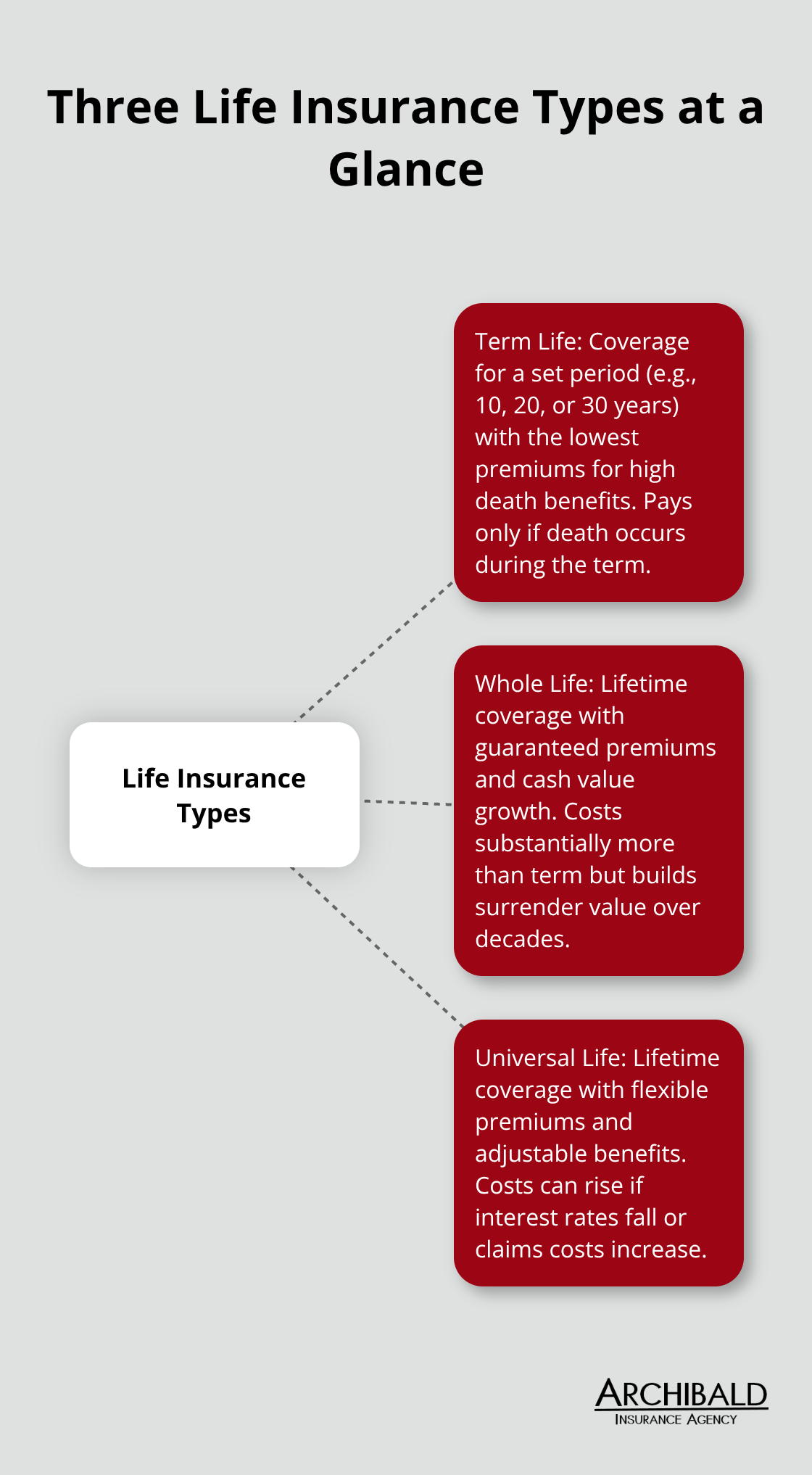
Term life insurance covers you for a set period-typically 10, 20, or 30 years-and pays a death benefit only if you die during that window. Term premiums have dropped significantly over the past decade as life expectancy data has improved, making term one of the cheapest ways to get substantial coverage. A 35-year-old in good health can lock in a 20-year term policy for $30 to $50 monthly for $500,000 in coverage. Once the term ends, coverage stops unless you renew, and renewal premiums jump dramatically. Some policies let you convert to permanent coverage before expiration, which matters if your health declines later.
Whole Life Insurance: Lifetime Coverage with Cash Value
Whole life insurance covers you for your entire lifetime and builds cash value you can access while alive. Premiums stay level throughout your life, which sounds stable but costs significantly more upfront-sometimes 10 to 15 times more than term. A 35-year-old paying $500 monthly for whole life gets the same $500,000 death benefit as someone paying $40 for term, but the whole life policy accumulates surrender value over decades. Your agent should explain how the policy builds value and what you can expect in future years.
Universal Life Insurance: Flexibility Between Term and Whole Life
Universal life sits between term and whole life: it offers lifetime coverage with more flexible premiums than whole life, though those premiums can increase if interest rates drop or claims costs rise. Ask your agent for a worst-case premium scenario so you know the maximum you’d pay to keep the policy active. This flexibility appeals to people who want options, though it also means your costs aren’t guaranteed to stay the same.
Which Type Fits Your Timeline
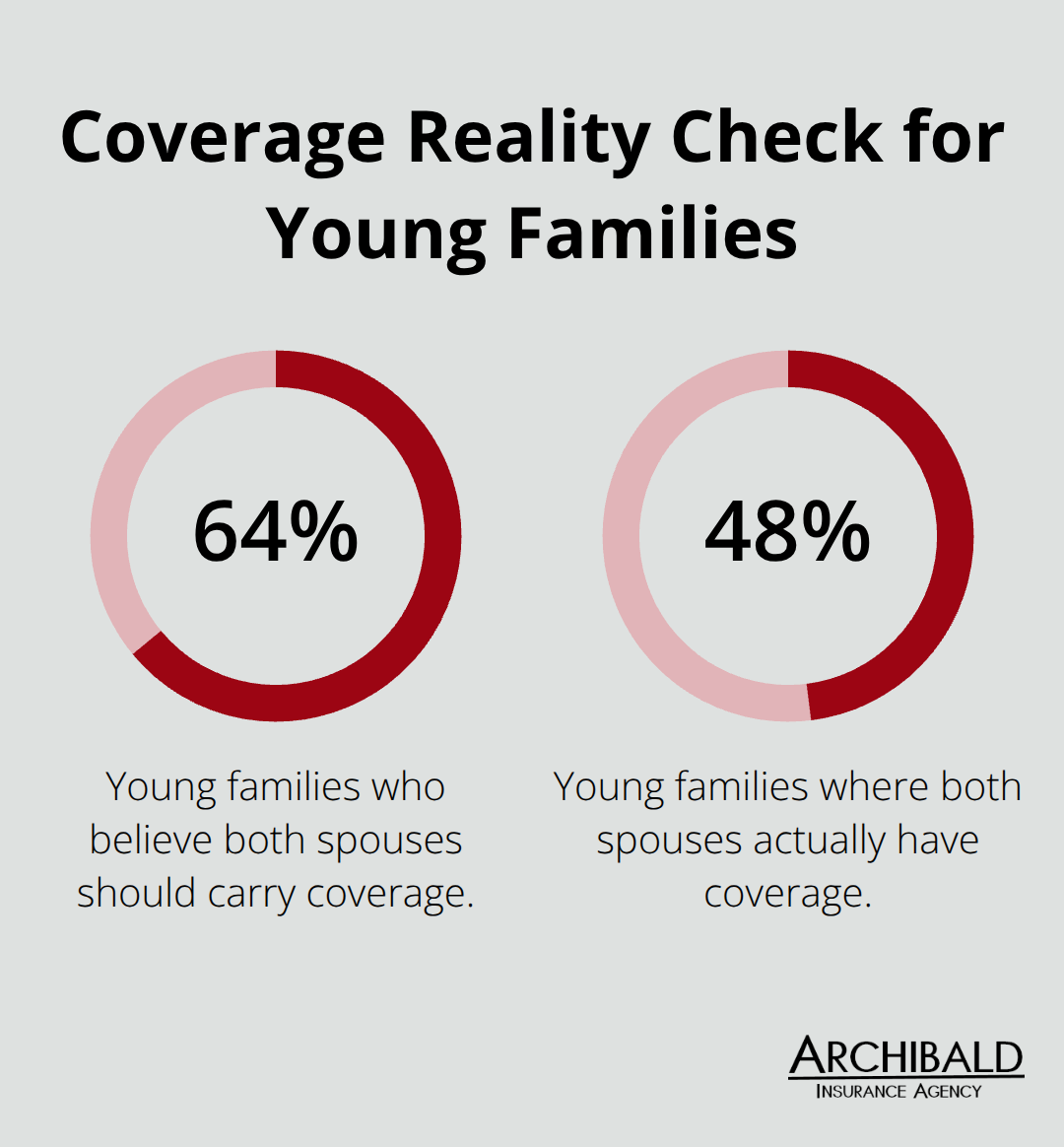
Young families with mortgages and dependents almost always benefit most from term. The math is blunt: term gives you maximum protection when your family needs it most at minimal cost. If you’re 30 with two kids and a $300,000 mortgage, a 30-year term policy costs far less than permanent coverage and expires when your kids finish college and your mortgage is paid. Established families or those concerned about estate taxes sometimes use permanent coverage, but that’s a different financial strategy altogether. Universal life appeals to people who want flexibility-you can skip payments in some years if cash flow tightens, though this erodes the policy’s value. The NAIC’s research shows that 64% of young families believe both spouses should carry coverage, yet only 48% actually do, usually because cost feels prohibitive. Term eliminates that excuse.
Moving Forward with Your Decision
The type of life insurance you choose depends on your age, family situation, and financial goals. Once you understand these three options, the next step involves assessing how much coverage your family actually needs and what your budget can support.
How Much Life Insurance Do You Actually Need
Calculate Your True Coverage Needs
Calculating your coverage needs starts with a cold, honest number: how much would your family need to survive if you died tomorrow. This isn’t theoretical. Start by adding up what your family depends on from your income annually, then multiply by the years until your kids finish college or your mortgage ends. If you earn $60,000 yearly and have 20 years until your youngest turns 22, you’re looking at roughly $1.2 million in coverage as a baseline.
Then factor in your mortgage balance, outstanding debts, funeral costs (typically $8,300 for burial and $6,280 for cremation), and any college savings gaps. A parent earning 70% of household income should carry significantly more coverage than a spouse earning 20%, yet many couples split coverage equally without thinking. Don’t ignore non-working spouses either-replacing childcare, housekeeping, and meal preparation costs real money if one spouse dies. The NAIC’s research shows 64% of young families believe both spouses should carry coverage, which reflects the actual financial reality of household operations.
Match Your Budget to Realistic Coverage
Your budget determines which type of coverage you can sustain, and this matters far more than picking the perfect product. A policy you abandon after three years protects nobody. If you can comfortably afford $50 monthly, a 20-year term policy for $500,000 to $750,000 makes sense. If $50 monthly strains your finances, drop to $30 and get $350,000 in coverage rather than overstretching into whole life.
Premiums increase with age and health changes, so locking in a term policy while you’re young and healthy is significantly cheaper than waiting. Ask your agent for the actual year-by-year premium schedule for any policy you’re considering, not just the first-year cost. Universal life policies can seem attractive because premiums appear flexible, but that flexibility cuts both ways-if interest rates fall or claims costs spike, your premium can jump substantially.
Understand the True Cost of Permanent Coverage
Whole life premiums never change, which sounds reassuring until you realize you’re paying 10 to 15 times more than term for the same death benefit. Riders like accidental death or waiver of premium add cost but rarely matter if you’re young and healthy. Focus on getting adequate base coverage first, then explore riders only if budget allows.
Once you’ve determined how much coverage you need and what you can afford to pay, the next step involves understanding the specific features and options available within each policy type-and how those features affect both your costs and your protection.
Getting Life Insurance in Utah
Find an Independent Agent Who Represents Multiple Carriers
Utah residents often feel confused about how to actually buy life insurance. The process becomes straightforward once you break it into three concrete steps: finding the right agent, gathering quotes, and completing the application.
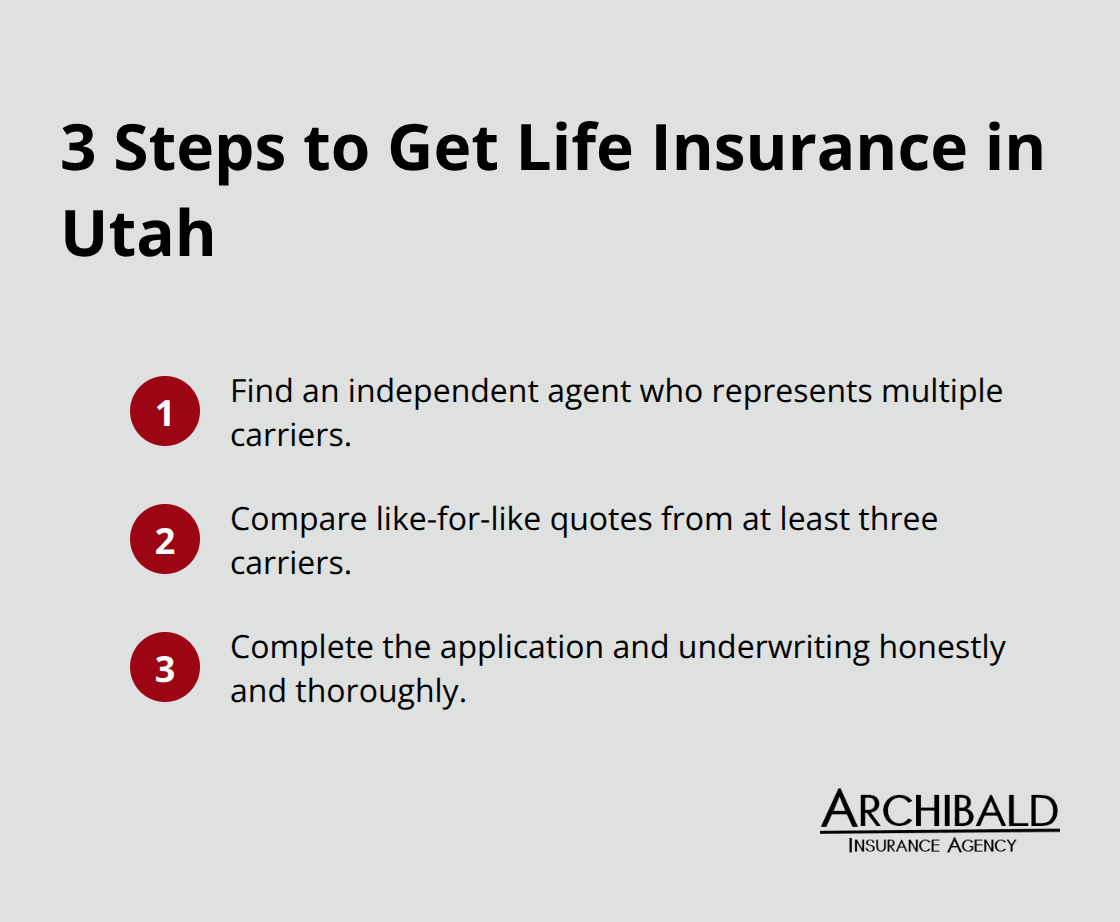
Start with an independent agent who represents multiple carriers rather than calling insurers directly or using online comparison sites that prioritize volume over accuracy. An independent agent in Utah has access to numerous different carriers, meaning they can match your health profile and budget to policies you’d never find on your own.
When you meet with an agent, bring your recent pay stubs, mortgage statement, and a list of any outstanding debts so they understand your full financial picture. This takes 15 minutes and eliminates vague recommendations. Ask your agent directly how they’re compensated-commissions are standard and built into premiums regardless of how you buy, so you never pay extra for agent help.
Compare Quotes from Multiple Carriers
Request quotes from at least three carriers for the same coverage amount and term length so you can compare apples to apples. Don’t just look at the first-year premium; ask for the guaranteed renewal rate at year 11 or 21 if you’re considering a 20 or 30-year term, because that number determines whether you can afford to keep coverage active later. This comparison reveals which carriers offer the best value for your specific situation rather than the lowest initial cost.
Complete the Application and Underwriting Process
Once you’ve selected a policy, the underwriting process begins and this is where honesty matters absolutely. Health questions on the application determine your rate class-Standard, Preferred, or Preferred Plus-and false statements can void your entire policy if discovered during a claim. Insurers in Utah verify tobacco use through medical records and nicotine tests, so claiming you’re smoke-free when you’re not creates a coverage problem later.
The underwriting timeline typically takes 2 to 4 weeks for standard cases; if you have health conditions, expect 6 to 8 weeks. Some carriers offer simplified issue policies with minimal medical questions, but these cost more and cap coverage at lower limits, making them useful only if you’re declining health or in a rush. Don’t cancel your current policy until your new one is fully approved and in force-this is the single biggest mistake people make. Your agent will provide a clear approval date so you know exactly when the new coverage is active.
Review Your Policy After Approval
Once approved, review your policy within the free look period, typically 10 to 30 days, to confirm beneficiary information is correct and personal details match your application. Verify that your beneficiary identifiers include Social Security numbers or tax IDs so the insurer can locate the right person when the time comes. This final step takes minutes but prevents serious problems for your family later.
Final Thoughts
Selecting life insurance comes down to three concrete decisions: choosing the right type for your timeline, calculating coverage that matches your family’s actual needs, and working with someone who understands Utah’s insurance landscape. Term life remains the smartest choice for most families because it delivers maximum protection when you need it most without straining your budget. The math is straightforward-a 35-year-old in good health locks in affordable coverage for decades, protecting dependents through their most vulnerable years. Your budget determines what you can sustain, and a policy you actually keep matters infinitely more than the perfect product you abandon.
Life insurance options in Utah have expanded significantly, giving you genuine choices rather than one-size-fits-all products. Start with adequate base coverage at a premium you can comfortably afford, then adjust as your life changes. Review your policy every few years to account for inflation and shifting family circumstances, especially after major life events like marriage, children, or mortgage payoff. The challenge isn’t finding coverage-it’s finding the right coverage for your specific situation.
This is where professional guidance makes a real difference. We at Archibald Insurance Agency represent multiple carriers, meaning we match your health profile and budget to policies tailored to your needs rather than pushing what’s easiest to sell. Contact an independent agent, bring your financial details, and get quotes from multiple carriers-the younger and healthier you are, the lower your premiums lock in.
Disclaimer: The information provided in this blog is for general informational purposes only and does not constitute legal, financial, or insurance advice. Coverage options, terms, and availability may vary. Please consult with a licensed professional for advice specific to your situation


