Term vs Whole Life Insurance Which is Right for You?

Choosing between term and whole life insurance is one of the biggest decisions you’ll make for your family’s financial security. The right policy depends on your budget, timeline, and long-term goals.

At Archibald Insurance Agency, we help Utah families navigate this choice with clarity. Let’s break down what each option offers so you can make an informed decision.

Understanding Term Life Insurance

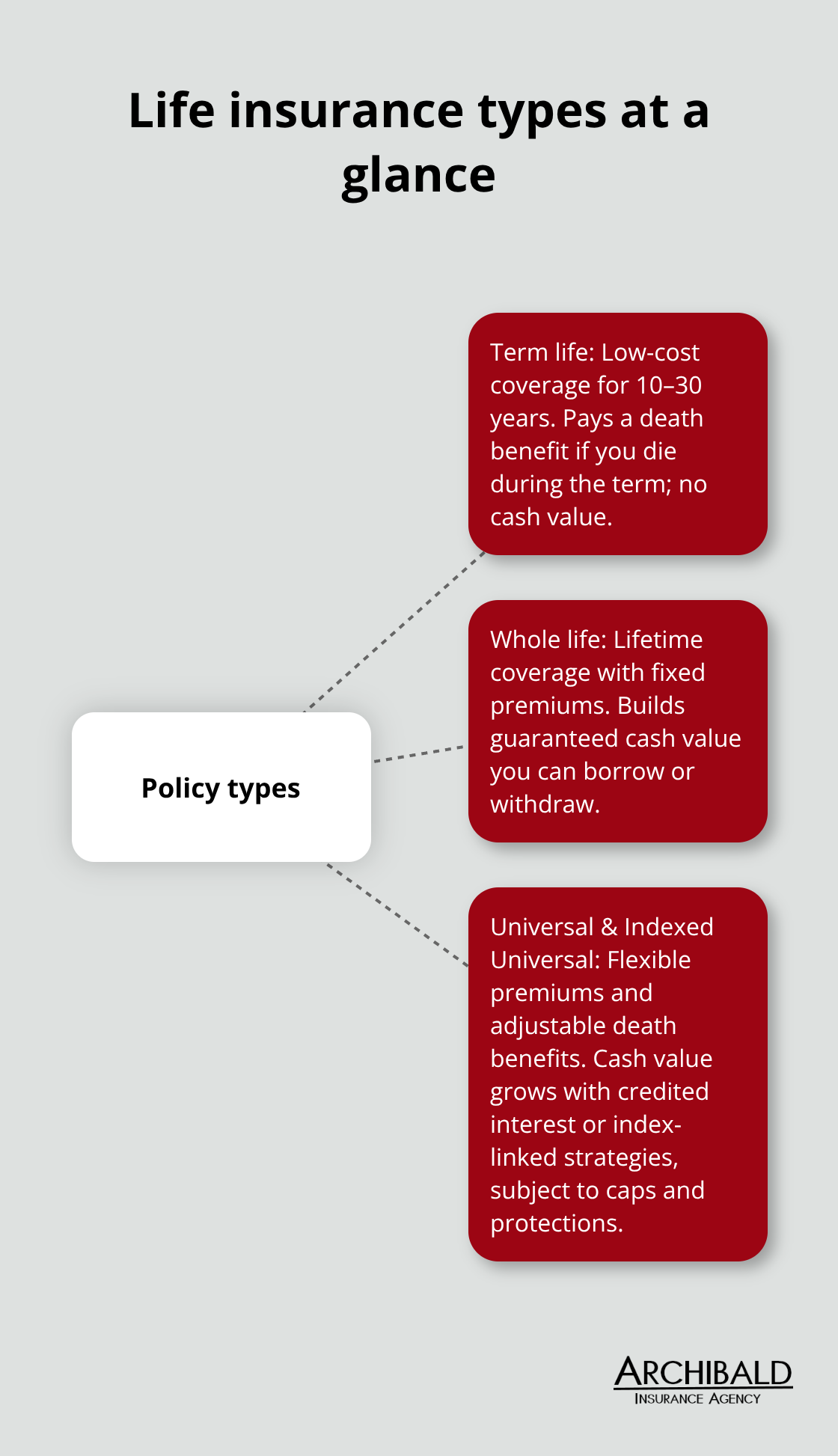
Term life insurance provides straightforward protection: you pay a monthly or annual premium, and if you pass away during the policy term, your beneficiaries receive the death benefit. No cash value exists, no investment component complicates the picture, and no hidden layers obscure what you’re buying. You purchase pure protection for a defined period. In Utah, the average life insurance premium sits around $636 per year, though term policies typically cost significantly less than permanent alternatives. For a 45-year-old man seeking $1 million in coverage, a 20-year term policy costs approximately $1,830 annually, while a 30-year term runs about $3,308 per year. Women in the same age group pay less due to longer life expectancy-20-year terms around $1,420 and 30-year terms near $2,340. These numbers matter because affordability determines whether families actually maintain coverage or let policies lapse.

What Term Life Insurance Covers

Term policies protect your family with a straightforward death benefit. If you pass away during the coverage period, your beneficiaries receive the full amount tax-free. This money helps cover funeral costs, outstanding debts, mortgage payments, and lost income. The policy offers nothing more and nothing less-pure financial protection without the complexity of investment accounts or cash accumulation.

Selecting Your Coverage Window

Term lengths typically range from 10 to 40 years, and the most popular choice among Americans is the 20-year level term, representing about 39% of all term policies purchased according to LIMRA data. A 30-year term captures another 18% of the market, making these two options the dominant choices for families. The 20-year term aligns perfectly with the period when most families face their heaviest financial obligations: young children still at home, mortgages with decades remaining, and earning years ahead.

Share of term life policies by term length in the U.S. - term vs whole life insurance

A mother with two young children might select a 20-year term that expires when her youngest turns 21, providing protection during the critical years when dependents need financial support.

Flexibility Through Conversion

Some term policies offer a return of premium feature, allowing you to recover all paid premiums if you outlive the term, though this option increases your annual cost. Conversion options matter enormously. Many term policies allow you to convert to permanent coverage during a specified conversion window, even if your health changes. This flexibility means you avoid being locked into a decision made years ago when circumstances were different. A single father with a term policy might convert to provide for a new spouse if life circumstances shift unexpectedly.

Affordability That Families Can Maintain

Term life remains the most accessible way to protect your family on a budget. Lower premiums mean families can afford higher death benefits without straining monthly finances. This affordability factor directly impacts whether protection stays in place or lapses when money gets tight. As your situation evolves-children grow older, debts shrink, retirement approaches-you may find that your insurance needs change. Understanding what term life offers sets the stage for comparing it against permanent options that work differently and cost substantially more.

Understanding Whole Life Insurance

Whole life insurance operates on a fundamentally different principle than term: it lasts your entire lifetime, not just a set number of years. You pay a fixed premium each month or year, and that premium never changes regardless of age or health changes down the road. The policy guarantees a death benefit payout whenever you pass away, whether that’s in 5 years or 50 years. For a 45-year-old man seeking $1 million in coverage, whole life costs approximately $21,360 annually according to Wealth Enhancement Group data, compared to $1,830 for a 20-year term. A 45-year-old woman pays around $17,610 yearly for the same whole life coverage versus $1,420 for term. These numbers reveal the real trade-off: permanent protection comes at a steep price.

Quick comparison of annual premiums for $1M coverage at age 45, men and women, term vs whole life. - term vs whole life insurance

Lifetime Coverage and Death Benefits

Whole life policies guarantee a death benefit payout whenever you pass away. This permanence distinguishes whole life from term insurance, which expires after a set period. Your beneficiaries receive the full death benefit tax-free, regardless of when you die. The policy never lapses as long as you pay premiums, eliminating the risk that coverage ends before you do.

Cash Value Component

Beyond the death benefit, whole life policies accumulate cash value over time. This cash value grows at a guaranteed rate set by the insurance company, and you can borrow against it tax-free during your lifetime. If you withdraw funds beyond what you’ve paid in premiums, those excess withdrawals get taxed as ordinary income. Some whole life policies pay dividends based on company profits, though dividends aren’t guaranteed. The cash value component creates a secondary benefit beyond pure protection, functioning as a forced savings account that grows regardless of market conditions.

When Whole Life Makes Financial Sense

Whole life works best when you need permanent protection that outlasts your working years and you want predictability in both premiums and benefits. A spouse relying on your income for life, a child with special needs requiring lifelong support, or estate planning objectives like covering potential estate taxes all favor whole life’s permanence. The policy’s cash value provides a genuine advantage here: you can access funds for retirement supplementation, education expenses, or emergency needs without canceling the policy entirely. Accelerated benefits in some whole life policies can also provide funds during your lifetime if you face terminal or chronic illness, turning the policy into a multi-purpose financial tool rather than purely a death benefit vehicle.

Hub-and-spoke diagram of scenarios where whole life insurance is appropriate.

The Premium Reality

However, the high premiums mean you’ll likely afford less total coverage than with term insurance. If your primary goal is replacing income for dependents until they become independent, term life delivers far superior value per dollar spent. Whole life shines for long-term obligations and estate planning, not for temporary income replacement needs. The decision hinges on whether your insurance need is permanent or temporary, and whether you value cash value growth enough to justify premiums that can exceed term costs by 1,000 percent.

Understanding these two distinct approaches sets the stage for comparing them directly. The choice between term and whole life depends on your specific situation, timeline, and financial priorities-factors we’ll examine in the next section.

Key Differences and How to Choose

Coverage Duration Reveals Your True Need

Term and whole life diverge sharply in how they work financially, and understanding these differences reveals which policy actually serves your circumstances. The core distinction isn’t philosophical-it’s mathematical. Term life delivers maximum death benefit for your premium dollar in the early years when your family faces the heaviest financial pressure. A 45-year-old man pays $1,830 annually for $1 million in 20-year term coverage; that same $1,830 buys roughly $85,000 in whole life death benefit according to Wealth Enhancement Group data. The gap widens with age and desired coverage amount.

If you’re protecting a family through your peak earning years while children attend school and your mortgage dominates your finances, term life’s affordability allows you to purchase adequate protection without financial strain. Whole life makes sense only when you’ve determined that your insurance need extends beyond a specific timeframe. A surviving spouse who won’t remarry and depends entirely on your income for life, a child with special needs requiring permanent support, or significant estate taxes that will exist whenever you die-these situations favor permanent coverage.

The Conversion Bridge

The conversion feature bridges both worlds effectively. Many term policies allow conversion to permanent coverage during a set window, typically 10 to 15 years. This flexibility means you can lock in today’s health at current rates while maintaining the option to extend protection if circumstances change. If you convert at age 55 after your children finish college, the conversion preserves your insurability even if new health issues emerge, avoiding the higher premiums or denial that comes with applying fresh for permanent coverage.

Cost Compounds Over Decades

Cost compounds dramatically over decades, making this the practical decision point. Maintaining a $1 million whole life policy from age 45 to 85 costs approximately $1.068 million in premiums for a man, versus roughly $36,600 for a 20-year term that expires at 65. If your need actually ends when you retire with paid-off debts and adequate savings, you’ve overpaid substantially for coverage you no longer need. Conversely, if you let a term policy lapse at 65 when you still need protection, you face either paying vastly higher premiums to renew or losing coverage entirely.

Assess Your Timeline Honestly

The solution requires honest assessment of your actual timeline. When will your children become financially independent? When will your mortgage be paid? When will you have accumulated sufficient retirement savings that your family won’t need income replacement? These answers determine whether you need 20, 30, or 40 years of protection. If your analysis shows protection needs persisting beyond a reasonable term length, converting partway through or purchasing whole life for those extended years costs far less than whole life from the start.

The Practical Utah Approach

Utah families balancing mortgages, education costs, and retirement savings typically benefit from term insurance during their working years, then reassessing at 55 or 60 whether permanent coverage makes financial sense for remaining obligations. This practical approach avoids both the trap of underinsurance and the waste of overpaying for permanent protection you’ll never need.

Final Thoughts

Term versus whole life insurance represents a fundamental choice about how you protect your family’s financial future. Term life delivers affordability and straightforward protection during your peak earning years when dependents rely on your income most heavily, while whole life provides permanence and cash value growth for situations where your insurance need extends throughout your lifetime. The correct choice depends entirely on your timeline, financial obligations, and long-term goals-neither option is universally right or wrong.

Start by identifying when your insurance need actually ends. If you’re protecting young children until they finish college, covering a mortgage that will be paid off in 20 years, or replacing income until retirement, term insurance provides the coverage you need at a price your budget can sustain. If you’re concerned about permanent obligations like a spouse’s lifetime income needs, a child with special needs, or estate taxes that will exist whenever you pass away, whole life’s permanence justifies the higher cost. Many Utah families find that a combination approach works best: term insurance for defined obligations paired with whole life for longer-term needs that persist beyond your working years.

Contact Archibald Insurance Agency today to explore term vs whole life insurance options tailored to your specific situation. As an independent agency representing multiple insurance carriers, we compare coverage across different companies to find protection that fits both your needs and your budget. Our team takes time to understand your family’s timeline, financial obligations, and goals before recommending a policy.

General Liability Insurance for Small Businesses Explained

One accident on your business property can cost thousands in medical bills, legal fees, and settlements. General liability insurance for small businesses protects you from these financial disasters.

At Archibald Insurance Agency, we help Utah business owners understand why this coverage matters and how to get the right protection for their specific needs.

What General Liability Insurance Actually Covers

The Core Protection Your Business Needs

One accident on your business property can cost thousands in medical bills, legal fees, and settlements. General liability insurance protects your business when someone gets hurt on your property or your business operations damage someone else’s property. This coverage pays for medical bills if a customer slips and falls in your store, covers legal defense costs if you’re sued, and handles settlement payments if you lose a case. The U.S. Bureau of Labor Statistics reported non-fatal workplace injuries in Utah during 2022, many of which could trigger liability claims against businesses. A typical slip-and-fall claim costs around $20,000, but legal fees can push total costs above $100,000 if the case goes to court.

What Your Policy Actually Covers

Your policy covers bodily injury claims, property damage liability, and personal injury claims like libel or slander related to your business. Medical payments coverage under your policy pays for minor injuries on your premises without requiring the injured person to file a lawsuit, which often prevents small incidents from becoming expensive claims. This coverage is separate from workers’ compensation, which only covers your employees.

Overview of general liability coverage and exclusions for U.S. small businesses

The most common GL claims involve slips, trips, and falls, accounting for over 30% of all claims, so premises safety directly impacts your risk profile and potential premiums.

Critical Coverage Gaps You Must Know

What general liability doesn’t cover matters just as much as what it does. The 2025 Hiscox Underinsurance in Small Business Report found that 74% of small business owners misunderstand what general liability actually protects. Many owners mistakenly believe GL covers fires or floods on their owned property, theft of their own equipment, or professional mistakes like missed deadlines. These gaps require separate policies like commercial property insurance, cyber liability, or professional liability coverage.

Industry and Operation-Specific Risks

If you operate from a home-based office, verify that your coverage extends to those operations. If you use vehicles for business, personal auto insurance won’t cover you, so you need commercial auto coverage or hire and non-owned auto coverage added to your policy. Industry-specific risks demand different limits: a contractor handling heavy equipment faces higher exposure than a consulting firm, so don’t assume standard limits protect you adequately. Understanding your exact business operations helps you identify which coverage gaps pose the greatest threat to your financial stability.

Why Your Business Needs General Liability Coverage

The Real Cost of Operating Without Coverage

General liability insurance isn’t optional for Utah small businesses-it’s the foundation that keeps financial disasters from destroying what you’ve built. Without it, a single incident drains your cash reserves, damages your credit, and forces you to close. A slip-and-fall on your premises can result in significant medical and legal costs that come directly from your pocket if you lack coverage.

Meeting Contract and Lease Requirements

Your clients and landlords won’t wait for you to figure this out. Most commercial leases require proof of general liability before you occupy the space, and clients demand a certificate of insurance before signing contracts. Without it, you simply don’t get the job. Insurance carriers recognize this reality: they’ve priced general liability premiums at around $45 per month for small Utah businesses, making it one of the cheapest protections you can buy relative to the risk it covers.

Building Professional Credibility

General liability coverage signals to customers and partners that you operate professionally and responsibly. When you produce a certificate of insurance on demand, you demonstrate financial stability and accountability that builds trust immediately. This matters especially if you’re competing for larger contracts or working with established companies that vet their vendors carefully. The cost of not having coverage isn’t just the potential claim itself-it’s the lost business opportunities, the damaged reputation when you can’t meet requirements, and the stress of operating without a safety net.

Choosing the Right Coverage Limits

Different industries face different exposures, so your coverage limits should match your actual operations, not just the minimum that sounds affordable. A contractor handling heavy equipment needs higher limits than a consulting firm. A retailer with high foot traffic faces greater slip-and-fall exposure than a home-based service provider. Understanding your specific risk profile helps you select limits that truly protect your business.

Moving Forward with Protection

Once you understand why coverage matters, the next step involves assessing your industry-specific risks and determining the adequate limits for your situation. This process ensures you carry protection that matches your actual exposure rather than guessing at what you need.

How to Choose the Right Coverage for Your Business

Start With Your Actual Risk Profile

Start with your industry’s real risk profile, not generic minimums. A florist operating from a retail location faces different exposures than a contractor using heavy equipment on job sites. The 2025 Hiscox Underinsurance in Small Business Report found that 77% of small businesses carry insufficient coverage, often because owners guess at limits rather than assess real risk. Document what your business does daily: Do customers visit your premises? Do you handle products that could cause injury? Do you operate vehicles for business? Do you work from a home office? Each answer shapes your coverage needs.

Construction businesses typically pay $1,500 to $5,000 annually for general liability, while consulting firms pay $300 to $700, reflecting genuine risk differences. Location matters too-a retail location has different exposure than the same business in another area.

Cost ranges for general liability insurance among U.S. small businesses - general liability insurance for small business

Determine Coverage Limits That Match Your Growth

Once you identify your actual operations, standard limits become obvious. Most contracts require $1 million per occurrence and $2 million aggregate, but your specific assets and revenue growth may demand higher limits. The 2025 Hiscox report shows 62% of small businesses have grown revenue by 20% or more in the past two years. If you fall into that group, your coverage limits from two years ago no longer reflect your real exposure.

Key percentages influencing small business liability coverage decisions - general liability insurance for small business

Higher revenue means more customers, more transactions, and more potential claims. Assess whether your current limits protect your actual asset value and income level. An umbrella policy provides an extra layer of liability protection by covering costs that go beyond your other liability coverage limits.

Compare Quotes Across Multiple Carriers

Shopping for quotes reveals massive price variations that justify the effort. Carriers charge differently based on industry classification, claims history, safety practices, and risk assessment. Getting quotes from multiple carriers prevents you from overpaying by hundreds of dollars annually.

Some carriers offer bundled policies that combine general liability with commercial property coverage at 10% to 15% savings compared to separate policies, while others focus on specific industries. When comparing quotes, scrutinize what’s actually covered and what’s excluded-an unusually cheap quote often hides exclusions that leave you underinsured for your specific risks.

Leverage Safety Improvements for Lower Premiums

Ask carriers about discounts for safety improvements like better lighting, security upgrades, or formal safety training programs. Many insurers reduce premiums for businesses with documented safety procedures and ongoing training. These investments pay for themselves through lower insurance costs while simultaneously reducing your actual injury risk.

Small businesses can obtain certificates of insurance immediately after purchasing, which you’ll need for contracts and leases. Review your coverage every two years or whenever your business size changes significantly, since static policies don’t account for growth, new equipment, expanded operations, or changed client bases.

Final Thoughts

General liability insurance for small businesses protects your assets, satisfies contract requirements, and keeps your operation running when accidents happen. Without coverage, a single incident drains your cash reserves and forces closure; with it, you transfer that financial risk to an insurer and focus on growth instead of lawsuits. Most Utah small businesses pay around $45 monthly for this protection, making it affordable relative to the catastrophic costs it prevents.

Assess your actual business operations, identify your industry-specific risks, and determine what coverage limits match your real exposure rather than guessing at minimums. Get quotes from multiple carriers to find competitive rates that fit your budget, then obtain your certificate of insurance immediately so you’re ready for contracts and leases. The team at Archibald Insurance Agency understands Utah small businesses and can help you navigate these decisions by comparing options across multiple insurers to find coverage that fits your specific needs.

Review your coverage every two years or whenever your business changes significantly, since growth, new equipment, expanded operations, or different client bases all shift your risk profile. Static policies don’t account for business evolution, so regular attention keeps your protection aligned with reality and prevents the underinsurance problem that affects 77% of small businesses today. This ongoing approach ensures your general liability insurance for small business stays relevant as your operation develops.

Life Insurance Policies Without Medical Exams

Getting approved for life insurance doesn’t always require a medical exam. At Archibald Insurance Agency, we help Utah residents understand how life insurance policies without medical exams work and whether they fit your situation.

No-exam policies offer speed and simplicity, but they come with trade-offs you should know about. This guide walks you through your options so you can make an informed decision.

How No-Exam Life Insurance Actually Gets Approved

Underwriting Without Medical Tests

No-exam life insurance skips the doctor’s visit, but underwriters still evaluate your health-they just do it differently. Instead of ordering blood work and EKGs, insurers pull information from prescription databases, medical records they can access with your permission, and your answers to a health questionnaire. This approach works because most people applying for no-exam coverage fall into lower risk categories or seek smaller benefit amounts. The underwriting relies on third-party data like your prescription history and answers to health questions rather than medical lab results.

For example, a 35-year-old applying for $500,000 in term coverage receives a decision within days. The insurer reviews whether you take medications for serious conditions, checks your driving history for risky behavior, and confirms basic health facts through your application. Banner Life offers no-exam options across all 50 states and approves qualifying applicants quickly using this streamlined approach. The speed matters because some people need coverage urgently-whether for mortgage protection, income replacement, or to cover final expenses-and waiting weeks for medical test results isn’t realistic.

Quick comparison of accelerated underwriting, simplified issue, guaranteed issue, and traditional underwriting.

Speed Varies by Product Type

The approval timeline for no-exam policies ranges from same-day decisions to one or two weeks, depending on the product type. Accelerated underwriting streamlines the life insurance application by using data to assess risk, often removing the need for a medical exam. Legal & General America offers instant-decision options for people in their 20s and 30s, making this approach particularly attractive for younger buyers. Simplified issue policies take slightly longer because they collect less health information upfront, so underwriters need more time to assess risk.

Guaranteed issue policies approve everyone regardless of health, but they come with tight coverage limits-usually around $25,000-making them suitable only for funeral expenses rather than income replacement. The real trade-off isn’t speed versus safety; it’s speed versus lower premiums and higher coverage limits.

Pricing and Coverage Trade-Offs

A healthy 35-year-old nonsmoker pays roughly $25.76 monthly for a $500,000 20-year term policy, according to Policygenius data. Simplified issue policies typically cost more because insurers collect less data and set lower maximum coverage amounts. If you’re in good health and willing to answer detailed health questions, accelerated underwriting gives you speed without sacrificing rates.

If you have pre-existing conditions or prefer not to share extensive medical history, simplified or guaranteed issue becomes your option (though expect higher premiums and lower coverage ceilings). The choice depends on your health status, urgency, and how much coverage you actually need. Understanding these three product types helps you identify which one aligns with your situation before you move forward with an application.

Which No-Exam Product Fits Your Situation

Three Products, Three Different Approaches

No-exam life insurance comes in three distinct types, and selecting the wrong one wastes money or leaves you underinsured. Guaranteed issue policies accept everyone but cap coverage around $25,000, making them suitable only for funeral costs. Simplified issue skips the medical exam but asks shorter health questions and typically limits coverage to $1 million or less, with premiums running higher than fully underwritten policies because insurers have less data to assess risk. Accelerated underwriting uses algorithms and third-party data to speed decisions for healthier applicants, often delivering same-day approvals and competitive rates that rival traditional underwriting.

Who Qualifies for Each Type

The real difference lies in who qualifies and what you’ll actually pay. If you’re under 50 and in decent health, accelerated underwriting delivers the best combination of speed and cost. If you have pre-existing conditions like controlled diabetes or depression, simplified issue becomes practical because you avoid the medical exam entirely while still accessing meaningful coverage amounts. Lincoln Financial stands out for underwriting people with pre-existing conditions and offers no-exam options for conditions that would normally trigger closer scrutiny. Guaranteed issue makes sense only if you’ve exhausted other paths or need quick coverage for final expenses.

Pricing Differences Between Products

A healthy 35-year-old nonsmoker pays roughly $25.76 monthly for a $500,000 20-year term policy through accelerated underwriting, but simplified issue policies for the same person typically run 30 to 50 percent higher. Guaranteed issue at $25,000 coverage starts around $9.95 monthly, but that low price reflects the tiny benefit amount.

Percentage range showing simplified issue premiums versus accelerated underwriting for the same applicant. - life insurance policies without medical exams

Pacific Life offers up to $3 million without medical exams for ages 18-60, which matters if you’re in decent health. Nationwide Life Essentials provides instant approval up to $1.5 million for qualified applicants using accelerated underwriting.

Speed and Your Decision Factors

The timing question matters too: guaranteed issue approves instantly with zero health questions, simplified issue takes one to two weeks, and accelerated underwriting usually completes within days. Your choice depends on three factors: your current health status, how much coverage you actually need, and whether you can wait a week or two for approval. If you’re healthy, accelerated underwriting wins every time. If you have health concerns or limited funds for premiums, simplified issue beats guaranteed issue because you access real coverage amounts instead of funeral-only limits.

Hub-and-spoke map connecting applicant profiles to the best no-exam life insurance option. - life insurance policies without medical exams

Once you identify which product type matches your situation, the next step involves evaluating specific carriers and comparing quotes to lock in the best rate for your circumstances.

Who Really Benefits from No-Exam Life Insurance

Young Adults Get the Best Rates

No-exam policies work best for specific situations, and applying for one when traditional underwriting makes more sense costs you money. If you’re under 50, in good health, and need coverage within days rather than weeks, accelerated underwriting delivers the strongest outcome. You’ll access competitive rates comparable to fully underwritten policies while avoiding medical exams and lab work. Young adults in their 20s and 30s particularly benefit here-a 30-year-old nonsmoker in Utah pays around $9 to $12 monthly for a $250,000 term policy through no-exam programs, according to pricing data from Insuranceopedia. That’s dramatically cheaper than other life stages and makes accelerated underwriting the obvious choice for this demographic.

Pre-Existing Conditions and Smokers Find Relief

If you have pre-existing conditions like controlled diabetes, depression, or heart disease, simplified issue or guaranteed issue policies remove the barrier of extensive medical scrutiny. Lincoln Financial specifically underwriters people with these conditions favorably and offers no-exam options for situations that would normally trigger additional investigation. Smokers also benefit from no-exam paths because some carriers avoid charging smoker rates when they skip medical exams entirely. Mutual of Omaha’s guaranteed-issue and simplified-issue policies require no medical exam or only limited health questions, making them practical for smokers who face higher premiums through traditional underwriting.

When No-Exam Policies Fall Short

The real weakness of no-exam policies emerges when you need substantial coverage or have limited budget flexibility. Guaranteed issue caps out around $25,000, which only covers funeral costs and final medical bills-not income replacement for a family depending on your paycheck. If you earn $75,000 annually, financial experts recommend carrying 10 to 20 times your salary in coverage, meaning $750,000 to $1.5 million. Simplified issue policies max out around $1 million and cost 30 to 50 percent more than accelerated underwriting for the same person. A healthy 35-year-old nonsmoker pays $25.76 monthly through accelerated underwriting but significantly more through simplified issue, making the premium difference substantial over a 20 or 30-year term.

Traditional Underwriting Wins for Large Coverage Amounts

Traditional underwriting becomes the better choice when you need $2 million or more in coverage, have stable health history, and can wait two to four weeks for approval. You’ll lock in lower rates and access unlimited coverage amounts that actually protect your family’s financial security rather than just cover final expenses. Evaluate your actual coverage need first, then select the policy type that delivers that amount at the lowest cost-not simply choosing no-exam because it sounds faster.

Final Thoughts

No-exam life insurance policies without medical exams work best when you match the product type to your actual situation rather than choosing based on speed alone. Accelerated underwriting delivers competitive rates and quick approvals for healthy applicants under 50, while simplified issue serves people with pre-existing conditions who want to avoid extensive medical scrutiny. Guaranteed issue removes all health barriers but limits coverage to funeral expenses around $25,000, leaving your family severely underprotected if you’re the primary earner.

Start by calculating your real coverage need-financial experts recommend carrying 10 to 20 times your annual salary in life insurance. A healthy 35-year-old nonsmoker pays roughly $25.76 monthly for $500,000 in 20-year term coverage through accelerated underwriting, which provides meaningful protection at an affordable rate. Compare what you actually need against what each product type delivers, then evaluate whether the premium difference justifies choosing a more expensive option with lower coverage limits.

We at Archibald Insurance Agency help Utah residents navigate these decisions by representing multiple carriers and comparing quotes across different product types. Our team assesses your health status, coverage goals, and budget to identify whether accelerated underwriting, simplified issue, or guaranteed issue makes sense for your situation. Contact Archibald Insurance Agency to discuss your options and receive personalized recommendations based on your specific needs.

How Much Life Insurance Do I Really Need?

Most people guess when it comes to life insurance coverage. They pick a number that sounds reasonable and hope it’s enough.

At Archibald Insurance Agency, we see this mistake constantly. The truth is that how much life insurance you need depends on your specific financial situation, not on what your neighbor carries or what an online calculator suggests.

This guide walks you through the real factors that determine your coverage amount and shows you how to calculate a number that actually protects your family.

What Actually Drives Your Coverage Need

Your life insurance needs rest on hard numbers, not assumptions. Start with what you actually earn and what your family would lose if you died tomorrow. If you bring in $75,000 annually and your spouse stays home with two children, your family loses that entire income stream plus the childcare services you implicitly provide. The National Association of Insurance Commissioners recommends calculating how many years your dependents would need that income replaced. For a 35-year-old with a 30-year mortgage and children in grade school, you’re likely looking at 25 to 30 years of income replacement. That’s not a guess-that’s a calculation based on your actual timeline.

Your existing debts matter just as much. A $300,000 mortgage doesn’t disappear when you do. Neither do credit card balances, car loans, or student debt. These obligations would fall to your estate or surviving family members, consuming a portion of any life insurance payout. Include every debt when you calculate coverage, not just the mortgage.

Hub-and-spoke visual showing the core factors that determine life insurance coverage needs. - how much life insurance do i need

The Real Cost of Raising Children

Education costs climb faster than inflation. Based on U.S. Department of Agriculture estimates, raising a child to age 17 could cost anywhere from $241,106 to $513,722, and that doesn’t include college. If you have two children and want to fund four years of in-state university tuition, you add $80,000 to $120,000 to your coverage need. A 45-year-old parent with a $150,000 group life policy at work, a $100,000 mortgage, $25,000 in other debts, $120,000 in college costs, $20,000 for funeral expenses, and $40,000 in savings actually needs approximately $1.2 million in coverage after subtracting what they already have and their savings. That’s the real math.

Many people underestimate this number because they forget that a surviving parent would need to hire childcare, maintain the home, and cover all household expenses on a single income or reduced income. These aren’t theoretical costs-they’re monthly bills that don’t stop.

How Your Situation Changes Everything

A single-income household with one working parent needs vastly different coverage than a dual-income household where both spouses earn similar amounts. If both spouses earn $60,000 and both work, you need coverage for each person based on their individual income loss, not just one income stream. Many families make the mistake of insuring only the higher earner.

A stay-at-home parent also needs coverage because replacing their unpaid work-childcare, cooking, cleaning, household management-costs real money. Estimate what you’d pay to hire someone to do these tasks full-time and include that in your calculation.

Age and Timeline Shape Your Need

Your age and the ages of your dependents matter significantly. A 30-year-old with young children needs more coverage than a 55-year-old whose kids are graduating college. The younger you are, the longer your family would need that income replacement, so your coverage need is higher. Once your children finish school and your mortgage declines, your coverage need decreases substantially.

These calculations reveal why a one-size-fits-all approach fails. Your specific circumstances-income level, family structure, debts, and timeline-determine the actual protection your family needs. The next section explores how different households translate these factors into specific coverage amounts.

What Coverage Amount Actually Works

The Ten-Times Rule Falls Short

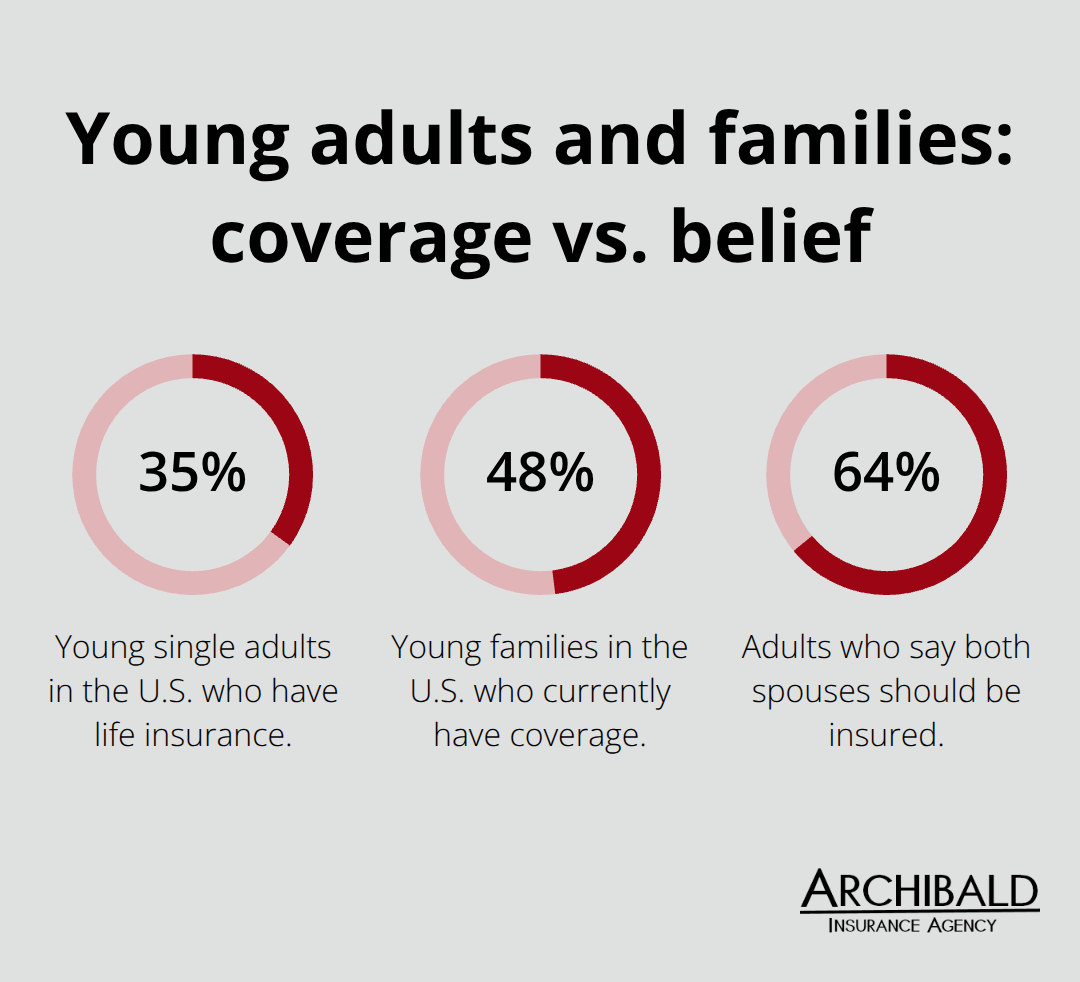
The ten-times-income rule floats around everywhere, and it’s dangerously incomplete. A 40-year-old earning $80,000 annually would get $800,000 in coverage using that formula, but if they have two children, a mortgage, and college plans, they’re severely underinsured. The real coverage amounts that work depend on what you’re actually trying to protect. The National Association of Insurance Commissioners found that only about 35 percent of young singles carry life insurance at all, and many who do have no idea whether their coverage matches their obligations.

Percentage chart highlighting key figures mentioned in the article. - how much life insurance do i need

Single-Income Households Need Substantial Protection

For single-income households where one spouse works and the other manages the home and children, the working spouse needs coverage that replaces their income for at least 20 to 30 years, depending on the youngest child’s age. Add in the mortgage, debts, college costs, and funeral expenses, and most single-income families need substantial protection. A practical example: a 35-year-old earning $65,000 with a $200,000 mortgage, two children ages 8 and 11, $15,000 in car loans, and plans to fund college typically needs around $900,000 to $1.1 million in total coverage. If they already have a $150,000 group policy through their employer, they should buy an additional $750,000 to $950,000 in personal coverage.

Dual-Income Families Face Different Calculations

Dual-income households face a different calculation because both spouses generate income that the family depends on. If both spouses earn $70,000 each, losing either income stream creates a financial crisis. Each spouse needs individual coverage based on their own income replacement need, not a combined household number. A couple where both earn $70,000, have one child, a $250,000 mortgage, and combined debts of $30,000 typically needs substantial individual coverage. That sounds high until you consider that a surviving spouse earning $70,000 cannot easily replace a lost $70,000 income while also managing childcare and household expenses. Many dual-income families make the mistake of insuring only the higher earner, leaving themselves exposed if the lower earner dies. The cost of childcare alone often exceeds $12,000 to $18,000 annually, and that expense doesn’t vanish if one spouse passes away.

Term Premiums Have Dropped Significantly

Your actual coverage amount should reflect your actual obligations and timeline, not a generic formula. Term life insurance premiums have dropped noticeably over the past decade, making higher coverage amounts more affordable than people assume. A 35-year-old in good health can often secure $1 million in 30-year term coverage for $30 to $50 monthly. At that price, there’s no reason to settle for $500,000 when your family needs $1 million.

Structure Your Coverage to Match Your Life

Most families buy the minimum they think they can afford rather than buying what they actually need and then finding the price point that works. Start with your real need, then shop for the rate that fits your budget. If $1 million costs more than you can manage right now, a 20-year term policy costs less than a 30-year policy, or you can layer policies-perhaps a $750,000 policy for 30 years paired with a $250,000 policy for 20 years. This laddering approach lets you adjust coverage as your mortgage shrinks and your children age. Calculate your specific need first, then work backward to find the policy structure and term length that fits your finances. That approach beats guessing every single time, and it positions you to make informed decisions about which policy type actually serves your family’s long-term goals.

How to Calculate Your Coverage Amount

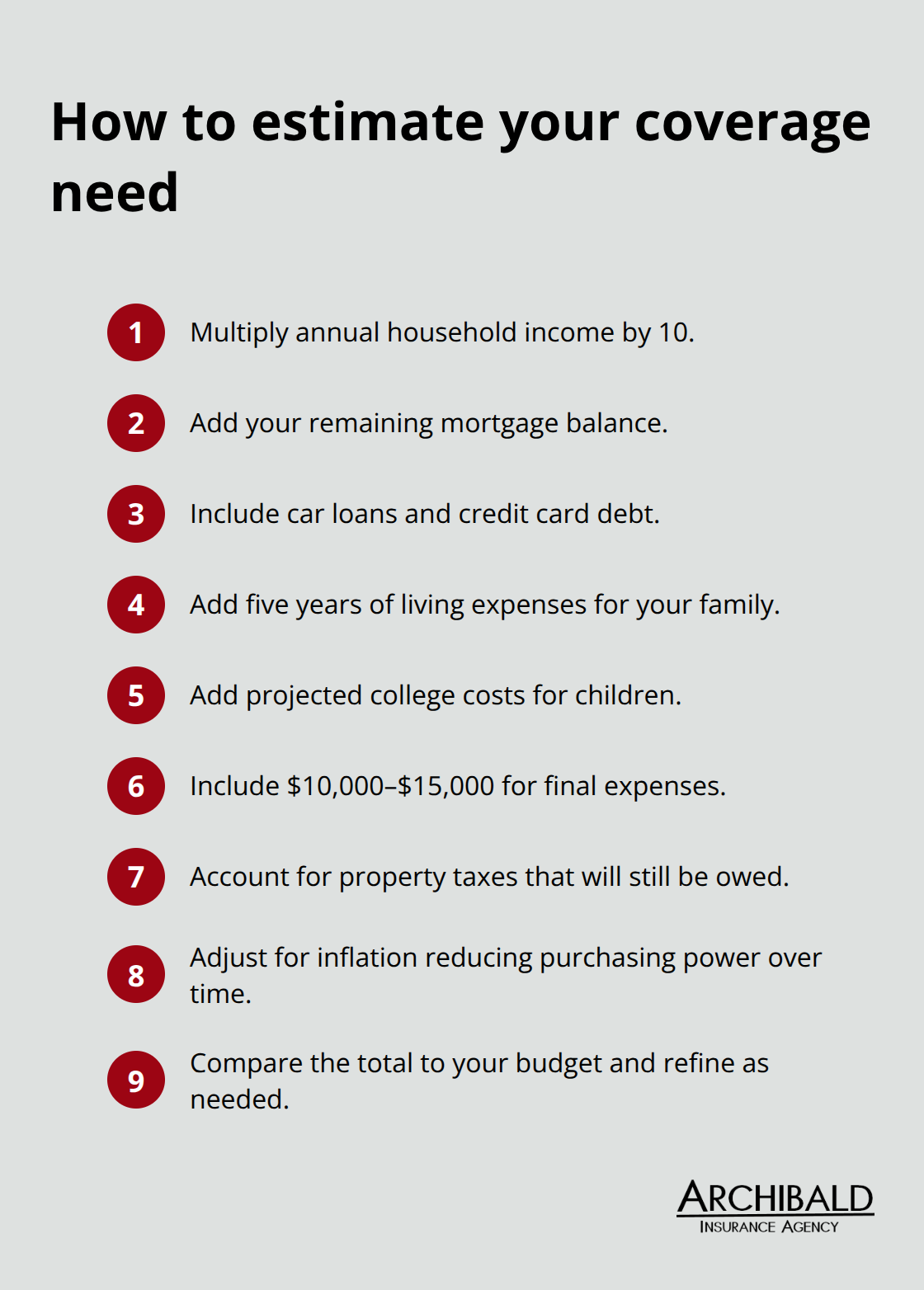
Two practical methods separate guesswork from actual numbers. The first method multiplies your annual income by the years you want that income replaced, then adds your debts, mortgage, funeral costs, and education expenses while subtracting what you already have in savings and existing coverage. If you earn $70,000 annually and want 25 years of income replacement, that’s $1.75 million before you add a $250,000 mortgage, $30,000 in other debts, $20,000 for funeral costs, and $100,000 for college. Subtract $50,000 in savings and a $100,000 group policy from your employer, and you arrive at approximately $1.93 million in needed coverage. This approach, sometimes called the needs analysis method, forces you to confront actual numbers instead of abstract formulas.

Compact steps summarizing two methods to calculate life insurance coverage needs.

The second method divides your annual income by a conservative return rate, typically 4 to 5 percent, to determine how much capital your family would need to generate that income through investments. At a 5 percent return, a $70,000 income requires $1.4 million in invested assets. Both methods work because they anchor your decision to real financial obligations rather than generic rules. The key difference is that the first method accounts for specific debts and timeline, while the second assumes your family will invest the death benefit and live on returns.

Gather the numbers you actually know

You need your recent pay stubs, mortgage statement, car loan documents, credit card statements, and any college savings you’ve already accumulated. These documents tell you exactly what your family would lose and what obligations would remain. Most people underestimate their actual debts because they forget smaller obligations like dental work, car repairs, or medical debt. Write down every monthly bill you currently pay and multiply by 12 to see your true annual expenses. Then ask yourself honestly: if you died tomorrow, how many years would your family need that income? If your youngest child is 8 years old, you’re likely looking at 10 years minimum until they could work, but realistically 15 to 20 years until they’re truly independent. A 45-year-old with a 30-year mortgage and teenagers in high school needs different coverage than a 35-year-old with young children. This timeline directly increases or decreases your coverage need, and it’s the number most online calculators miss because they don’t account for your family’s specific situation.

Work with a qualified professional

An insurance professional can run multiple scenarios with you-what happens if inflation rises, what happens if you need care before you die, what happens if your spouse’s income changes. A qualified agent can also show you how different policy types affect your coverage strategy. A 35-year-old might buy $800,000 in 30-year term coverage, while a 50-year-old might layer a 20-year term policy with a smaller permanent policy designed to cover final expenses and provide flexibility later. The structure depends on your timeline and goals, not on a formula. Someone qualified can also explain what happens to your coverage as you age and your circumstances change, helping you avoid buying too much coverage early or too little now.

Final Thoughts

The answer to how much life insurance you need isn’t found in a formula or a neighbor’s policy. It lives in your specific numbers: your income, your debts, your dependents’ ages, and how long they’d need financial support. A $500,000 policy sounds substantial until you subtract a $250,000 mortgage, $30,000 in debts, $100,000 in college costs, and funeral expenses-suddenly that coverage falls short. Conversely, buying $2 million in coverage when you only need $1 million wastes money on premiums you don’t have to spend.

An insurance professional can run scenarios specific to your situation, explain how different policy types affect your long-term strategy, and help you structure coverage that adapts as your life changes. They understand that a 30-year-old’s needs differ from a 50-year-old’s needs, and they can show you how to layer policies or adjust terms to match your timeline and budget. This professional guidance translates your specific circumstances into actual coverage amounts without pushing you toward unnecessary protection.

Your next step is straightforward: gather your financial documents and schedule a conversation with a qualified professional. Bring your pay stubs, mortgage statement, debts, and education savings goals so someone experienced can help you move from guessing to knowing exactly how much life insurance you need. Contact Archibald Insurance Agency to start that conversation.

How to Calculate Homeowners Insurance Cost

Homeowners insurance costs vary dramatically based on where you live, what your home is worth, and the coverage you choose. Understanding what goes into these calculations helps you make smarter decisions about your policy.

At Archibald Insurance Agency, we work with Utah homeowners every day who want to know exactly how to calculate homeowners insurance costs and find ways to pay less. This guide walks you through the factors that matter most and shows you concrete steps to lower your premium.

What Drives Your Homeowners Insurance Premium

Location Creates the Biggest Price Differences

Your location in Utah has the single biggest impact on what you pay for homeowners insurance, and the numbers prove it. Salt Lake County median premiums jumped from $1,045.42 in 2020 to $1,578.57 in 2023, a 51% increase. Summit County saw premiums nearly double from $1,437.38 to $2,829.61 over the same period-a 96.8% jump. Weber County hit an 86.4% increase, while Utah County climbed 71.6%.

Percentage increases in homeowners insurance premiums across selected Utah counties from 2020 to 2023 - calculate homeowners insurance cost

Your ZIP code matters because it reflects local disaster history, fire department proximity, and property values in your area. Even within Utah’s more affordable pricing compared to the national average, where you live determines whether you pay $1,272 or well over $6,548 annually. Provo averages about $97 per month, while West Valley City runs closer to $100 per month. These differences stem from how often claims happen in your neighborhood, how quickly emergency services respond, and the cost to rebuild homes in your specific area.

Replacement Cost Sets Your Coverage Foundation

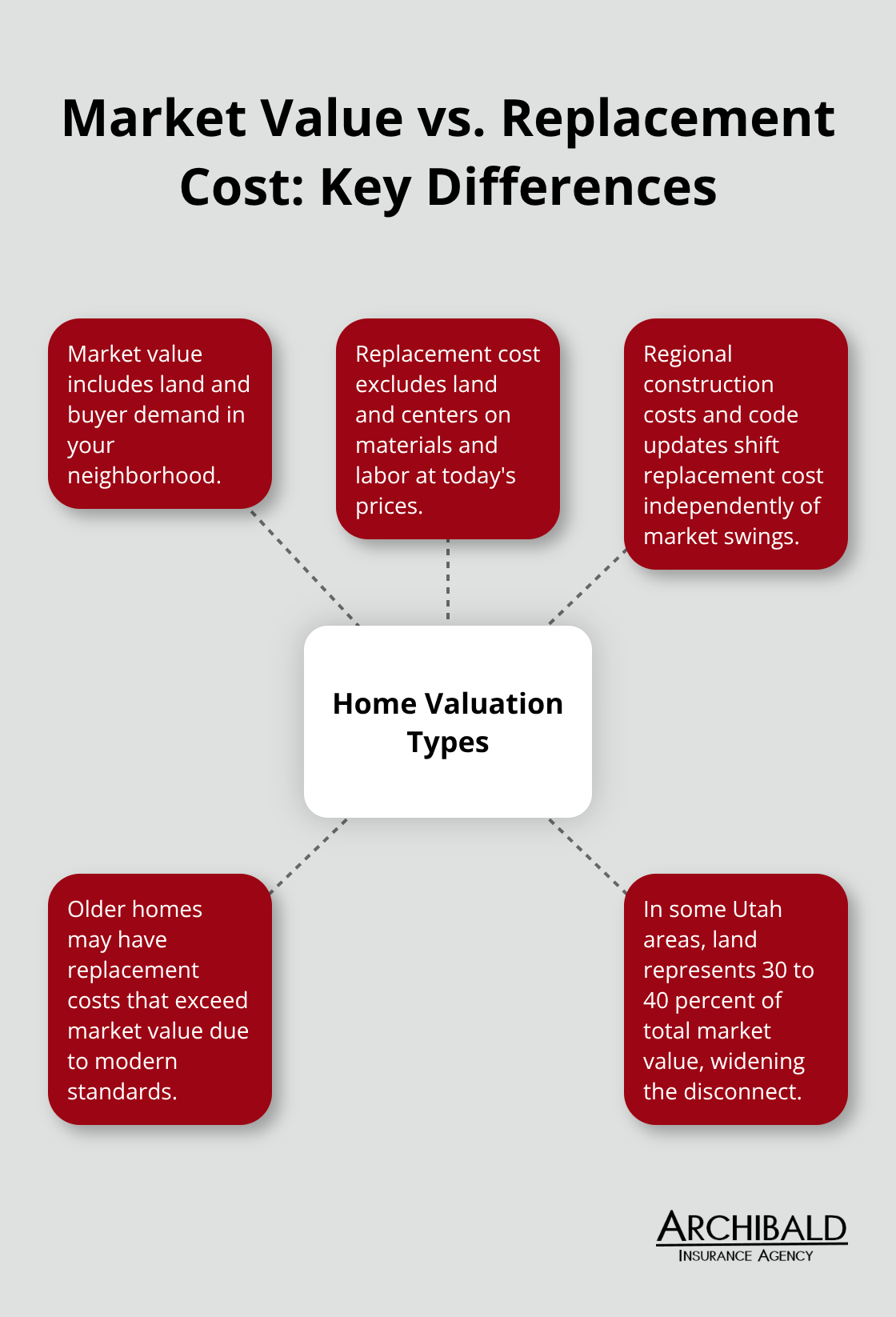
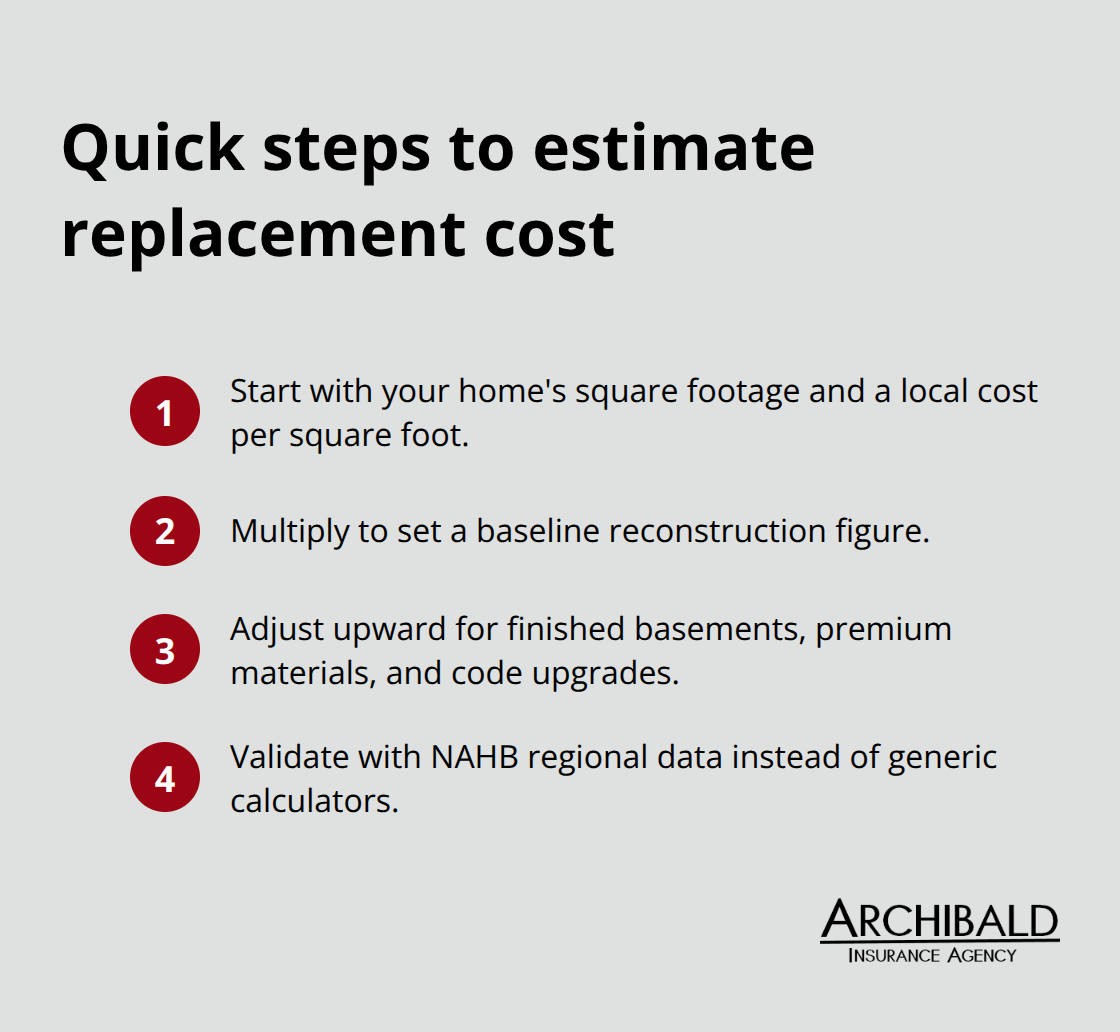
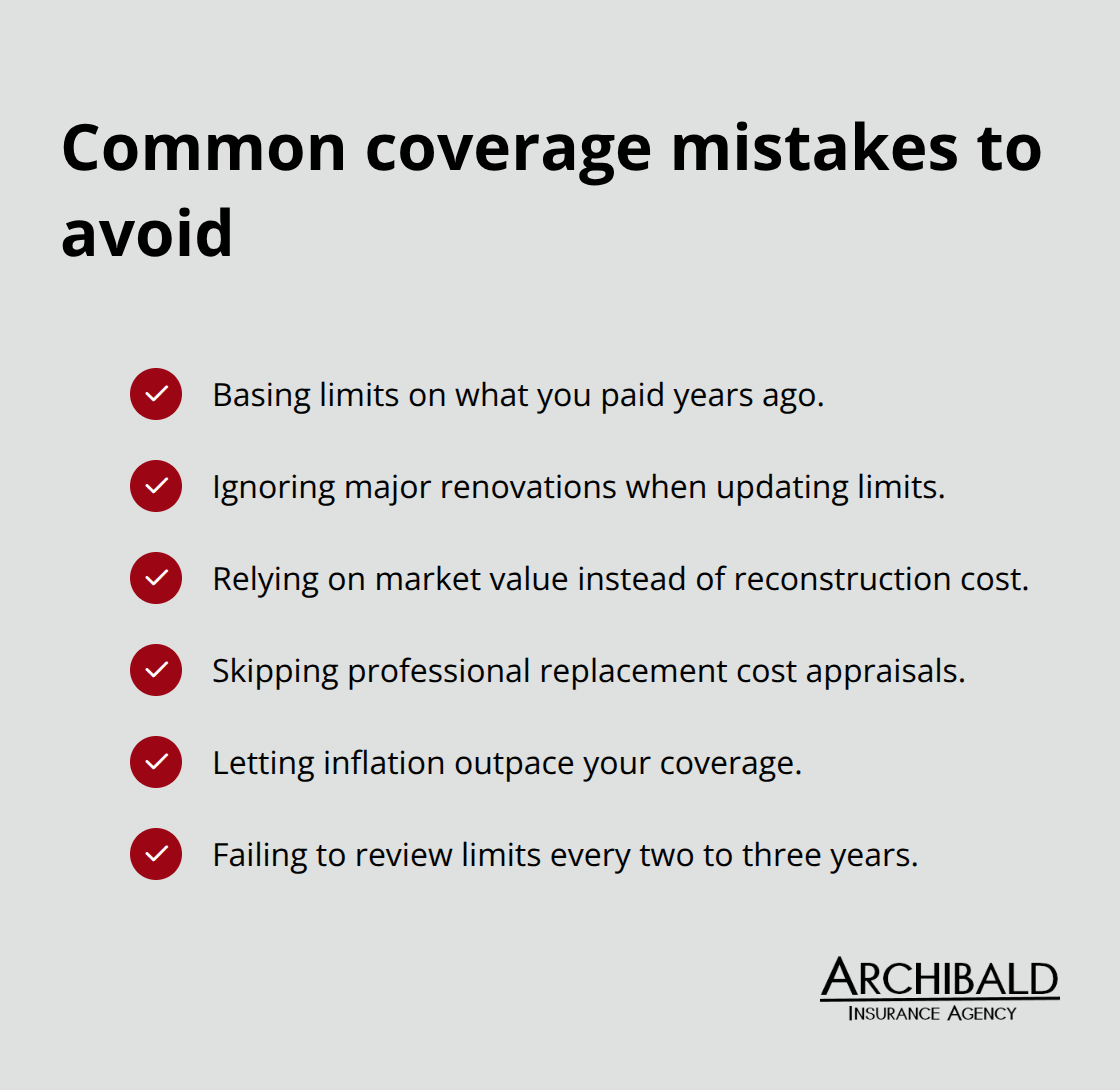
Your home’s replacement cost-not its market value-is what insurers use to calculate your dwelling coverage and your premium. Multiply your square footage by replacement cost per square foot to get an accurate dwelling coverage amount. If you own a 3,000 square foot home in an area where rebuilding costs $180 per square foot, you need $540,000 in dwelling coverage. Underestimating this number is a costly mistake because you’ll face a gap when you file a claim.

Personal Property and Deductible Choices Impact Your Total Cost

Personal property coverage should typically be 50% to 75% of your dwelling coverage, so higher home values automatically push up your total premium. Your deductible choice directly affects what you pay each month. Jumping from a $1,000 deductible to a $5,000 deductible can lower your annual premium significantly, but only if you have emergency funds available to cover that higher out-of-pocket cost when you file a claim. The trade-off between monthly savings and out-of-pocket risk matters more than most homeowners realize, and it shapes how insurance companies calculate your rate.

How Insurance Companies Price Your Policy

Claims History Signals Future Risk

Insurance companies use a two-step calculation to arrive at your premium: they calculate the pure premium (the expected cost of claims relative to your property value) and then add an expense ratio for operating costs and profit. Your claims history as a statistical predictor of future claims feeds directly into that first calculation because insurers view past claims as a key risk factor. If you filed two claims in the past five years, your premium might run around $1,596 annually, compared to $1,243 per year if you’ve had no claims in five years or longer, according to MoneyGeek’s analysis. Even small claims can raise your rate by roughly 12%, so insurance companies treat your filing history as a core risk factor.

Credit Score Creates Dramatic Premium Differences

Your credit score influences premiums just as heavily as claims history, sometimes by up to 48% depending on your credit tier. A homeowner with excellent credit might pay around $1,016 per year while someone in a fair credit range pays roughly $2,396 annually for identical coverage. Insurers use credit scores as a statistical predictor of how likely you are to file a claim and how you manage financial obligations, not as personal judgment about your character.

Hub-and-spoke diagram showing factors insurers use to price a homeowners policy

Home Age and Construction Materials Determine Underwriting Risk

The age of your home matters significantly because older homes typically cost more to insure. A home built in 1950 with original wiring and plumbing represents higher risk than a 2015 home with updated systems, so your construction year directly affects your premium calculation. Frame construction with a shake or treated roof costs substantially more to insure than brick construction with a composition roof, sometimes adding $55 to $111 per month to your premium depending on condition and location. Insurance underwriters assess whether your roof is near the end of its lifespan, whether your electrical system meets current standards, and whether your plumbing is prone to failure-these factors determine your risk profile before you ever discuss coverage limits.

Fire Protection Class Affects Your Rate

The distance from your home to the nearest fire hydrant and the quality of your local fire department feed into your final premium through what insurers call your fire protection class. Homes within 5,000 feet of a fire hydrant and served by well-equipped departments get better rates than rural properties, sometimes creating premium differences of 20% or more for otherwise identical homes. This geographic factor combines with your home’s age and construction type to complete the underwriting picture that shapes what you pay each month.

Understanding these risk factors helps you see why your premium lands where it does. The next step is learning what you can actually control to lower that cost.

How to Reduce Your Homeowners Insurance Premium

Bundle Your Home and Auto Insurance for Immediate Savings

Bundling your home and auto insurance typically delivers a 10% to 25% discount on both policies, making this the easiest immediate action you can take. If you carry auto insurance with one company and homeowners with another, you’re leaving money on the table every single month. Moving both policies to the same carrier takes one phone call and can save you hundreds annually. This single step addresses one of the most straightforward ways insurers reward lower-risk customers.

Checklist of actionable steps to lower homeowners insurance costs - calculate homeowners insurance cost

Adjust Your Deductible to Match Your Emergency Savings

Your deductible choice offers immediate control over your monthly cost. Standard homeowners insurance deductibles often range from $500 to $2,000, although they can be higher or lower depending on your insurance carrier and budget. The mistake most homeowners make is selecting a high deductible without building the cash reserves to support it, which creates financial stress when a covered loss occurs. Match your deductible to what you can actually afford to pay out of pocket.

Install Security Features That Insurers Reward

Installing physical security features like monitored burglar alarms, deadbolt locks, and smoke detectors signals lower risk to insurers and often qualifies you for discounts ranging from 5% to 15% depending on the system and your carrier. A professionally monitored system costs between $20 and $50 monthly but can reduce your annual insurance premium by $100 to $200, making the investment worthwhile within the first year. These upgrades address the underwriting factors that directly influence your premium calculation.

Update Your Home’s Age-Related Systems

Your home’s age and construction condition influence whether you qualify for preferred rates or face higher premiums. If your home was built before 1980, updating your roof, electrical system, or plumbing can improve your underwriting classification and lower costs. Insurers often require roof replacement if it’s within five years of the end of its lifespan, so addressing this proactively prevents coverage denials and rate increases.

Improve Your Credit Score and Shop Regularly

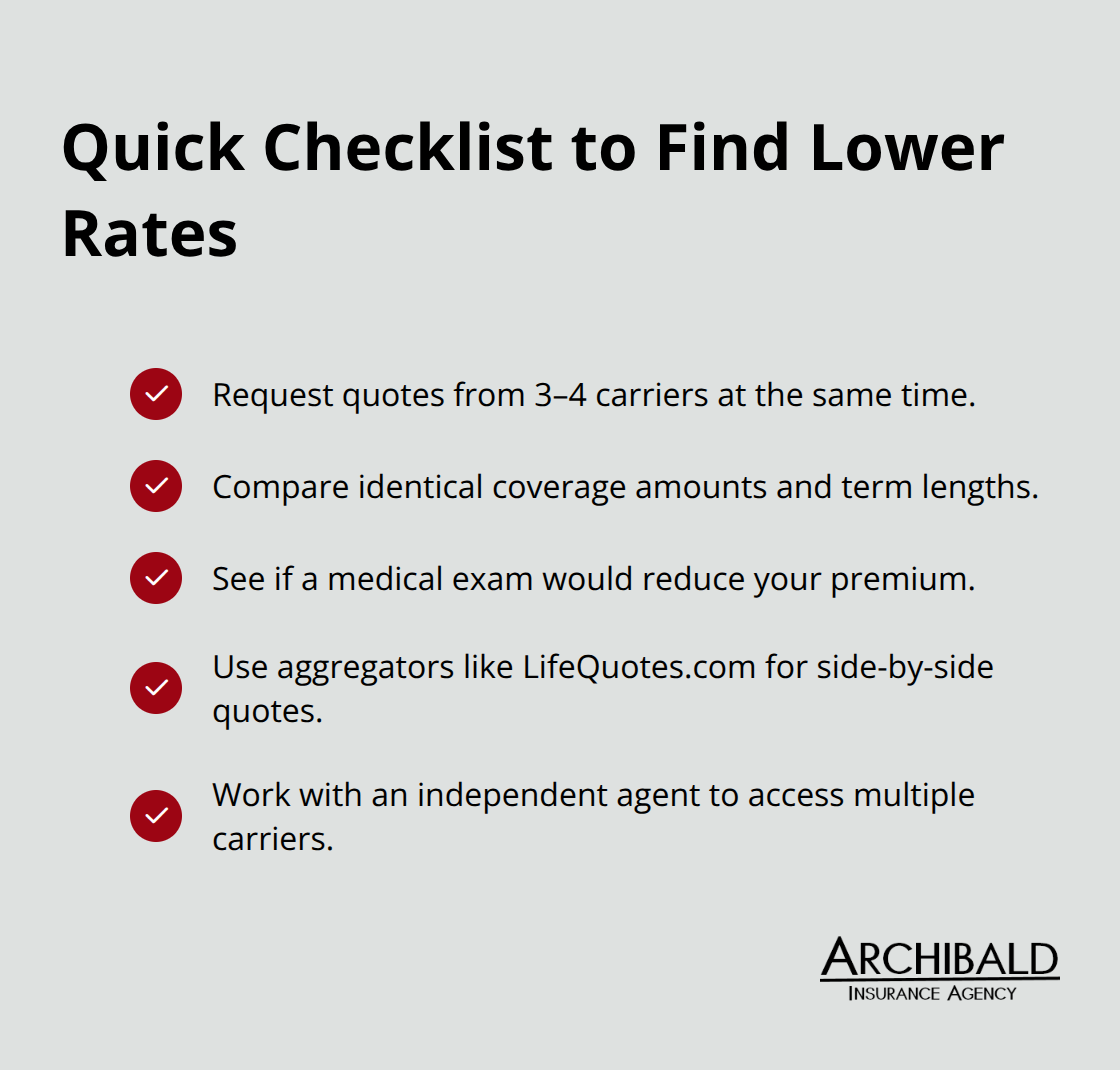
Credit score improvements deliver substantial savings because premiums can vary by up to 48% across credit tiers. If you’ve worked to improve your credit from fair to good range, notify your insurer because they may re-evaluate your rate without requiring a policy change. Shopping your policy every two to three years matters more now than ever because insurers adjust rates differently based on market conditions and claims trends in your area. Utah premiums increased approximately 13% in 2024 alone, so a quote that looked competitive two years ago may no longer reflect current market pricing. Getting three to five quotes from different carriers ensures you’re not overpaying for identical coverage. When comparing quotes, verify that deductibles, coverage limits, and valuation methods match across all quotes so you’re genuinely comparing apples to apples. Some insurers price replacement cost coverage much higher than actual cash value, so understanding which valuation method each quote uses prevents costly surprises when you file a claim.

Final Thoughts

Your homeowners insurance premium reflects three core factors: where you live in Utah, what your home costs to rebuild, and the coverage limits you choose. Location drives the biggest differences, with some counties seeing premiums nearly double between 2020 and 2023. Your replacement cost determines your dwelling coverage foundation, and your deductible choice directly controls your monthly payment.

You have real control over several factors that shape what you pay each month through bundling policies, raising your deductible, installing security features, and improving your credit score. Start by requesting actual quotes from multiple carriers rather than relying on online calculators, and have your home’s square footage, construction year, roof type, and claims history ready so you can compare identical coverage across different insurers. Utah’s market offers competitive options, but rates vary dramatically by provider, so shopping around typically saves hundreds annually.

We at Archibald Insurance Agency understand that navigating how to calculate homeowners insurance cost feels overwhelming when you’re trying to balance protection with affordability. As an independent agency in Salt Lake City, we represent numerous insurance carriers, which means we show you options that fit your specific needs and budget rather than pushing you toward one company’s products. Contact us at archibald-insurance.com to discuss your situation with someone who knows Utah’s insurance market and can help you find the right coverage at a competitive rate.